On this page
Long train journeys offer a unique environment. Unlike planes or cars, trains provide tables, large windows, and room to move, making them ideal for hands-on activities. Instead of relying on screens to pass the time, you can use the journey to practice observation, mathematics, and spatial awareness.
Why are train journeys good for active learning?
Travel naturally broadens a child's horizons, but it also has measurable academic benefits. The change of scenery stimulates curiosity, and seeing new towns or landscapes prompts questions that lead to spontaneous learning. Research by the Student & Youth Travel Association (SYTA) found that 54% of teachers state that travel has a very positive impact on a student's academic performance, and 53% report it positively influences their social development.
The physical space of a train carriage is ideal for structured activities. You have a table for drawing, the train's rhythm provides background focus, and the changing scenery offers prompts for observation games. Unlike a car ride where a parent must drive, a train allows you to sit face-to-face with your child and participate.
How do you manage a child's attention span on a train?
A common mistake parents make on long trips is giving a child all their activities and toys at once. This quickly leads to fatigue. According to developmental guidelines from Brain Balance Centers, a child's capacity for sustained attention is roughly two to five minutes per year of age.
This means an eight-year-old might only focus on one task for 16 to 40 minutes before they naturally need a change of pace. To keep them engaged over a multi-hour journey, you need a strategy:
Rotate activities: Shift between high-focus tasks (like maths or reading) and low-focus tasks (like looking out the window or listening to an audiobook).
Take movement breaks: Take advantage of the train's layout. Walk down the aisle to the café car or stand by the doors at a long station stop to reset their attention.
Use timeboxes: Set a timer for 20 minutes for a specific game, then pack it away and move on to something else.
Hold things back: Keep a few novel activities hidden in your bag to bring out during the final, most restless hour of the journey.
What are the best map and station games?
Geography is easier to teach when you are physically moving across the country. Maps give children a sense of scale and help them understand distance.
The Map Tracker: Before your journey, print a physical map of your route with all the scheduled stops marked clearly. Have your child cross off each station as the train departs. This helps them visualize the journey's progress and reduces the classic "are we there yet?" questions by giving them a visual representation of time and distance.
Station Alphabet: Look at the upcoming stations on the route map and try to find one for every letter of the alphabet. If you cannot find a station, look out the window and try to spot a sign or object that starts with the missing letter.
Journaling the Scenery: Give your child a notebook and ask them to keep a logbook of the trip as if they were an explorer. They can draw the types of bridges you cross, note the changing colours of the soil, or tally the number of freight trains or rivers you pass.
How to teach timetable maths on a train
A train schedule is essentially a giant maths puzzle, providing an opportunity to practice real-world problem-solving. You can use the timetable to practice addition, subtraction, and basic physics equations related to speed and distance.
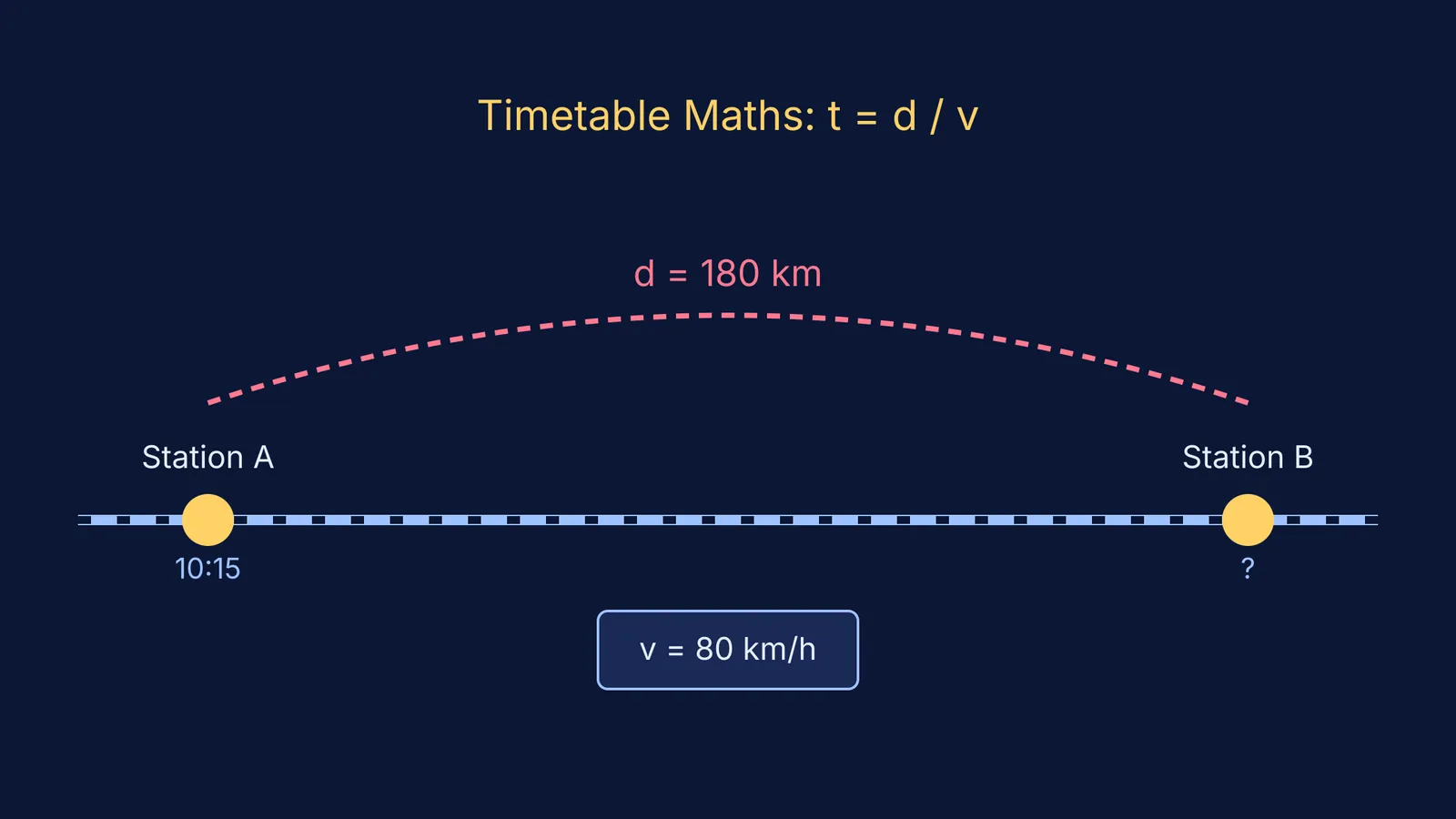
If the timetable says your next stop is 180 kilometers away, and the digital display in the carriage shows you are traveling at 80 kilometers per hour, you can ask your child to calculate the exact arrival time. They use the basic kinematics formula: Time = Distance ÷ Speed.
In this case, 180 divided by 80 is 2.25 hours (which translates to two hours and fifteen minutes). If it is currently 10:15 in the morning, they can add the time to find out you will arrive at 12:30. You can verify their answer by checking the official timetable.
If they are working on schoolwork during the trip and get stuck on a difficult calculation or fraction, Fermi's AI tutor can work out what they already know and build a plan for the session, so they sit down to a clear next step instead of staring at a blank page.
Bringing a science mindset to the journey
Trains are massive feats of engineering. Encourage your child to think about how the train works. Ask them why they think the tracks are laid on crushed stones (ballast) rather than solid concrete, or have them observe how the train leans into curves.
If they start asking questions about the forces keeping the train on the tracks or how electric trains draw power, encourage them to write the questions down. Later, they can explore these physical principles in the Concept Library.
By turning the journey into an interactive learning exercise, you reduce screen time and help your child see the practical application of what they learn.