

On this page
Two paper cups, a long string and ten minutes are enough for a classic sound experiment. Change one thing at a time (the string, the length, the tightness) and your child is doing real physics, not just playing.
What do you need to make a string telephone?
Two paper cups (plastic cups also work; thin ones are easier to pierce)
About 5 metres of string to start, plus other kinds to compare
A sharp pencil or a toothpick, and a matchstick or paper clip for each cup
Make a small hole in the centre of each cup's base with the pencil tip. An adult should do this if you use a nail or scissors.
Push one end of the string through the hole from outside and tie it to a matchstick inside the cup, so it cannot slip out.
Do the same with the other cup.
Walk apart until the string is straight and tight. One person talks into their cup while the other holds their cup over one ear.
Do not use kite manja; its glass coating cuts skin. Keep the string away from stairs and roads, and never shout into a cup.
How does a string telephone work?
The NCERT Class 8 science chapter on sound explains that sound is made by vibrating objects, and that sound can travel through any solid, including strings. It uses a toy telephone as its example (NCERT Class 8 Science, Chapter 10: Sound).
Here is the chain, step by step:
Your voice makes the air inside the cup vibrate.
That air pushes the flat base of the cup back and forth, like the skin of a small drum.
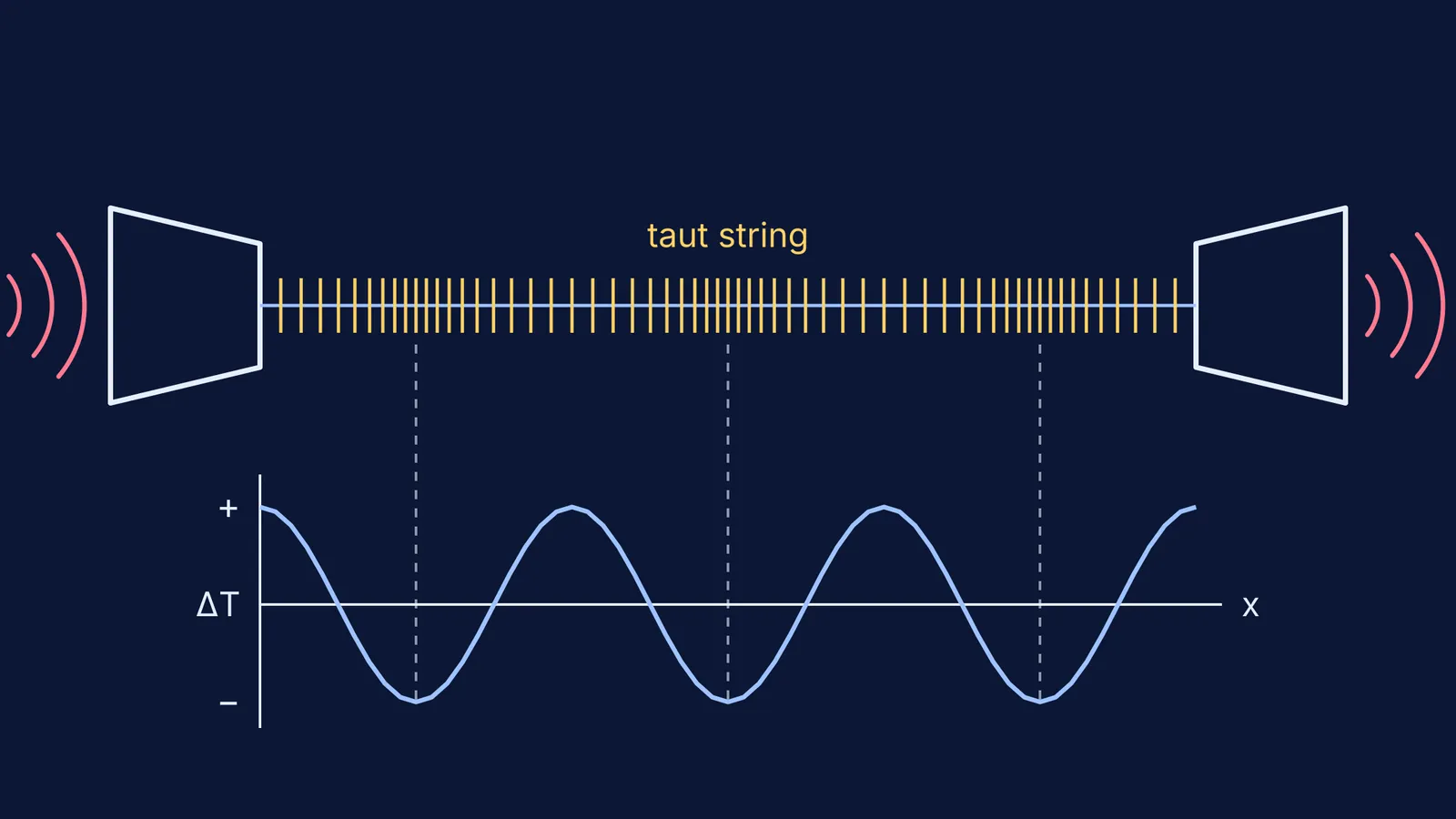
The base tugs the string. The tug runs along the string as a pattern of tiny stretches and squeezes.
At the far end, the string tugs the second cup's base, which pushes the air into your friend's ear.
The base of each cup acts as a diaphragm that turns sound in the air into vibrations that change the tension of the string (Wikipedia: Tin-can telephone). The same page says an acoustic string phone is attributed to the scientist Robert Hooke as early as 1667.
In open air your voice spreads out in every direction; the string guides the vibration along one line to the other cup.
Sound also moves faster through solids. HyperPhysics lists the speed of sound as 344 m/s in air at 20°C (HyperPhysics: speed of sound in air). It gives 1482 m/s in water at 20°C and 5790 m/s for a longitudinal wave in stainless steel (HyperPhysics: sound speeds in liquids and solids). For older children, our explainer on why sound travels fastest in solids goes through the physics.
Which string works best for a string telephone?
This is where the experiment begins. The TeachEngineering string telephone lesson asks students to compare a taut string with a loose one. Its discussion notes that soft materials tend to absorb more sound than solid ones (TeachEngineering: String Telephones). That gives your child a prediction to test.
Try four strings of the same length:
Cotton sewing thread
Jute or sutli twine from the kitchen drawer
Nylon fishing line
Thin craft wire
Keep the cups, speaker, sentence, voice level and tightness the same. Ask your child to predict the order first and write it down.
A results sheet you can copy
The speaker whispers the same five-word sentence each time. The listener, not told which string is on, scores it:
0: heard nothing
1: heard a sound, no words
2: caught some words
3: repeated the whole sentence
Note the string, length, score and one word about the sound (muffled, sharp, buzzy). Repeat each test, swapping roles.
Does the length of the string matter?
Pick your best string and try 2 m, 5 m and 10 m, or start long and halve the length each time, as the TeachEngineering lesson suggests; it notes that sound waves lose strength with distance. Then let the string touch a wall or door frame and listen again. Anything that soaks up the string's vibrations makes the voice quieter.
What can you say to explain it to your child?
Try this script while you hold one cup:
"When you talk, your voice is a shake in the air. The shake wiggles the bottom of the cup. The cup tugs the string, the string tugs the other cup, and that cup shakes the air in my ear. If the string is floppy, the tug gets lost."
Then ask what will happen if you pinch the string, and let them try it. For a follow-up, the paper-cone stethoscope project uses the same idea, and why there is no sound in space answers the next question children usually ask.
The squeezes in a real string are too small to see. The Fermi Simulation Lab has interactive simulations for ideas that are easier to see than to read.


