

On this page
If your child freezes at a sum like 919 ÷ 6, they are in large company. The fix is rarely more worksheets. It is showing what each line of the method means, with things they can hold, then a card that names every step.
Why does my child find long division so hard?
Only 30.7% of children enrolled in Class 5 in rural India could solve a 3-digit by 1-digit division problem in 2024, according to the ASER 2024 national findings, a household survey that tests each child one on one. A sample division task in the survey is 919 ÷ 6, the kind of sum your child meets in homework.
Long division is hard for three reasons:
It stacks four operations. A child must divide, multiply, subtract and track place value at once. One slip spoils the answer.
The words hide the ideas. "Bring down the 1" sounds like magic. Really, leftover hundreds are traded for tens so they can be shared again.
It is taught as a routine. A child who memorised the order but not the reason has nothing to fall back on when lost.
It is worth the effort. A study of national data sets from the US and UK found that primary school children's knowledge of fractions and division predicted their algebra and overall maths achievement in high school, five or six years later (Siegler and colleagues, 2012, Psychological Science).
How do you teach division by sharing sweets?
Children take part in fair sharing long before they are taught written division. In a study of 113 preschoolers, setting problems as sharing scenarios predicted performance on division but not on addition or subtraction, and answers children acted out with objects were much more accurate than their spoken ones (Hamamouche, Chernyak and Cordes, 2020, Cognitive Development).
So start with real things. Make sweets come in three sizes: a box holds 100, a packet holds 10, and loose sweets are ones (paper slips labelled "box" and "packet" work too). If place value is still shaky, our guide to explaining place value with sticks and coins is the step before this one.
Now share 9 boxes, 1 packet and 9 loose sweets among 6 children:
Share the boxes. Each child gets 1, which uses 6, so 3 boxes are left.
Three boxes cannot go fairly to 6 children, so open them: 30 packets, plus the 1 you had, makes 31.
Share the packets. Each child gets 5, which uses 30, so 1 packet is left.
Open it: 10 loose sweets, plus the 9 you had, makes 19.
Share them. Each child gets 3, which uses 18, so 1 sweet is left over.
Each child has 153 sweets, with 1 left over. Your child has just done long division without writing it.
What does each step of long division mean?
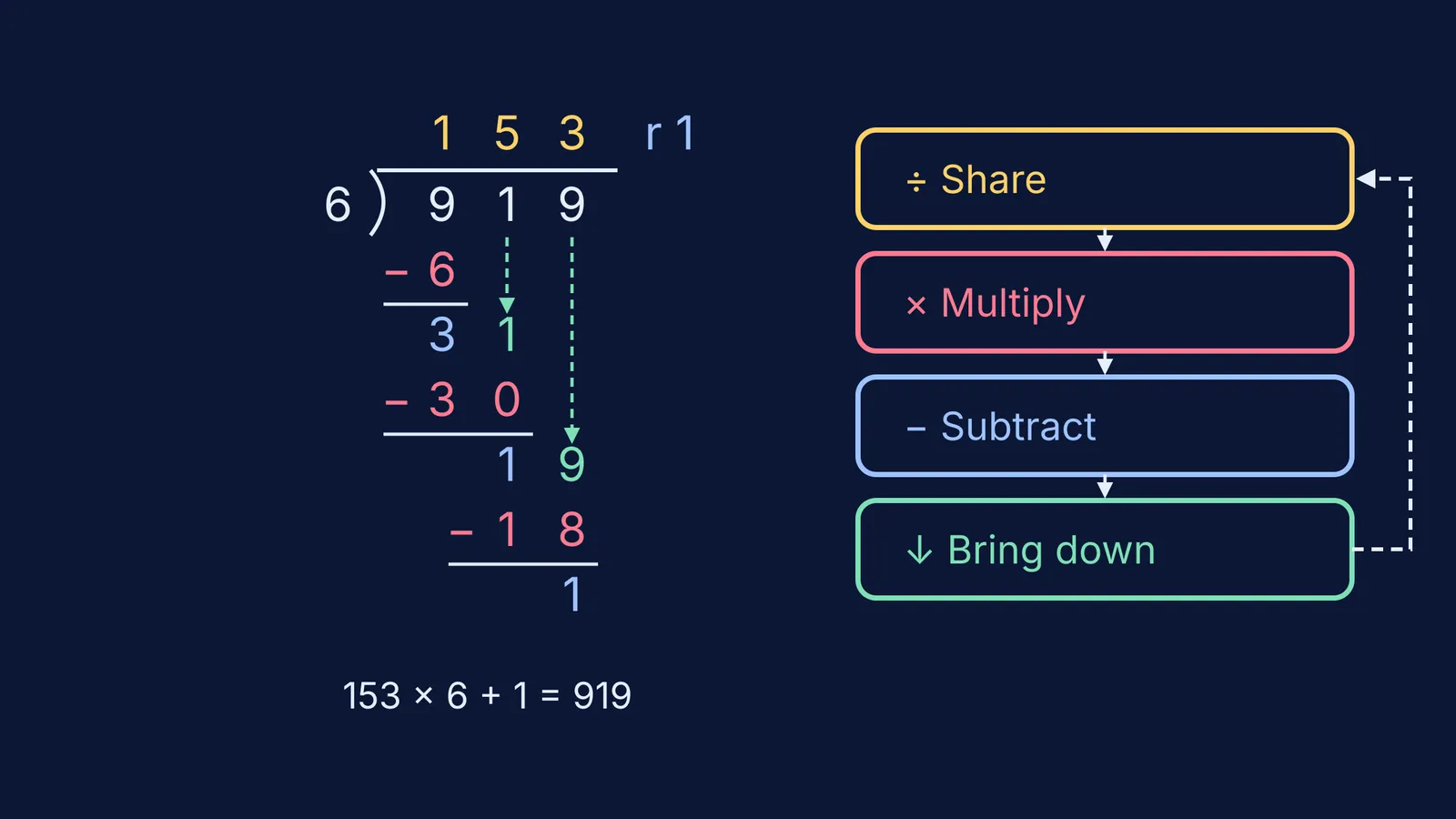
Copy this step card onto an index card for the notebook. Each step matches a move with the sweets:
Share (÷): how many does each person get from this place? Write it on top.
Multiply (×): how many did you use in total? Write it under.
Subtract (−): how many are left? This must be smaller than the divisor.
Bring down (↓): open the leftovers into the next smaller place and add the next digit.
Then go back to step 1 until there are no digits left, and finish with a check: answer × divisor + remainder should equal the number you started with. For 919 ÷ 6, that is 153 × 6 + 1 = 919.
Have your child say each step aloud as they write. "Subtract: 31 take away 30 leaves 1" catches mistakes that silent copying misses. Here is why showing working in maths matters beyond this one topic.
How can you practise long division at home without tears?
Keep sessions short and follow this order:
First few sessions: share objects only, dividing by 2 to 5. No writing.
Next few sessions: share objects and write each step beside them, using the card.
After that: written method with the card; objects only when stuck.
Once it feels easy: hide the card for one problem a day and see if your child can name the steps.
Watch for the zero trap. In 612 ÷ 6, one ten cannot be shared among 6, so that place gets a 0: the answer is 102, not 12. Ask, "How many packets did each child get?"
Useful things to say: "Which step are you on?", "What is left, and can we still share it?" and "Show me with the packets." Don't take the pencil. Everyday sharing helps too, as in these ideas for maths while cooking with kids.
If your child keeps going wrong at the same point, the Fermi Problem Library has worked problems with a step-by-step solver that explains the reasoning rather than printing an answer, so you can spot the broken step together.
Tonight, try one problem with sweets before any writing.


