

On this page
You look at your child's maths homework, expecting a page of logical calculations. Instead, there is a large blank space under the question, followed by a single number scrawled at the bottom. When you ask them how they found that answer, they tap their head and proudly say they did it mentally.
While mental maths is a useful skill for everyday arithmetic, skipping the working out in complex problems is a habit that costs students in both exam marks and long-term learning. Here is why showing the mathematical process is just as important as finding the answer, and how to help your child shift their approach.
Why does my child only write the final answer in maths?
Students often skip steps because they believe the final answer is the only part that matters to a teacher, or they are simply rushing to finish their homework so they can move on to other activities. However, attempting to hold an entire multi-step algebra or geometry problem in their head forces them to rely entirely on working memory.
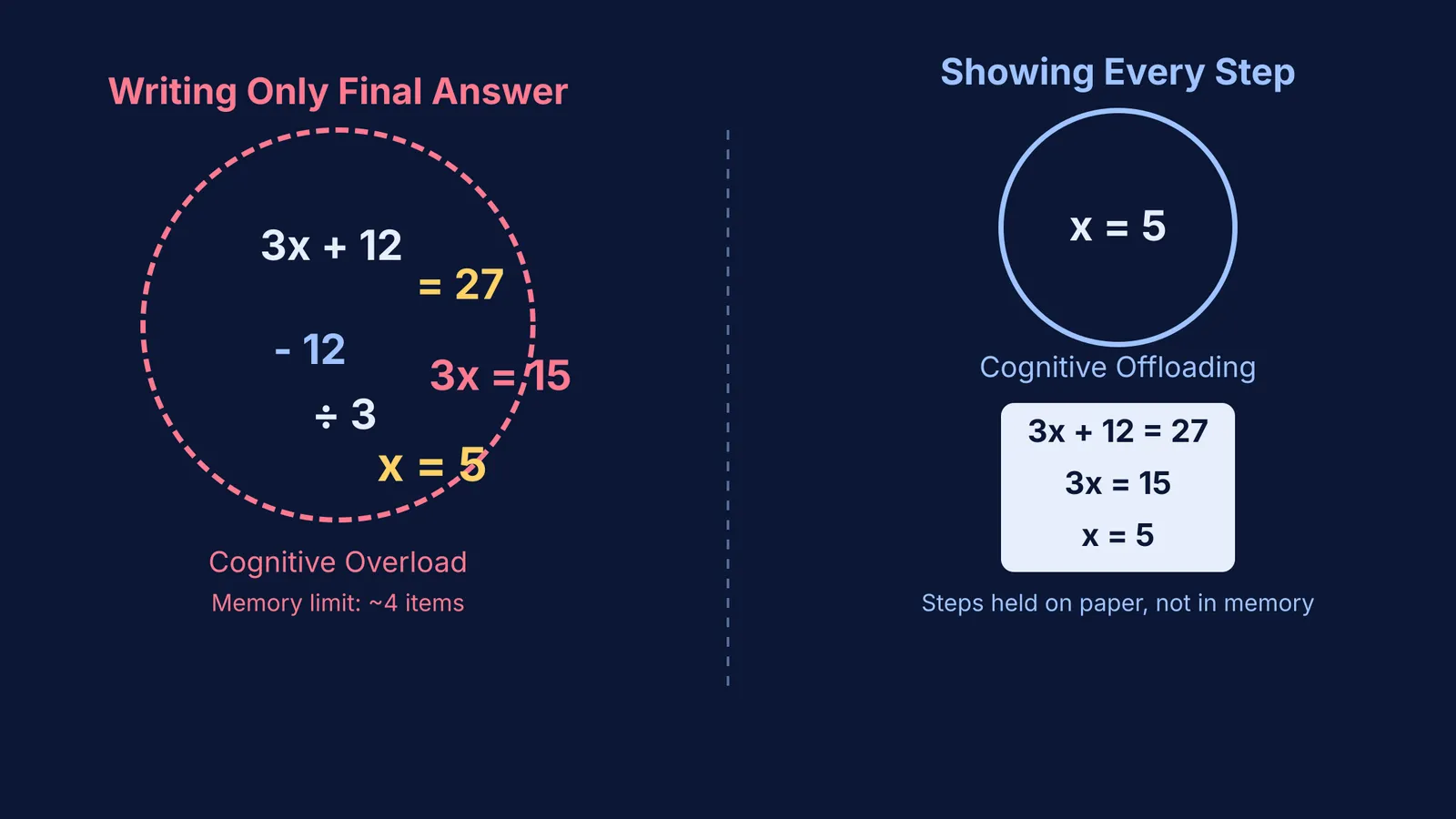
According to a foundational 2001 study, human working memory can hold only about four items at a time. When a student tries to juggle negative signs, fractions, and multiplication simultaneously, they quickly hit this cognitive limit. This mental overload is precisely why students often drop a minus sign or forget to carry a number when solving equations mentally.
By writing down each step, students engage in what psychologists call cognitive offloading. A 2016 review of the practice showed that shifting information from memory to a physical medium frees up cognitive resources. When a student writes down the intermediate step, they no longer have to actively remember it, allowing the brain to focus entirely and accurately on the next calculation.
Does showing steps get more marks in exams?
Yes, because modern exams test the mathematical method, not just the numerical result. Major Indian examination boards, including the CBSE, use explicit step marking schemes where partial credit is awarded for every correct logical progression.
If a student makes a small arithmetic error in the final line but showed the correct mathematical method and formulas, they will still secure most of the marks for that question. Conversely, a correct answer with absolutely no working might not be awarded full credit, as the examiner cannot verify how the student arrived at the solution. Relying purely on the final answer is a high-risk strategy that rarely pays off in high-stakes testing.
Furthermore, showing work deepens mathematical understanding. A 2017 meta-analysis found that generating self-explanations for steps significantly improves mathematics learning. When students write their steps out clearly, they are forced to articulate their reasoning, turning rote calculation into active learning.
How can we build the habit of showing work?
Breaking the habit of writing only the final answer requires a shift in how you review your child's work. Instead of treating maths homework as a race to a single correct number, reframe it as a communication exercise.
Use a specific script to praise the process: Instead of checking if the final answer is right and moving on, say something like: "I see you got 15 here. Can you walk me through the step you took right before that?" This reinforces that the method is what you value.
Implement the two-column method: Have your child draw a vertical line down the middle of their page. The left side is strictly for the mathematical steps, and the right side is for a brief written note on what they did (for example, "divide both sides by 3" or "find a common denominator").
Practise with guided problems: Using tools that focus on the journey rather than the destination can help reset their expectations. The Fermi Problem Library features a step-by-step solver that explains the reasoning behind each line, continually reinforcing that the method is an integral part of the answer.
Engage an AI tutor: Fermi's AI tutor can work out what your child already knows and build a plan for the session. Because the tutor holds a line of reasoning, it actively expects the student to work through the process and explain their logic rather than just accepting a final number. To see how this dynamic works in practice, read our guide on Trying an AI tutor with your child: a 20-minute parent's guide.
Research consistently shows that guided, step-by-step practice yields better results than simply providing the final solution. For more on this, you can read our breakdown of ChatGPT hints vs human tutor hints: what a 2024 maths study found. By making the steps visible and explicit, your child will make fewer errors, secure more partial credit, and actually understand the mathematics they are studying.


