

On this page
Division, fractions and later algebra all lean on tables, and many children get there late. In rural India, 30.7% of Class 5 children could do a three-digit by one-digit division sum in 2024, according to the ASER 2024 national findings. Tables do not need hours of chanting: a sensible order, a few patterns and a few minutes of play a day go a long way.
Why doesn't chanting tables on its own stick?
Chanting builds a chain of sounds. A child who recites "seven eights are fifty-six" may still start from "seven ones" to reach it, and may not see that 8 × 7 is the same fact. Understanding means seeing 3 × 4 as three rows of four, which turned sideways is four rows of three.
In a 2006 study by John Woodward, 58 fourth-graders learned multiplication facts through timed drills alone or through strategies plus timed drills. Both groups got fast, but the strategy group generally did better at using the facts in bigger problems and estimates.
A strategy sounds like this: for 6 × 7, "Five sevens are 35. One more seven makes 42."
In what order should my child learn the tables?
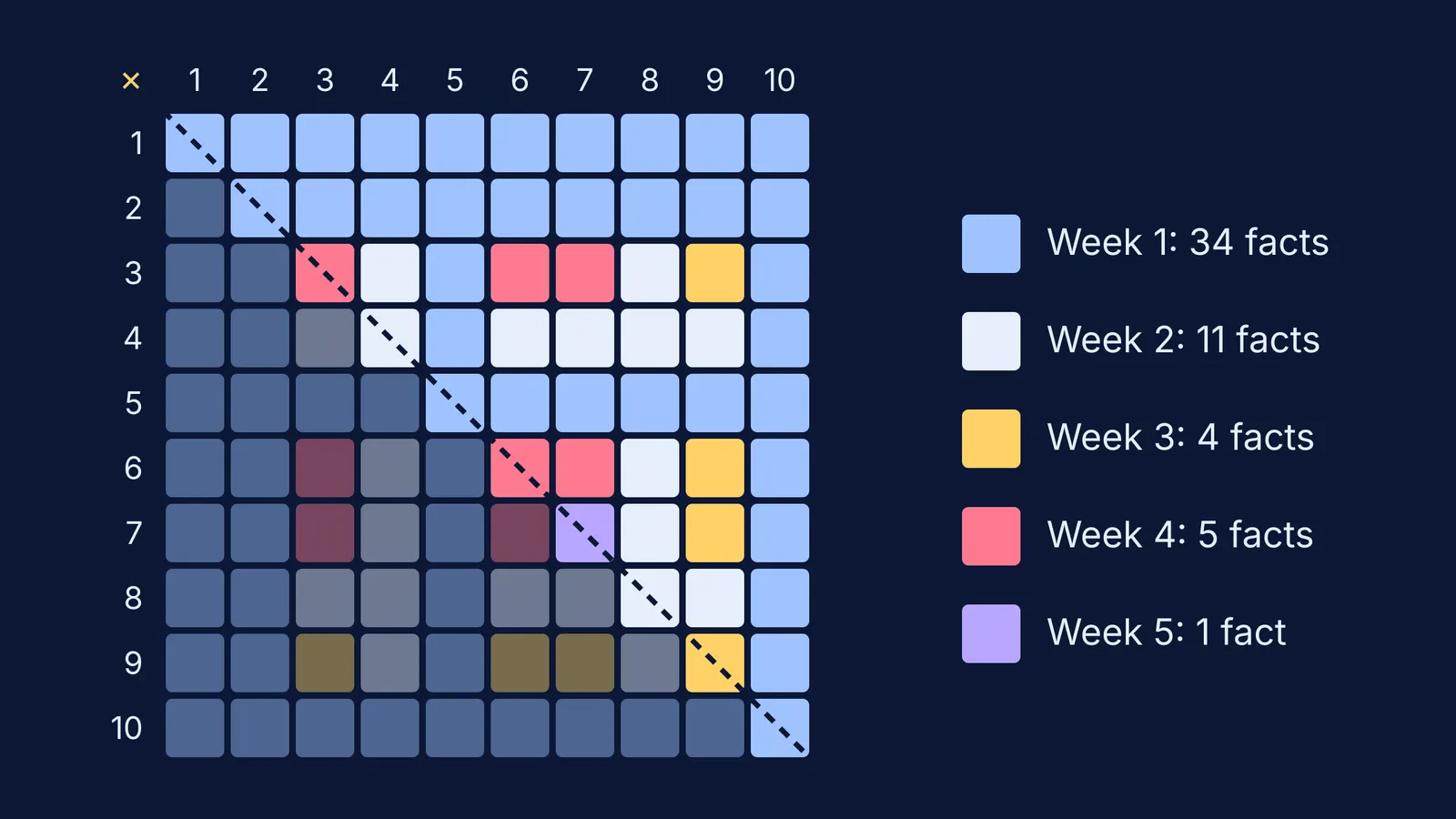
Not 1 to 10 in a line. Start with what your child already knows and let each week build on the last. A 10 × 10 grid has 100 cells, but because 3 × 4 is the same as 4 × 3 there are only 55 different facts, and this order keeps the new ones small:
Week 1: ×1, ×10, ×2 and ×5. ×10 adds a zero, ×2 is doubling, ×5 is half of ×10. That covers 34 of the 55 facts.
Week 2: ×4 is double ×2, and ×8 is double ×4. Eleven new facts.
Week 3: ×9 is ten groups minus one: 9 × 7 = 70 − 7. Four new facts.
Week 4: ×3, then ×6 as double ×3. Five new facts.
Week 5: ×7. Thanks to turnarounds, only 7 × 7 is new. Spend the week on mixed review.
If the school expects tables up to 12, add a sixth week: ×12 is ×10 plus ×2. Move on when your child answers the week's facts without counting on fingers, not when the calendar says so.
Which multiplication patterns should my child spot?
Write a table out and ask, "What do you notice?" Let your child find these:
Turnarounds: 3 × 8 equals 8 × 3. Lay out 3 rows of 8 buttons, then turn the tray sideways.
In the ×9 table up to 9 × 10, the digits of each answer add up to 9 (18, 27, 36).
×5 answers end in 0 or 5; ×10 answers end in 0.
Every answer in the ×2, ×4, ×6 and ×8 tables is even.
Square numbers (1, 4, 9, 16) sit on the grid's diagonal.
What quick daily games help tables stick?
Short and spread out beats crammed. In a study of 48 third-graders who practised addition facts for 19 days, children who split the same four minutes of daily practice into two or four sessions showed faster growth in fluency than children who did all four minutes in one go. That study used addition, but it is a sensible guide for tables too.
Games that take a minute or two:
Bus-stop flash: you say a fact, your child gives the answer and its turnaround.
Array hunt: egg trays, chocolate bars, window grilles. "Which table is that?"
Dice duel: roll two dice and multiply; the bigger product wins.
Missing number: "Something times 6 is 42." This trains division too.
Kitchen maths: doubling a recipe, as in our guide to maths activities while cooking with kids.
How do I stop tables practice turning into a fight?
Worry crowds out the thinking a sum needs. In a University of Chicago study of 88 first-graders and 66 second-graders, children reported worry about maths as early as first grade, and high anxiety put otherwise successful students almost half a school year behind their less anxious peers.
Use a timer only for your child to beat their own score, never to compare with a sibling. If a session ends in tears, stop and try tomorrow; our piece on homework tantrums in 6-to-8-year-olds has ideas for that moment. If worry about maths lasts for weeks, talk to the class teacher or school counsellor.
A script for when your child is stuck:
"You don't know 7 × 8 yet. Do you know 7 × 4?"
"Good, 28. How do we get from 4 groups to 8?"
When they get 56: "You built that from a fact you knew. That's the real skill."
Weighing extra classes? Read our guide to what abacus and Vedic maths classes teach and what they miss first. When an older child wants to see where multiplication leads, the Fermi Concept Library has every concept in mathematics with its own lesson and its place in the map.
Start this week with ×10, ×2 and ×5 and two short games a day.


