On this page
Your child brings home a colouring sheet: the elephant is half grey, half scribble. Before you say "try again, carefully this time", it helps to know what a 4- or 5-year-old's hands can actually do.
Is it normal for a kindergarten child to colour outside the lines?
For most children, yes. Developmental milestones are "things most children (75% or more) can do by a certain age", according to the CDC's milestone checklists. Colouring neatly inside a shape is not on the CDC checklists for ages 3, 4 or 5.
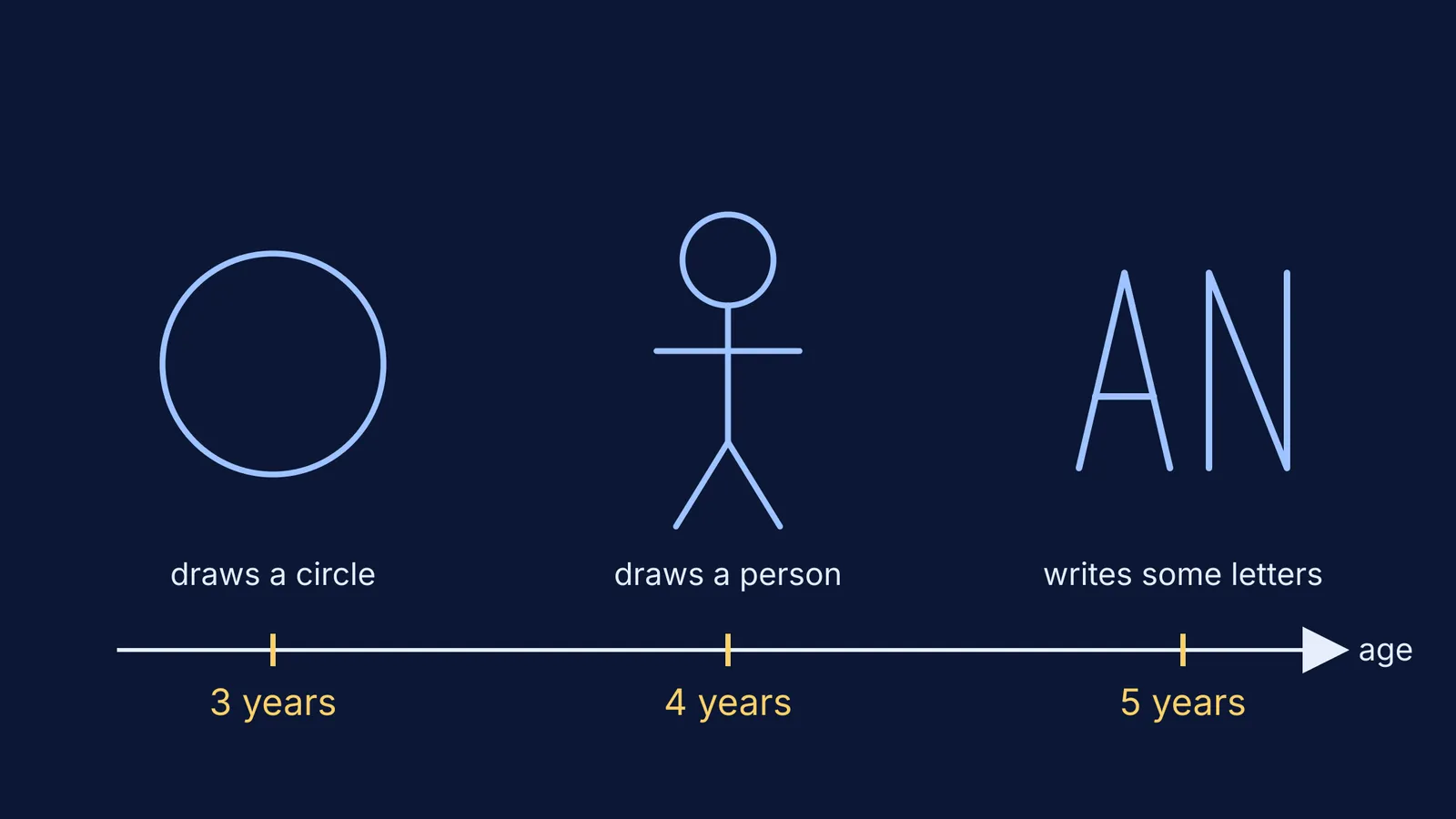
Here is what the checklists do say about hands and drawing:
By 3 years: draws a circle when you show them how, and strings items like large beads (CDC, 3 years).
By 4 years: holds a crayon or pencil between fingers and thumb, not in a fist, and draws a person with three or more body parts (CDC, 4 years).
By 5 years: writes some letters of their name and buttons some buttons (CDC, 5 years).
Staying inside a line asks a lot more: your child must watch the edge, slow down near it and stop the crayon on time, all while gripping it.
Why does fine motor control matter, if not for neat colouring?
Fine motor skills are the small movements of the fingers and hands, and they do matter for school. In a study in Child Development, Claire Cameron and colleagues assessed 213 children aged 3 and 4 at home before kindergarten. After accounting for background factors, children with stronger fine motor skills, especially at copying designs, scored higher on several achievement tests when kindergarten began and improved more by spring.
The skill that stood out was copying designs, not neat worksheets. Copying shapes, threading beads and tearing paper all give the same hands practice.
How can you build fine motor control through play?
You do not need a stack of colouring books. Pick two or three of these each day and rotate them:
Tear old newspaper into strips, then into small bits, and stick them inside a large outline to fill it.
Roll atta dough or clay into snakes and small balls, then pinch them flat.
Thread pasta, beads or cut straws onto a shoelace.
Pick up rajma or chana with fingers, then with a clothes peg, and drop them into a bottle. Stay close, since small items can be a choking risk.
Colour big shapes with thick borders first, then thinner ones as control grows.
If you want a full week laid out, our weekly fine motor play plan has one. If the grip itself looks awkward, see how to teach a young child to hold a pencil.
What should you say about your child's drawing?
What you say can matter as much as the crayon. In two studies by Melissa Kamins and Carol Dweck, 5- and 6-year-olds acted out role-play stories. Those who heard feedback about themselves as a person showed more "helpless" responses, including self-blame, after a setback than children who heard feedback about the process. That held for praise as well as criticism.
A separate home study by Elizabeth Gunderson and colleagues recorded parents talking with 53 children aged 14 to 38 months. Parents' praise of effort at that age predicted children's belief, at 7 to 8 years, that ability can grow.
So skip both "that's messy" and "you're a born artist". Try this script instead:
Instead of "You went outside the lines again", say "Tell me about this part. Why did you choose purple?"
Instead of "Do it neatly this time", say "You kept going until the whole trunk was coloured. That took a long time."
When your child says "I can't do it", say "Your hands are still getting stronger. Want to try the big circle first?"
Our guide to praising effort instead of ability has more examples.
When your children are older and studying science, Fermi's AI tutor notices where a student is stuck and decides whether to explain, ask or show.
When should you talk to a professional?
Most scribbly colouring is just practice in progress. The NHS describes developmental co-ordination disorder (DCD, also called dyspraxia) as a condition where a child's handwriting and drawings may appear scribbled and less developed than other children their age. The NHS also notes that a definite diagnosis does not usually happen before age 5, because children vary widely in their rate of development.
Talk to your doctor, and mention it to the class teacher, if you notice several of these:
After 4, your child still grips crayons in a fist most of the time.
They find drawing, buttons or eating with cutlery much harder than other children their age.
They often bump into things, drop things or fall over, or struggle with stairs.
The NHS says a doctor may refer your child to an occupational therapist or paediatrician for an assessment. Until then, keep the crayons out, keep the comments kind, and let the elephant be purple.