

On this page
When parents see a toddler clenching a crayon in a fist or hooking an index finger over the top, the instinct is to correct it. Many families download tracing sheets, buy rubber grips, or pry little fingers into a pencil pinch. Paediatric occupational therapists suggest doing the opposite. Forcing a child into an adult grip before their hand is physically ready leads to muscle fatigue, joint strain, and writing anxiety.
Motor control develops from the centre of the body outward—a principle called proximal-distal development. Large muscles in the shoulders stabilise first, followed by the elbow, wrist, and finally the intrinsic finger muscles. Expecting a two- or three-year-old to write with their fingertips is like asking them to run before they can balance on their feet.
Why is forcing a pencil grip too early counterproductive?
A toddler's hand bones and ligaments are still developing. X-rays show wide gaps between the carpal bones of the wrist, which are largely soft cartilage rather than bone. The hand arches and muscles needed to maintain an open web space—the circular pocket between thumb and index finger—take years of active play to form.
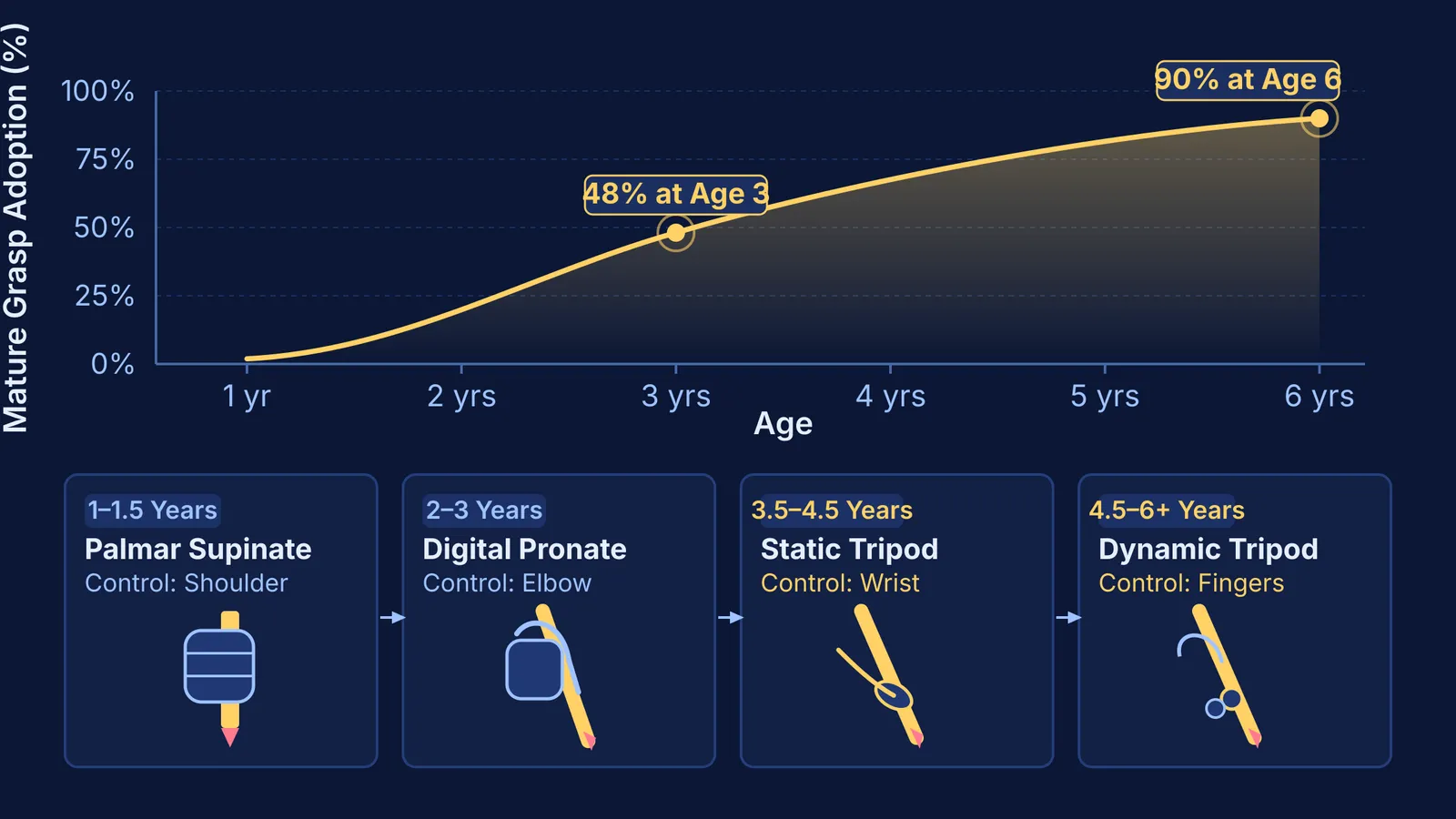
When forced to use adult pencils, children compensate for weak fingers by gripping tightly. This locks the wrist and produces painful cramps. In a landmark study published in the *American Journal of Occupational Therapy*, Schneck and Henderson (1990) evaluated 320 children aged 3.0 to 6.11 years. They found that 48% of three-year-olds naturally used mature grasps, rising to 90% by age six. Grasp maturation is gradual, not instantaneous.
India's National Curriculum Framework for Foundational Stage (NCF-FS 2022) reflects this progression. Competency C-3.3 focuses on building finger control through play, clay modelling, and scribbling rather than premature handwriting drills. As explored in our guide on how to help children learn without pressure, children build stronger skills when exploration precedes formal technique.
What are the natural stages of pencil grasp development?
Developmental occupational therapy studies, including Schneck and Henderson (1990), outline four sequential grasp stages between toddlerhood and primary school:
Palmar supinate grasp (12–18 months): A whole-fist hold with movement driven entirely from the shoulder.
Digital pronate grasp (2–3 years): Fingers point downward along the shaft with movement driven from the elbow.
Static tripod or quadrupod grasp (3.5–4.5 years): Three or four fingers hold the tool near the tip, while the wrist and forearm move as a rigid unit.
Dynamic tripod or lateral tripod grasp (4.5–6+ years): The pencil rests on the middle finger, guided flexibly by the thumb and index finger with active finger movement.
Many parents worry if their child uses four fingers instead of three, or wraps their thumb across the barrel. Research shows this worry is unnecessary. In a study of 120 fourth-grade students, Schwellnus et al. (2012) in the *American Journal of Occupational Therapy* found no significant difference in handwriting speed or legibility across different mature grasps. Function and comfort matter far more than textbook form.
Which playful activities build pencil grip without drills?
To support natural grasp development, focus on games that strengthen finger muscles:
Broken crayons: Break wax crayons into short fragments. Small pieces cannot be held in a fist, mechanically requiring a fingertip pinch.
Vertical surfaces: Taping paper to a wall, slate, or easel extends the wrist upward, putting fingers into a functional grip while stabilising the shoulder.
Playdough and clay: Pinching dough, rolling coils, and squeezing clay strengthen the palm arches and intrinsic hand muscles.
Tongs and pegs: Using kitchen tongs or clothes pegs to transfer pom-poms or beans teaches the thumb and index finger to work while the pinky side stays tucked.
How can parents support early writing at home?
Before writing letters, children need to understand that marks express ideas. Encourage free drawing and scribbling alongside shared reading with young children. Combining creative sketching with everyday maths talk with young children builds early literacy and numeracy together.
Ensure your child sits with their feet supported on a stool and the table near elbow height. Dangling feet force children to brace on their arms, freezing their wrists.
As children enter primary school, platforms like Fermi's AI tutor build on this same philosophy—noticing where a student is stuck and deciding whether to explain, ask, or show rather than drilling repetitive tasks.
If a child older than five experiences pain, tears paper from excessive pressure, or cannot hold small objects, consult a paediatric occupational therapist. For most preschoolers, broken crayons and playful exploration are all that is needed.


