

On this page
A jigsaw keeps a toddler busy, but research links it to something more: spatial thinking, or picturing how a shape looks once it is turned, flipped or moved.
Are jigsaw puzzles good for toddlers?
The best-known study is Early puzzle play: a predictor of preschoolers' spatial transformation skill, by Susan Levine and colleagues at the University of Chicago, published in Developmental Psychology in 2012. Researchers filmed 53 children and their parents at home for 90 minutes every four months, six times in all, between 26 and 46 months of age. About half the children (27 of 53) played with a puzzle at least once during those sessions.
At 4 years 6 months, the children who had played with puzzles did better at mentally rotating and moving flat shapes, after controlling for parent education, income and how many different words parents used. Among puzzle players, those who did puzzles more often scored higher.
The University of Chicago's summary notes that the ability to mentally transform shapes predicts science, technology, engineering and maths course-taking, degrees and careers in older children.
One caution: the researchers watched families rather than assigning puzzles at random, so other things about puzzle-playing homes may explain part of the difference. A later study by Jamie Jirout and Nora Newcombe in Psychological Science (2015), using a large, nationally representative US sample, pointed the same way: how often parents said their children played with puzzles and blocks was linked to scores on a block-design test, and the link held for boys and girls and across income groups. It, too, was observational.
The Levine study also found a gap in talk. Boys and girls did puzzles about equally often, and the paper found no significant difference in puzzle difficulty or how engaged parents were, but parents of boys used more spatial words during puzzle play. Use the same spatial talk with daughters as with sons.
How many pieces should a puzzle have at 2, 3, 4 and 5?
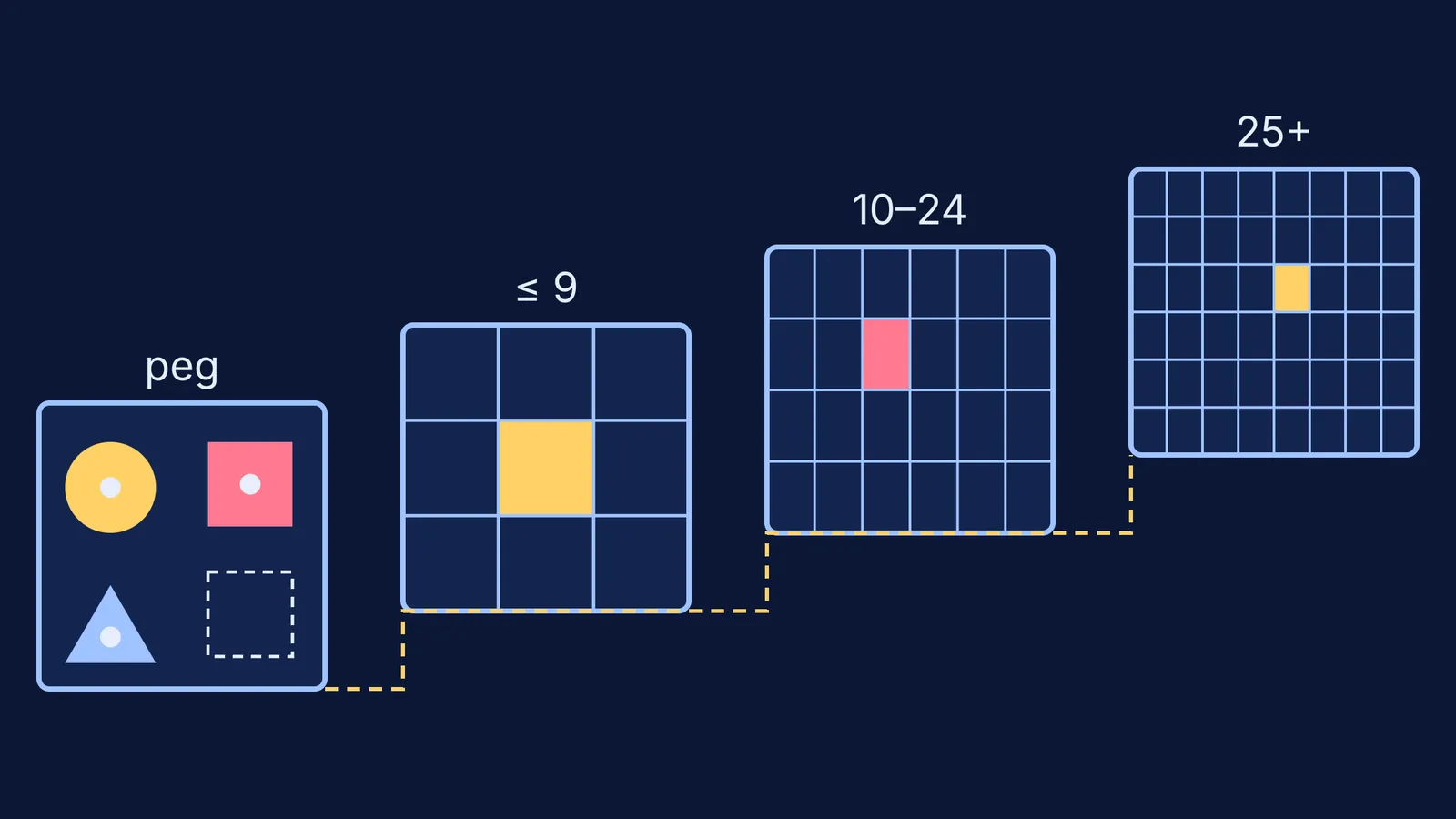
We found no official piece-count chart by age. The Levine team ranked difficulty in four levels: peg-board puzzles, jigsaws of 9 or fewer pieces, 10 to 24 pieces, and more than 24 (study methods). Our starting ladder uses those levels; the ages are our rough guides, not targets.
Around age 2: peg or knob puzzles with a few separate shapes, then 2 to 4 piece jigsaws of one familiar picture.
Around age 3: jigsaws of up to 9 large pieces with a clear picture and strong colours.
Around age 4: 10 to 24 pieces, with the box picture to compare against.
Around age 5: more than 24 pieces, including floor puzzles.
A simple test for moving: if your child finishes the same puzzle alone three times in a row, give them the next level. If they give up before halfway two sessions running, drop back one level for a week.
For under-threes, check piece size. The US Consumer Product Safety Commission's small parts rule bans small parts in products meant for children under 3, using a test cylinder sized like a young child's throat. Choose chunky pieces and bin any that start to break.
How do you help a toddler with a puzzle without solving it for them?
In a piece for Stanford's DREME network, Levine's advice comes down to three habits: use spatial words, guide with gestures instead of placing pieces yourself, and praise effort. Here it is as a help ladder. Move up a step only if the last one failed.
Wait. Count to ten silently.
Ask. "Which pieces have a flat edge?"
Describe. "You need a piece with a flat edge, like this one."
Narrow it down. Put two or three possible pieces in front of your child.
Point. Gesture at the gap or turn your hand to show a rotation.
Share a turn. Line a piece up near its spot and let your child push it in.
When a piece will not fit, try Levine's line: "That piece is upside down. What happens if you flip it and turn it sideways?" When the puzzle is done, "You worked hard on that puzzle" praises effort rather than talent.
What if your child gets frustrated or won't sit still?
Keep sessions short and stop while it is still fun. If sitting still is the bigger problem, see what to do when a 5-year-old cannot sit still for activities. Puzzles also fit into screen-free mornings for toddlers and pair well with sorting games for young children.
If you are worried about your child's development, talk to your paediatrician; puzzle progress is not a test.
When an older child at home reaches rotations or 3D molecule shapes, the Fermi Simulation Lab has interactive simulations for ideas that are easier to see than to read.


