

On this page
You sit down with your child to trace letters or finish a puzzle, and within minutes, they are wiggling, looking away, or sliding out of their chair. It is a common frustration for parents, leading to worries about focus and future school performance. But before you stress over whether your child is falling behind, it helps to look at what the science of child development actually says about how young minds work.
Is it normal that a 5-year-old cannot sit still for activities?
Yes. While it is easy to assume that school-aged children should be able to sit at a desk and work, true attention spans at this age are remarkably short. In many Indian homes, there is an early push for children to begin formal rote learning and extended homework sessions before they even reach primary school. However, expecting a young child to sit quietly for a long stretch contradicts developmental science.
According to the US Centers for Disease Control and Prevention (CDC), the expected cognitive milestone for a 5-year-old is just 5 to 10 minutes of sustained attention on a single activity, such as arts and crafts or story time.
This means that if your 5-year-old cannot sit still for activities that stretch to 20 or 30 minutes, they are not misbehaving; they are simply acting their age. Trying to force a young child to concentrate past their natural limit often leads to frustration for both of you and can create an early distaste for learning. It is completely normal for a child to need frequent shifts in activity to stay engaged.
How do movement breaks reset attention?
When a child sits for too long, their brain experiences attention fatigue. They are not choosing to ignore you; their cognitive load has simply maxed out. Cognitive load refers to the amount of information the working memory can hold at one time. A 5-year-old's working memory is still developing, and when they try to learn a new concept—like sounding out a word or writing a number—their brain works extremely hard. Once the cognitive load threshold is reached, they mentally check out.
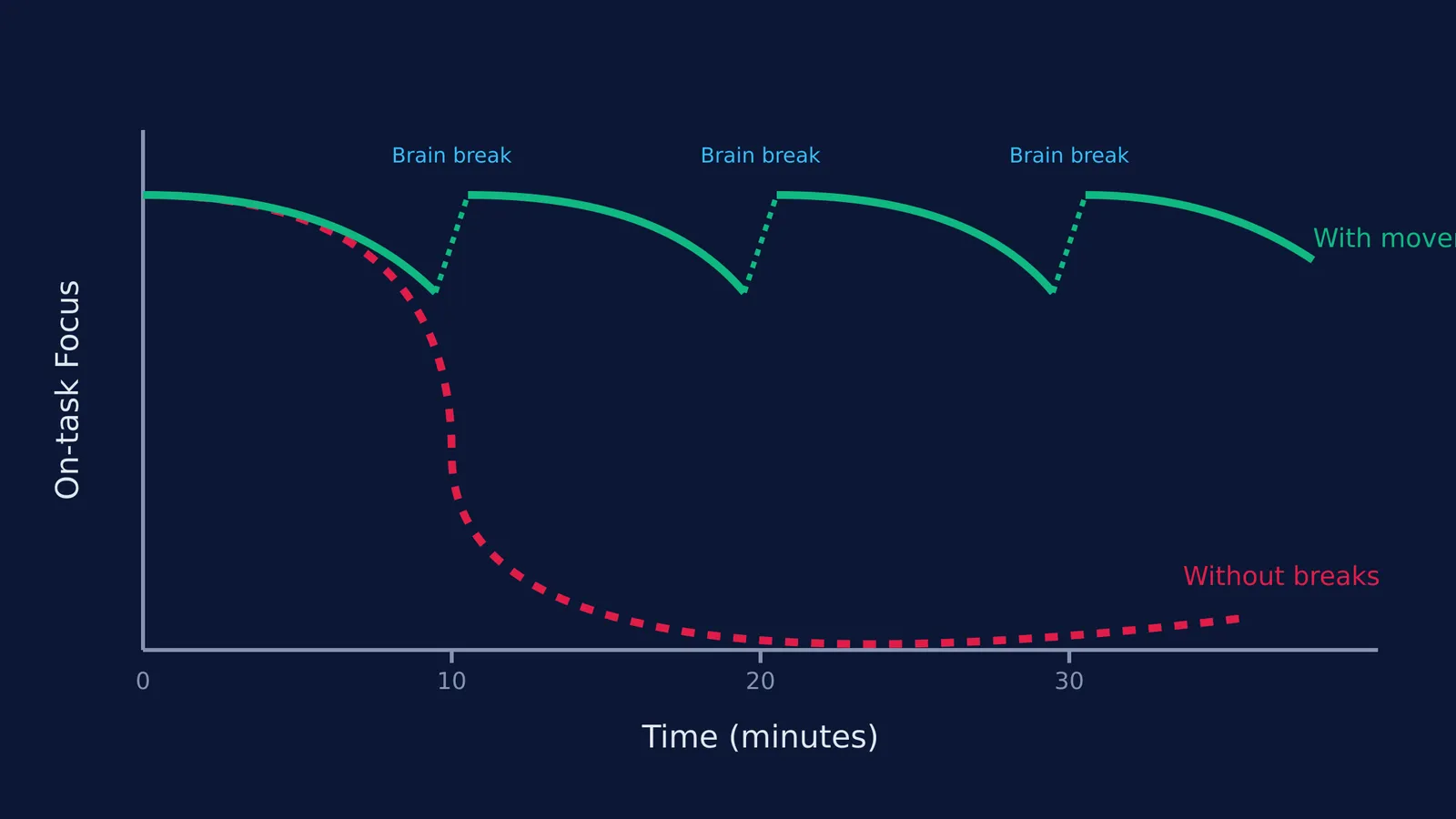
The fastest way to reset their focus is not strict discipline, but physical movement. Short bursts of physical activity—often called "brain breaks"—increase blood flow to the brain and release neurotransmitters that enhance motivation and executive function.
A landmark study published in *Medicine & Science in Sports & Exercise* measured the impact of classroom-based movement programs. The researchers found that 10-minute physical activity breaks improved children's on-task behaviour by 8%. For the students who struggled the most with focus, the improvement was even larger, jumping by 20%.
Rather than seeing movement as a distraction from learning, we should see it as the fuel that makes learning possible.
Short tasks and active learning games
If your child struggles to finish a worksheet or a matching game, the solution is to change the environment, not the child. Incorporating play into their routine builds the stamina they will eventually need for formal schooling. Here is a framework to make learning work for a 5-year-old's developing brain:
Use the 10-minute rule: Set a visual timer for 7 to 10 minutes. Here is what you might say to set this up: "We are going to do our puzzle until this timer beeps. Then, we get to do three frog jumps around the room!"
Schedule active resets: When the timer goes off, do 2 minutes of high-energy movement. Jumping jacks, "animal walks" (like crab crawling or frog walking), or dancing to a favourite song will instantly reset their attention.
Embodied learning: You do not have to separate movement and learning. Mix physical action directly into the task. If you are practising counting, have them jump over pillows while counting aloud. If they are learning letters, write them on large pieces of paper and have the child run to the correct letter when you call it out. Incorporating large motor skills helps reinforce the memory of what they just learned.
Building a routine around these natural limits makes learning positive rather than punishing. You can even read about setting up shared study and reading time to create a calm environment for these short bursts of focus, which works well if you have multiple children studying at once.
Adapting to harder work as they grow
These habits build a strong foundation for the years ahead. The need for structured breaks and clear, manageable tasks does not disappear when a child turns six. Even teenagers face cognitive overload when tackling difficult concepts. For more on the benefits of movement as students get older, you can explore what the reviews say about exercise and learning.
As children grow and take on harder subjects, breaking work into manageable pieces remains crucial. If an older sibling is struggling to focus on physics or maths, Fermi's AI tutor works out what they already know and builds a plan for the session, so they sit down to a clear next step rather than a blank page.
Start small with your 5-year-old. Respect their 10-minute limit, bring movement into their day, and watch their natural curiosity take over.


