

On this page
Your child has cleared JEE Main and is now one of the candidates allowed to sit JEE Advanced. The next few weeks feel strange at home: the pressure is still on, but the routine of the last two years has broken, and some friends got through while others did not. This guide sets out what those weeks look like, what you can take off your child's plate, and what to say when results differ.
How long is the gap between JEE Main and JEE Advanced?
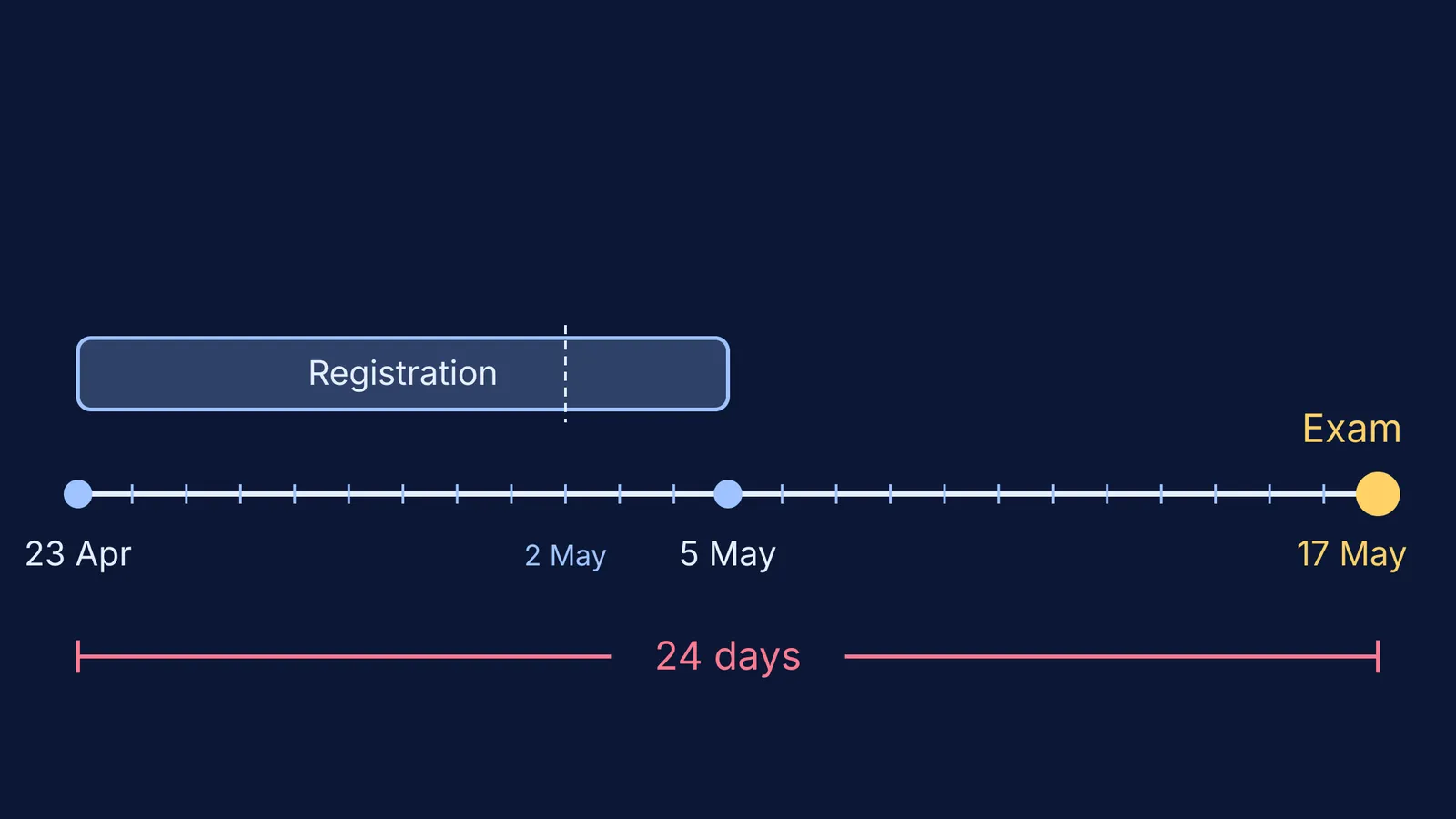
Not long. On the official JEE (Advanced) 2026 website, registration for qualified candidates opened on 23 April 2026, the deadline was extended to 5 May, and the exam was held on Sunday, 17 May 2026. That is 24 days from registration opening to the paper.
Eligibility is narrow. The JEE (Advanced) 2026 eligibility page says a candidate must be among the top 2,50,000 successful candidates, across all categories, in the B.E./B.Tech. paper of JEE (Main) 2026. The same page says a candidate can attempt JEE (Advanced) at most two times, in two consecutive years.
Dates change every year, so check the official site for your child's year rather than relying on last year's calendar. The point stays the same: this is a sprint of a few weeks, not a new course of study.
How can parents help between JEE Main and JEE Advanced?
Your job is not to teach. It is to make the house predictable so your child's energy goes into revision and mock papers.
Protect sleep first. The American Academy of Sleep Medicine consensus statement recommends that teenagers aged 13 to 18 sleep 8 to 10 hours per 24 hours on a regular basis. The panel linked regular sleep of this length with better attention, learning, memory and emotional regulation, all of which matter on exam day.
A calm daily rhythm for these weeks might look like this:
Fixed wake-up time, the same on every day including weekends.
Morning: one full-length mock or two timed sections, done at the exam's real start time.
Afternoon: review that mock. Every wrong answer gets a label: concept gap, wrong method, or careless slip.
Late afternoon: a walk, a game or an errand outside the house. Time away from the desk is part of the plan, not a break from it.
Evening: short revision of formulas and the error list, then meals with the family where nobody asks about scores.
Lights out at the same time each night, phone outside the room.
The afternoon review is where marks are actually found. JEE Advanced has used question types such as multiple-correct with partial marking, so it helps to understand how partial marking works in JEE Advanced multiple-correct questions before the last few mocks. When the error is a wrong method rather than a careless slip, the Fermi Problem Library has worked problems with a step-by-step solver that explains the reasoning rather than printing an answer, so your child can see where the method went off track.
Take over the logistics. Make a short list and own it: registration confirmation, admit card download, the exam centre route and travel time, photo ID, and the food plan for exam day. Every item you handle is one less thing in your child's head.
What should you say when friends got different results?
This is the hard part. Your child's best friend may not have qualified, or may have a far better JEE Main percentile. Both feel awkward. A few lines that work:
If a friend did not qualify: "You don't have to fix it for them. Send a message saying you're thinking of them, and that you'd like to meet after 17 May." (Use the real exam date for your year.)
If a friend scored much higher: "Their percentile is about their paper. Your Advanced paper starts from zero for everyone who sits it."
If relatives ask: "We're not discussing marks until the exam is over. Please just wish them well."
If your child says nothing: "You don't have to talk about it. I'm around after dinner if you want to."
Avoid ranking your child against cousins or neighbours, even as encouragement. Our guide on handling neighbours who compare your child with their son has more ways to deflect these conversations politely.
When is worry more than normal exam nerves?
Some nerves before a big exam are expected. Our article on talking to a child worried about entrance results covers everyday conversations. But if your child stops eating or sleeping for days, withdraws completely, or talks about hopelessness or self-harm, do not wait for the exam to pass. Speak to a doctor or counsellor. Tele MANAS, the free, 24x7 national mental-health helpline launched by the Ministry of Health and Family Welfare, can be reached on 14416 or 1800-891-4416.
After the exam, the same steadiness matters. Plan one ordinary, pleasant thing for the evening of the paper, and agree in advance that answer-checking can wait until the next morning.


