On this page
Families asking this usually mean two things: will the extra money buy a better education, and will it close doors later? An international board suits some children very well, but it buys a teaching style and a qualification, not an entrance-exam result.
What do you actually get for the higher fees?
International schools in India mostly teach the IB programmes or Cambridge (IGCSE, then AS and A Level). You pay largely for a different way of teaching and assessing: more coursework and projects, wider subject choice, and exams set outside India. Our guides on how IB and CBSE differ in teaching, cost and pathways and choosing between Cambridge IGCSE and CBSE for Class 9 and 10 compare the syllabi in detail.
Facilities and teaching vary by school, not by board. Ask how many students sit in a section and where last year's Class 12 went.
The qualification itself is recognised. The Association of Indian Universities equates five Cambridge IGCSE or O Level passes, including English, with Class 10, and two or three A Level passes with Class 12, according to an AIU letter reproduced in Cambridge's India recognition FAQ.
What does an international school not give you?
It does not, by itself, give your child an edge in JEE or NEET-UG. Those exams follow syllabi set in India, and students from every board sit the same paper.
It also does not settle eligibility. The Cambridge India FAQ says equivalence "is not necessarily sufficient to meet eligibility requirements for specific courses". Three details catch families out:
For IITs, the FAQ cites the rule of at least 75% aggregate in Class 12 or its equivalent, or the top 20 percentile of the board, and says Cambridge does not publish top-20-percentile data.
For NEET-UG, the FAQ says students must pass an AS Level English Language syllabus; IELTS or TOEFL scores do not count instead.
Timing: Cambridge's June-series results come out in August, so it advises students applying in India to sit the March series where possible (results in May) or the November series.
The JoSAA 2026 business rules add that each institute or programme "may have additional eligibility requirements". Rules change, so check the current official bulletins each year and ask the school which subject choices keep JEE and NEET open.
What are the hidden costs beyond tuition?
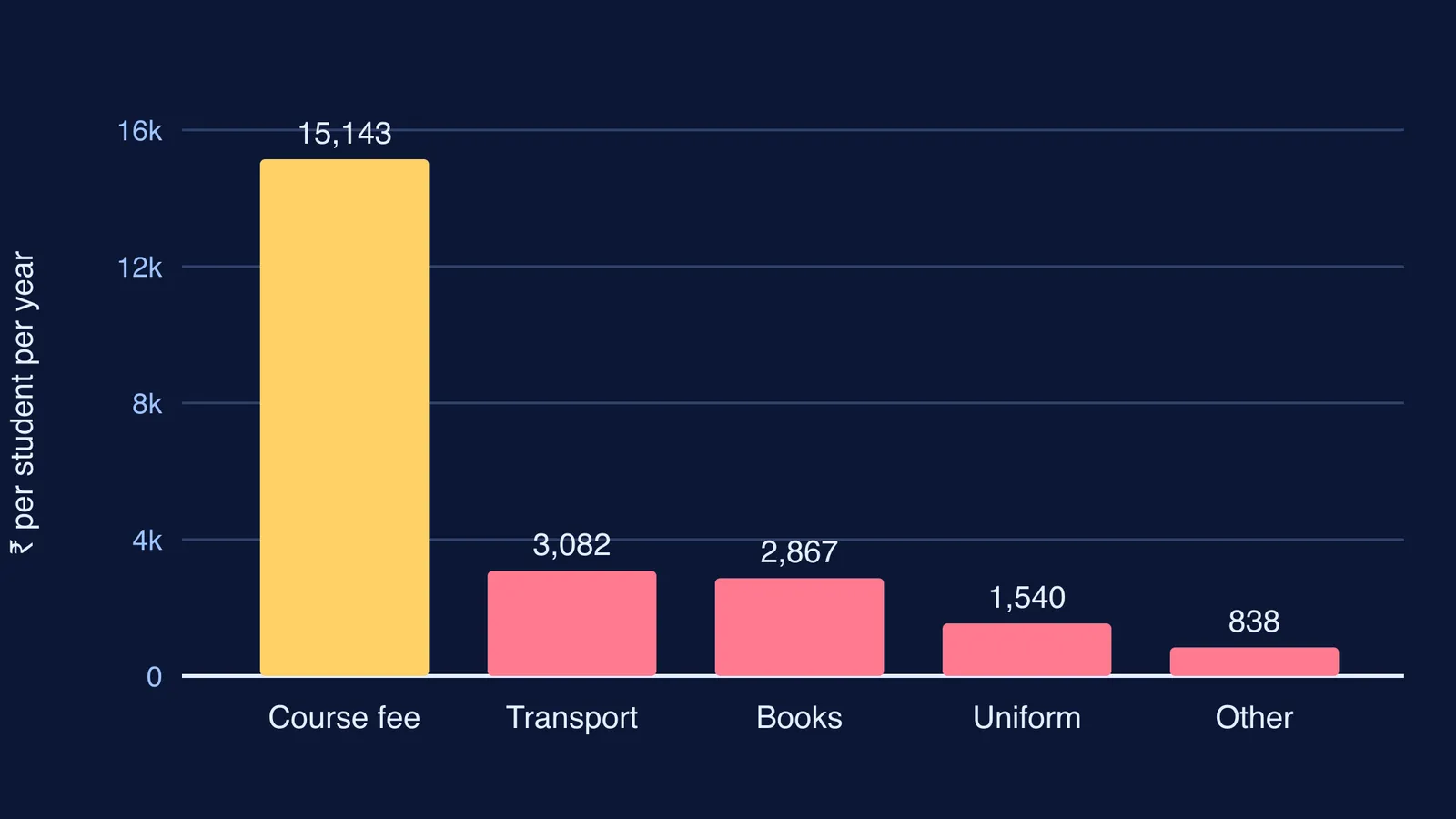
Tuition is not the whole bill. India's Comprehensive Modular Survey: Education 2025, run by the statistics ministry, found that urban households spent an average of ₹15,143 per student in the academic year on course fees. On top of that came ₹3,082 on transport, ₹2,867 on textbooks and stationery, ₹1,540 on uniforms and ₹838 on other items. By our calculation, those extras add about 55% to the course fee. These are averages across all urban schools, not international schools, whose bills are likely to be higher, but the pattern is worth checking.
Coaching is the other big extra. The same survey found that 27.0% of students across India were taking or had taken private coaching that year, and in urban areas the average coaching spend per higher secondary student was ₹9,950. If your child wants JEE or NEET-UG, budget for that on top.
Ask the school for these in writing:
Board registration and exam entry fees, per subject, for each exam year
Fee increases over the last three years
Transport, meals, uniforms, devices and software
Trips, residential programmes and activity fees
Deposits, and what is refunded if you leave mid-year
How do you decide if it fits your child's plans?
Run this five-question check before you sign:
Where does your child most likely want to study after Class 12: India, abroad, or not sure yet?
If India, which exams decide that path, and do this school's subject options meet their current rules?
Can you pay the full cost, with fee rises, until Class 12, not just this year?
Does your child enjoy open-ended projects and long writing, or do they do better with structured practice?
What would the same money buy elsewhere, such as a good CBSE or ICSE school plus savings for college?
Changing boards in Class 11 is possible but disruptive, so compare early with our guide to how families can compare CBSE, ICSE and state boards.
A worked example. Riya is in Class 8 and wants to study engineering in India. Suppose a school quotes tuition of ₹5 lakh a year (an illustrative figure, not a real quote). Five years to Class 12 is ₹25 lakh before any increase or extras, and she would need JEE preparation either way. For Riya, the international school is a choice of style, not a requirement for her goal.
If your child switches boards, or prepares for JEE alongside an IB or Cambridge syllabus, gaps often show up as missing concepts, not missing effort. The Fermi Concept Library covers every concept in physics, chemistry, biology, mathematics and computing, each with its own lesson, so you can fill one gap without rereading a whole textbook.
Start with question 1 at dinner this week.