

On this page
Choosing a board for your child in Grade 8 is a major decision. The choice between the Central Board of Secondary Education (CBSE) and the Cambridge International General Certificate of Secondary Education (IGCSE) shapes not just what students learn, but how they learn it over the critical Class 9 and 10 years.
Both boards are recognized globally and within India, but their approaches to teaching and testing are very different.
What is the difference between CBSE and IGCSE?
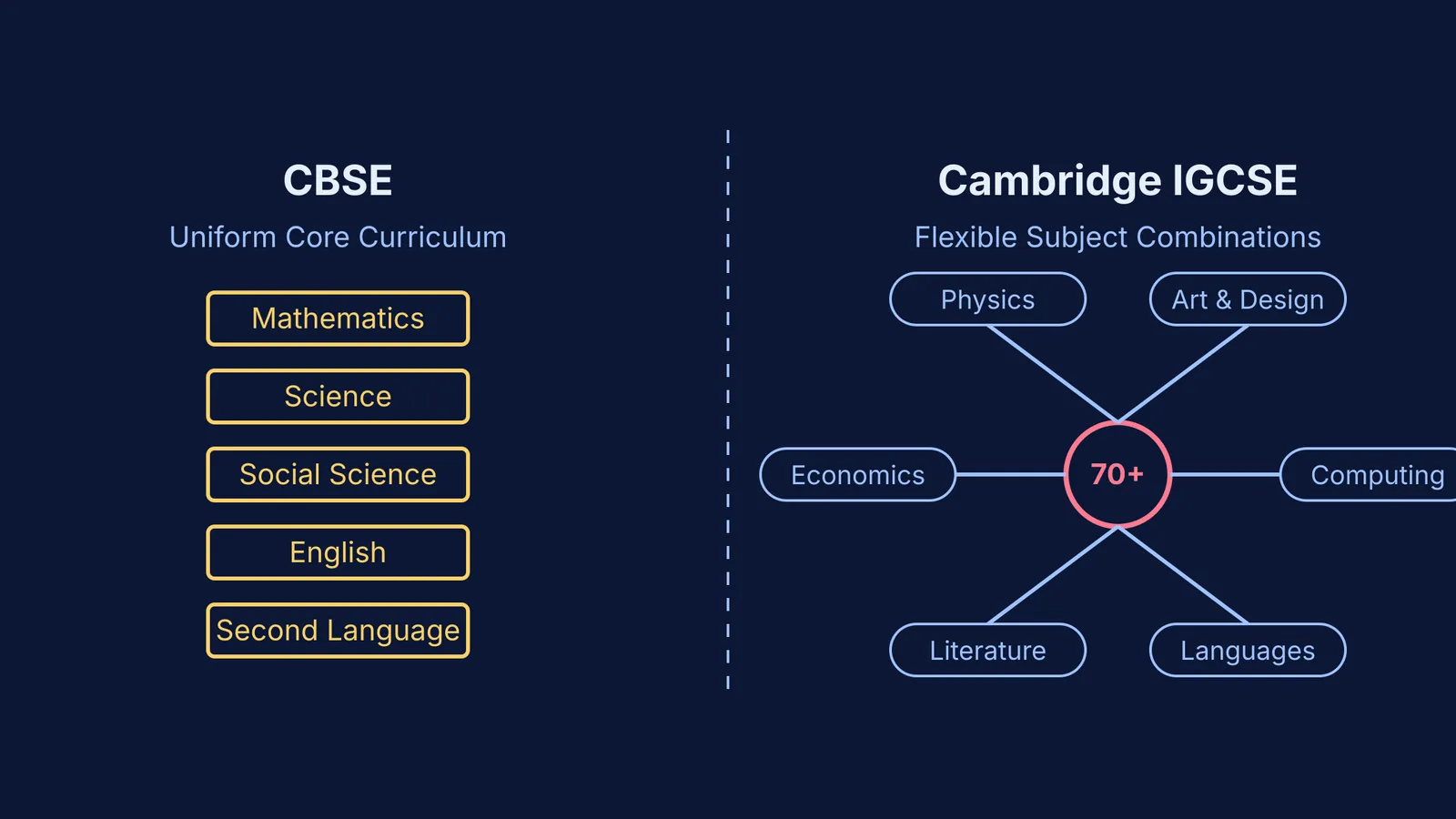
The CBSE is India's national board, known for its structured, step-by-step approach based on the NCERT syllabus. The CBSE oversees an immense network of affiliated schools. Its strength lies in a uniform curriculum that builds a strong theoretical foundation, particularly in mathematics and the sciences. Students typically take a fixed core of subjects: English, a second language, Mathematics, Science, and Social Science.
The Cambridge IGCSE, run by Cambridge University Press & Assessment, takes an inquiry-based approach. The Cambridge network has expanded rapidly in India. Instead of a fixed curriculum, it offers immense flexibility. Students can mix and match from over 70 subjects, allowing combinations like Physics, Art & Design, and Economics.
While CBSE tests a student's ability to retain and apply theoretical knowledge, IGCSE assessments often ask students to design an experiment or apply a concept to an unfamiliar real-world problem. If your child is curious but struggles to picture the physical systems they read about, the Fermi Simulation Lab can help them explore these concepts visually, which fits perfectly with the IGCSE's practical focus.
Which board is better for JEE and NEET preparation?
If your child's goal is to clear Indian competitive exams like the Joint Entrance Examination (JEE) or the National Eligibility cum Entrance Test (NEET), CBSE holds a distinct advantage.
The CBSE syllabus for Classes 11 and 12 serves as the direct blueprint for these national entrance tests. Because the Class 9 and 10 CBSE curriculum is designed to lead seamlessly into this higher secondary phase, students build the exact conceptual vocabulary needed for these exams early on.
IGCSE students can absolutely clear the JEE or NEET, but they often have to work harder in Class 11 to bridge the gap between Cambridge's application-heavy style and the vast theoretical depth expected by Indian competitive exams. Regardless of the board, if your child hits a wall with complex physics or maths numericals, they can use the Fermi Problem Library to work through the reasoning step by step, rather than just jumping to an answer. Parents also find value in explaining why science and maths matter to keep motivation high during these intensive years.
Can I switch from IGCSE to CBSE after Class 10?
Yes, switching from the Cambridge board to CBSE for Class 11 is a well-defined and common pathway.
To migrate successfully, your child must meet the equivalency standards set by Indian authorities. When you apply to a CBSE school for Class 11, the school will use the Percentage Uniform Marks (PUM) on your child's Cambridge Statement of Results to calculate their overall percentage. This calculation determines their eligibility for the Science, Commerce, or Humanities streams. Because the migration process is standardized, schools can admit students from recognized foreign boards without seeking prior approval from the CBSE.
How should we make the final decision?
Choosing the right board comes down to your family's plans and your child's learning style. Here is a practical framework to help you decide:
Future university plans: Are you aiming for undergraduate studies in the UK, US, or Australia? IGCSE is highly valued abroad for its emphasis on independent research. If Indian engineering or medical colleges are the target, CBSE is the more strategic choice.
Transferability: Does your job require frequent relocation within India? The vast network of CBSE schools ensures that your child's education will not be disrupted mid-year. IGCSE schools, while growing, are still predominantly located in Tier 1 and Tier 2 cities.
Learning style: Does your child thrive on structured, textbook-driven learning and clear expectations? CBSE provides exactly that. (You can see this structure in action when approaching the CBSE Class 10 maths paper). If they prefer exploring a wide variety of subjects and learn best by asking "why" and "how" rather than memorizing facts, they will likely enjoy the IGCSE approach.
Assessment preference: CBSE evaluates students primarily through a final board exam and internal assessments. IGCSE relies on a mix of written papers, practical lab work, and oral tests, depending on the subject chosen.
Both boards offer excellent educational foundations. The right choice is the one that aligns with how your child learns best and where they want to go next.


