On this page
If your child is finishing Class 10 at a school that offers both boards, or you are choosing a new school for Class 11, the IB-or-CBSE question comes down to four things: how your child learns, how they handle deadlines, what you can pay for two years, and where they want to study next. Here is what each board asks for.
How is teaching different in IB and CBSE?
A CBSE Class 12 student takes five subjects, with an optional sixth, plus internally assessed subjects such as Health and Physical Education, according to the CBSE Senior Secondary Curriculum 2025-26. The same document asks schools to use active and experiential learning rather than rote learning. The textbooks are fixed: the CBSE Physics syllabus for 2025-26 prescribes the NCERT books.
That Physics syllabus also shows what the board paper rewards. About 38% of theory marks test remembering and understanding, 32% test applying, and 30% test analysing, evaluating and creating.
An IB Diploma student takes six subjects, three or four at Higher Level and the rest at Standard Level, plus a core of Theory of Knowledge, an Extended Essay and Creativity, Activity, Service (IB Diploma Programme overview, which cites the IB's own guides). The IB recommends at least 240 teaching hours for each Higher Level course and 150 for each Standard Level course. Internal assessment, marked by the child's own teacher, makes up 20 to 50 percent of each subject's mark.
Which board has more workload, IB or CBSE?
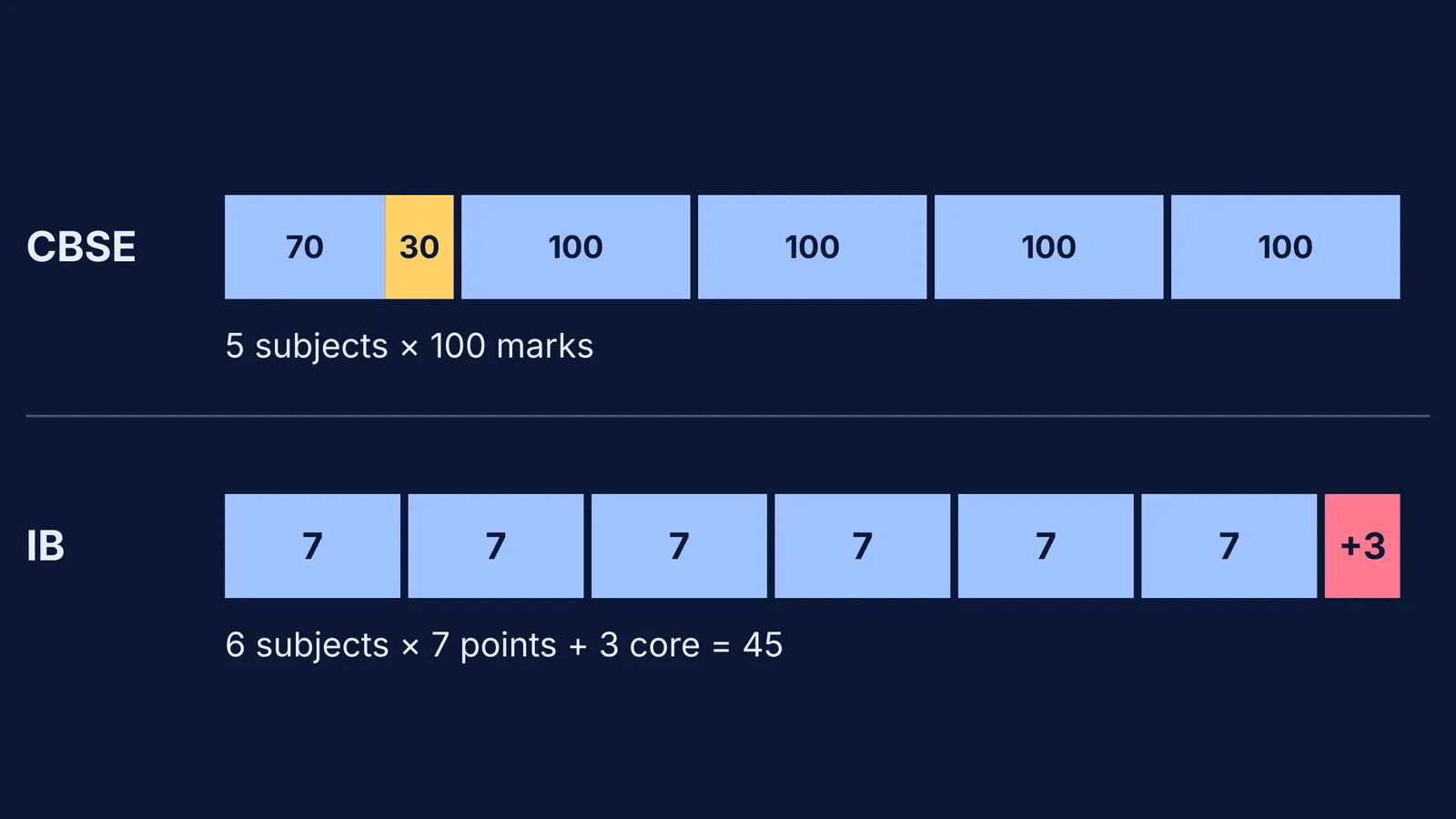
The bigger difference is when the work falls. CBSE weight sits at the end: the Class 12 Physics theory paper is 70 marks over 3 hours, with 30 marks for practicals (CBSE Physics syllabus).
IB weight is spread across two years of deadlines. Students write an independent research essay of up to 4,000 words and a 1,600-word Theory of Knowledge essay, and keep up Creativity, Activity, Service alongside their subjects (IB Diploma Programme overview). Each subject is graded 1 to 7, the core adds up to 3 points, so the maximum is 45, and a student needs at least 24 points for the diploma.
A child who works best in a focused push before one big exam may find CBSE's rhythm easier. A child who keeps a long project going without reminders may find the IB's suits them better.
How much do IB and CBSE cost?
For the 2027 board exams, CBSE charges schools in India ₹1,600 for five subjects, ₹320 for each extra subject and ₹160 per practical subject, as reported by Careers360.
IB fees are set by each school. As one example, a Ghaziabad school's published IBDP fee structure for 2027-28 lists ₹6,00,000 a year in tuition, plus ₹1,00,000 for IB registration and exam fees in Class 12, with books and transport extra. Ask every school for the full two-year total in writing, including exam fees, before you compare.
Which board is better for university in India and abroad?
For India, both can work. The NTA's JEE Main 2027 information bulletin lists the International Baccalaureate Diploma among qualifying exams, and asks candidates who finished Class 12 outside India, or with a board not on its list, for an equivalence certificate from the Association of Indian Universities. The bulletin also says each institute sets its own admission eligibility, so check the colleges on your child's list.
Abroad, universities read the two boards differently. The University of Warwick treats 90% across five Class 12 subjects as equal to A*AA at A level, while the University of Manchester asks for 80 to 95% overall depending on the course. Christ's College, Cambridge says Class XII on its own is not suitable preparation for a competitive application and looks for more, such as AP tests, while it asks IB applicants for 42 points with 776 at Higher Level. For more, read our guide on how CBSE results work for foreign university applications and the undergraduate application timeline for studying abroad.
A five-question checklist for your family
Sit down with your child and answer these together:
Where do you want to study after Class 12: India, abroad, or not sure yet?
Do you prefer one big exam, or steady deadlines and long projects?
Can we pay for two full years, including exam fees, without strain?
Does this school offer the exact subject combination your courses need, such as Higher Level Maths for a maths-heavy degree?
If you plan to sit Indian entrance exams, how will you cover that syllabus alongside school?
Then ask each school three questions: "What subject combinations did last year's Class 12 take?", "Where did they go after school?" and "What is the full two-year cost?" If the choice also involves a stream, our piece on choosing a stream by aptitude rather than marks helps.
Switching boards in Class 11 often exposes small gaps from earlier years. Fermi's AI tutor works out what your child already knows and builds a plan for the session, and the Fermi Concept Library has a lesson for every concept in physics, chemistry, biology and mathematics, so your child can work on a missing idea before a board paper or an internal assessment.