On this page
Your teenager has seen a reel about 16:8 fasting and announces that breakfast is cancelled. Before you argue, it helps to know what the research actually says. The short version: very little has been tested in healthy, growing teenagers, and the main trial in teens was run under close medical care.
What counts as intermittent fasting?
Intermittent fasting focuses on when you eat rather than what or how much you eat, as a 2024 scoping review in npj Metabolic Health and Disease defines it. It comes in two common forms:
Time-restricted eating: all food inside a daily window, often 8 hours, with nothing outside it.
Fasting days: a few very low-calorie days each week and ordinary eating on the rest.
Is intermittent fasting safe for teenagers?
The research cannot yet say it is, because the studies that would show it have mostly not been done. The same scoping review found 34 studies with 893 participants aged 12 to 25, and only 9 of them tested fasting as a treatment in young people with obesity. Its authors say rigorous studies are still needed before anyone knows how practical fasting is at this age.
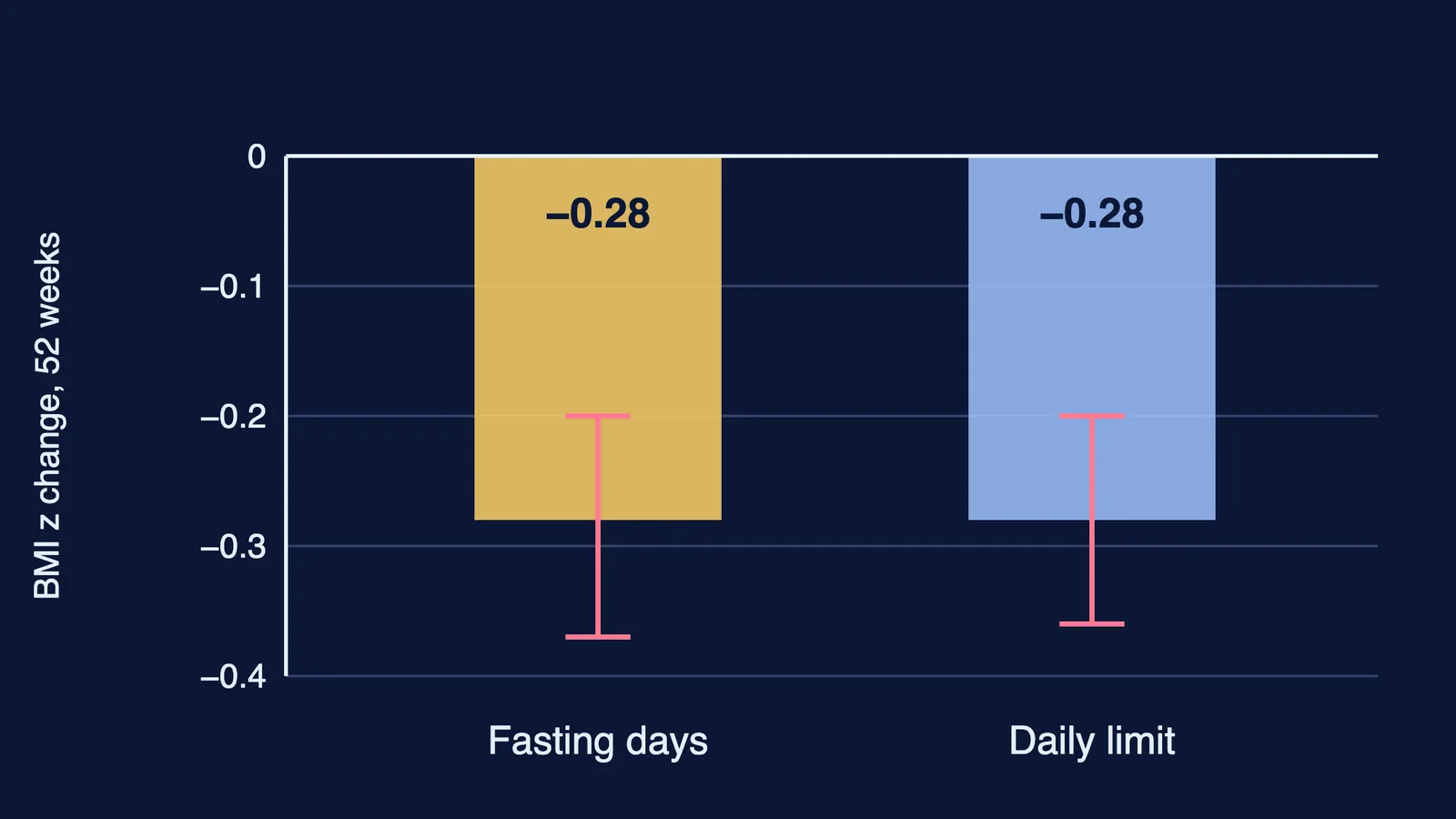
The main trial in teenagers is Australia's Fast Track to Health study, published in JAMA Pediatrics in 2024; its authors say it was the first randomised trial of fasting days in adolescents. It enrolled 141 adolescents aged 13 to 17, all with obesity and at least one related health problem, at two children's hospitals. One group had three days a week of about 600 to 700 kcal; the other followed a daily calorie limit.
After 52 weeks, both groups had the same average fall in BMI z score, -0.28, so fasting days worked no better than an ordinary daily plan (Lister et al., 2024). Every participant started with a 4-week very low-energy diet using meal replacements, and met a dietitian weekly in that phase. Only 97 of the 141 (68.8%) finished the year.
A companion paper from the same trial tracked mental health. It reported that 17 adolescents (12.1%) needed support or referral for depression or disordered eating, including 7 (5%) whose symptoms started or returned during the programme (Jebeile et al., 2024).
Why do paediatricians worry about fasting diets in the teen years?
The American Academy of Pediatrics put the worry plainly in its clinical report on preventing obesity and eating disorders in adolescents: some teenagers who try to lose weight may develop an eating disorder. The report says the focus should be on a healthy lifestyle rather than on weight. A summary of the report in AJMC adds two points families can use: children who eat with the family are less likely to show disordered eating, and families should talk about healthy eating, not dieting.
Fasting is also common among young people. In a Canadian survey of 2,762 adolescents and young adults, 47.7% of women, 38.4% of men and 52.0% of transgender or gender non-conforming participants said they had fasted in the past year. Fasting was linked with eating-disorder symptoms in every group, and with eating-disorder behaviours most consistently in women. The survey was a snapshot, so it cannot show which came first.
How do you talk to your teenager about fasting?
Lead with curiosity rather than a ban, so the conversation stays open. Try this four-step script over a meal, not in the middle of an argument.
Ask why. "What made you want to try it? What do you hope it will do?"
Share what's known. "I looked it up. The main study in teenagers was run through hospitals with regular dietitian visits, and fasting days did no better than a daily calorie plan."
Find the real goal. Most teens want more energy, better skin, a sports goal, or more time to study, not a number on a scale.
Agree on a next step. "Let's ask the doctor or a registered dietitian together, and keep eating dinner as a family meanwhile."
If the real reason is time, say during JEE Main or NEET-UG preparation, fix the timetable instead. A packed breakfast or a snack between school and coaching can help without skipping meals.
If your teenager is curious about the science itself, such as how the body uses glucose and stored fat between meals, the Fermi Concept Library has a lesson for each concept in biology and chemistry, which turns a trend into something to study rather than try.
The next step
Keep meals regular and shared, keep weight out of the conversation, and take questions about diets to a doctor or registered dietitian. The Tele MANAS number, 14416 (or 1800-89-14416), is listed on the Directorate General of Health Services page.