

On this page
A 7-year-old who drifts off after a few minutes of homework is usually not being lazy. Attention at this age is still developing, and your home can make focusing easier or harder.
How long can a 7-year-old concentrate?
No fixed number of minutes fits every child, but studies show the direction of travel. In a study of 57 children aged 5 to 12, Betts and colleagues (Child Neuropsychology, 2006) found rapid development in sustained attention from 5-6 to 8-9 years, and concluded that it improves to about age 10 and then levels off. Children in the same study did worse on harder, high-load tasks, so expect a tough worksheet to be harder to stick with than an easy one.
Watching kindergarten to fourth-grade classrooms in the US, Godwin and colleagues (Learning and Instruction, 2016) found that on-task behaviour declined as an activity's length increased from 10 to 30 minutes.
So treat about 10 minutes on one task as a sensible first block, then watch your own child: longer on favourite activities, shorter on hard ones.
In India, the load is meant to be light at this age. The Ministry of Education's School Bag Policy 2020 recommends no homework up to Class II and a maximum of two hours a week from Classes III to V. If your Class 2 child gets long daily homework, it is fair to ask the school why.
What kind of break helps a child refocus?
Movement is a good bet. In a study of 20 children aged about nine and a half, Hillman and colleagues (Neuroscience, 2009) found that after 20 minutes of moderate treadmill walking, children answered an attention task more accurately and did better on an academic achievement test than after resting. That was a lab study with older children, so treat it as a reason to make breaks active, not a promise.
Fast cartoons are a poor break. In a randomised study of 60 four-year-olds, Lillard and Peterson (Pediatrics, 2011) found that children who watched a fast-paced cartoon for 9 minutes did worse on tasks of self-control and working memory than children who drew or watched an educational cartoon. Those children were younger, but it is a good reason to save screens for after work.
Good breaks of 2 to 5 minutes:
ten jumps, skipping, or a lap of the balcony or courtyard
fetching a glass of water from the kitchen
animal stretches: tall like a giraffe, small like a mouse
drawing anything they like on scrap paper
What can you change at home so a young child settles to work?
Clear what they can see. In a lab classroom experiment with kindergarten children, Fisher, Godwin and Seltman (Psychological Science, 2014) found that children spent more time off task and learned less when the walls were heavily decorated than when the decorations were removed. At home, that suggests a desk facing a plain wall, one book and one pencil out, and the TV off in that room.
Protect sleep. The American Academy of Sleep Medicine recommends 9 to 12 hours of sleep per 24 hours for children aged 6 to 12, and links sleeping this much regularly with better attention, behaviour and learning.
A quick home checklist:
the same place and time each day
snack and outdoor play before work
only today's task on the table; phones in another room
a visible timer, so "how much longer?" has an answer
A simple after-school plan for a 7-year-old
Here is how one evening might run for a Class 2 child with a reading page and a few sums.
5:00 to 5:30: snack and outdoor play.
5:30: sit down together and say, "Two jobs today. Reading first, then sums. The timer tells us when it's break time."
5:30 to 5:40: reading aloud with the timer on. If they drift, point to the line instead of lecturing.
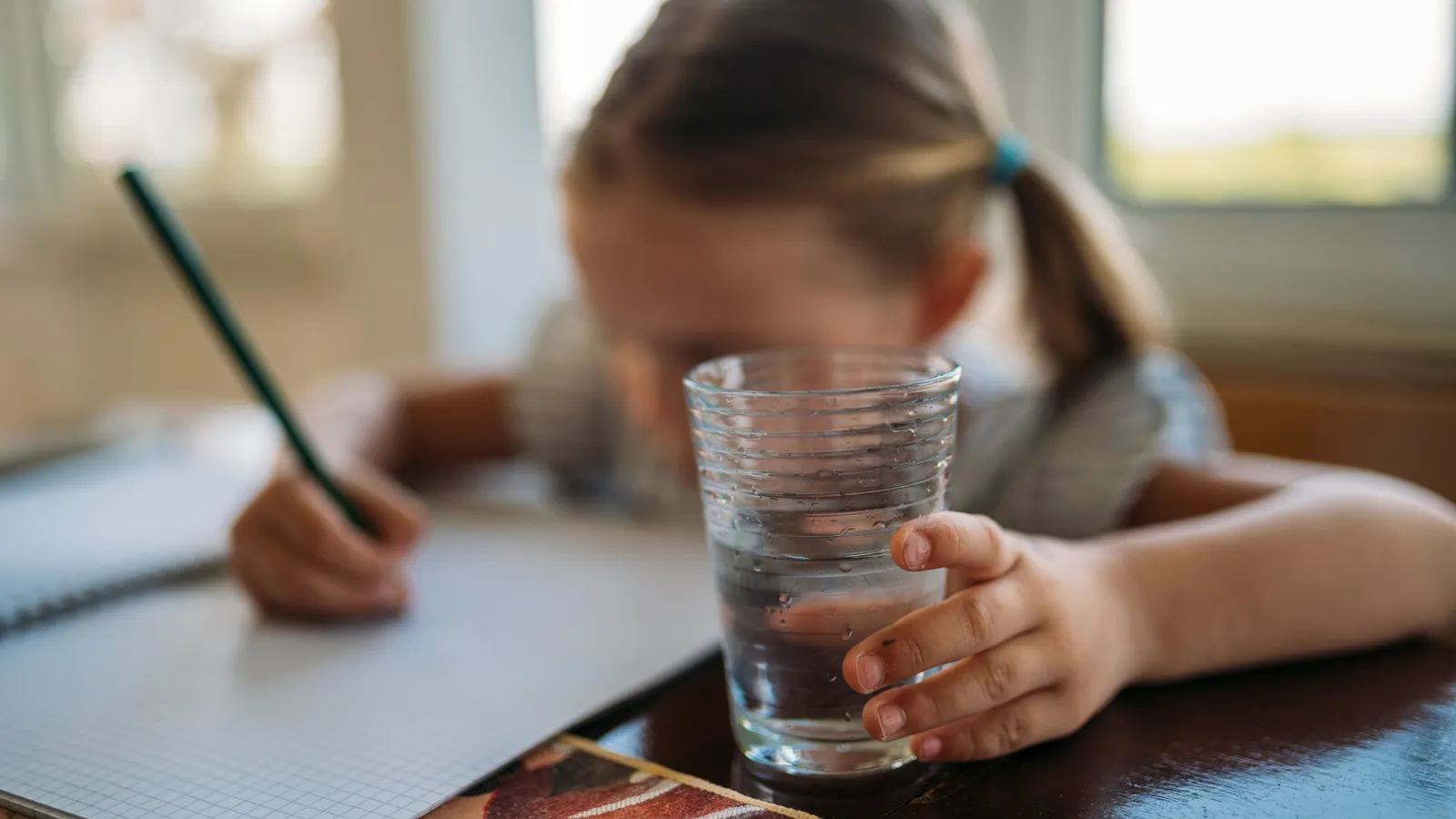
5:40 to 5:43: movement break, a glass of water, back to the chair.
5:43 to 5:53: sums, with the rest of the page covered so it looks small.
5:53: stop, even if one sum is left, and say, "You worked for two full blocks. Tomorrow we start with that last one."
Free time.
If a block keeps falling apart at 6 minutes, make it 6 minutes and add one minute a week. Praise the effort ("you kept going when it got hard"), not the result.
For a fidgety child, try these movement-friendly homework ideas for a restless 7-year-old; if evenings turn into fights, read why 6-to-8-year-olds throw homework tantrums; and for later years, see our class-wise guide to daily study hours.
When your child reaches higher-class science and maths, Fermi's AI tutor works out what they already know and builds a plan for the session, so they sit down to one clear task.
When should you ask for help?
If poor attention shows up everywhere, at school, at play and at home, and lasts for months, talk to the class teacher and your child's paediatrician rather than trying harder at home. If you feel overwhelmed yourself, Tele MANAS, the government's toll-free mental health helpline, offers telephone counselling on 14416.


