

On this page
India's main national reference point for how long children should work at home is a set of homework limits. Here they are, realistic ranges built on them, and a quick way to check whether the hours are working.
How many hours should a child study each day, class by class?
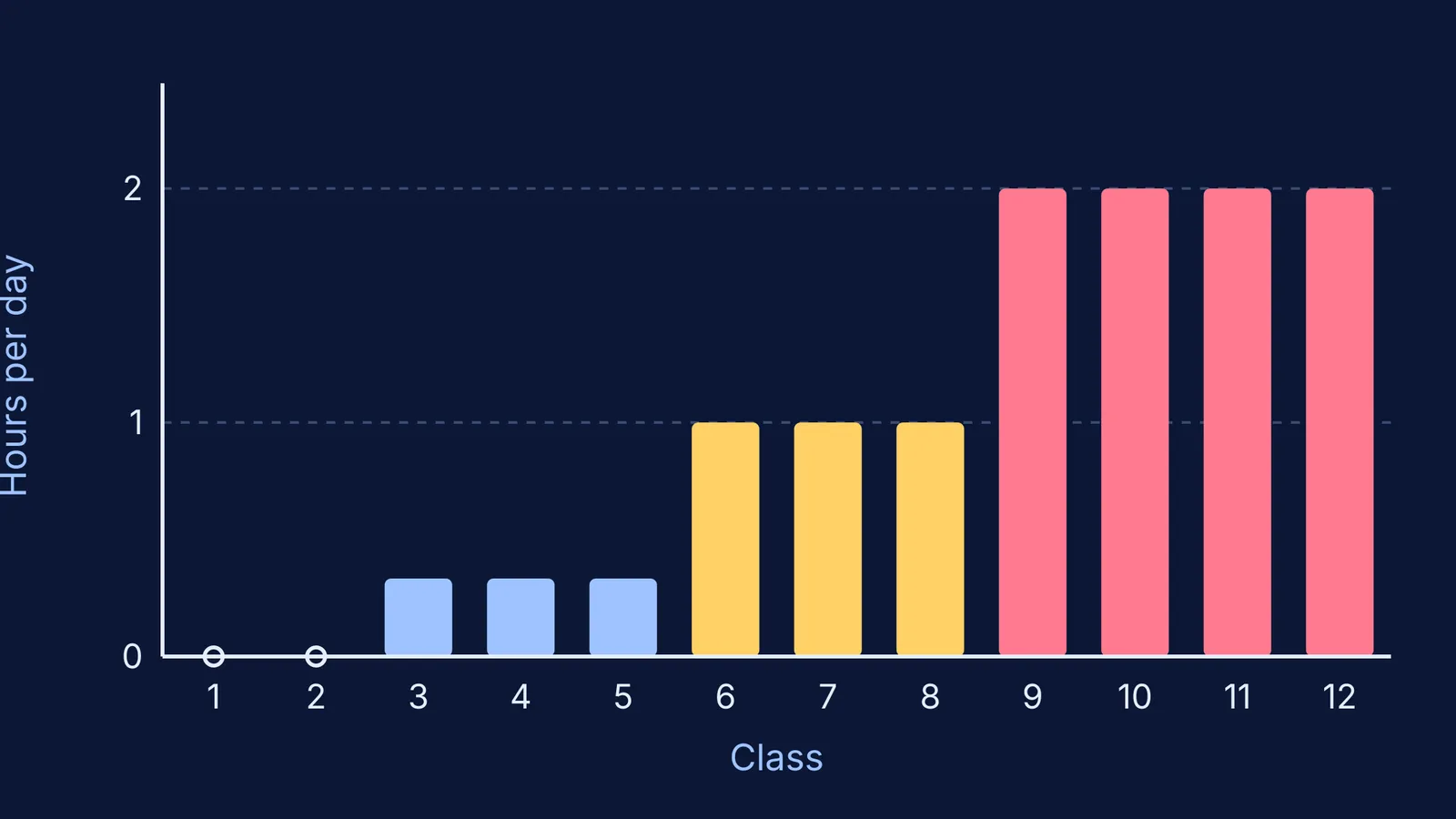
The School Bag Policy 2020, formulated by NCERT for the Government of India and re-notified by the Nagaland Board of School Education in February 2026, suggests these homework limits:
Classes 1-2: no homework.
Classes 3-5: at most 2 hours a week.
Classes 6-8: at most 1 hour a day.
Classes 9-12: 2 hours a day.
Here is how we would turn them into a daily plan at home:
Classes 1-2: no fixed study time. Read together, talk about numbers, play.
Classes 3-5: 2 hours a week works out to about 20 minutes on each of six school days. Short reading and practice, then stop.
Classes 6-8: up to an hour, homework included.
Classes 9-10: about 2 hours on school days, with extra revision blocks in the months before board exams.
Classes 11-12: 2 hours is the policy's figure. JEE or NEET-UG aspirants often study longer, so the quality of each hour matters.
Full-time aspirants: no official body sets a number. See the worked day below.
For what research says about homework at each age, read our guide to how much homework helps.
Does studying more hours mean better marks?
Up to a point. A synthesis of US studies from 1987 to 2003 by Cooper, Robinson and Patall (2006) found generally consistent evidence that homework helps achievement, though every study had design flaws. Studies of simple correlations found a stronger link in grades 7-12 than in kindergarten to grade 6.
The OECD's PISA in Focus brief on homework reports that 15-year-olds in OECD countries spent almost 5 hours a week on homework in 2012. The same brief says PISA 2009 data suggest that after about 4 hours of homework a week, extra time has a negligible impact on performance. It also found that average homework time is unrelated to how well a school system performs overall, pointing to factors such as the quality of instruction.
That covers one kind of hour for one age group, but it fits what parents see: a child can sit at a desk all evening and learn little.
What makes one study hour worth more than another?
A review of ten study techniques by Dunlosky and colleagues (2013) rated two as high utility: practice testing and distributed practice (spreading study out over time). Rereading and highlighting were rated low utility, even though students use them often.
So a good hour usually has three parts:
Recall before rereading. Close the book, recall what you can, then check.
Problems, not pages. Solve questions, including a few from older chapters.
Spacing. Return to a topic after a few days instead of finishing it in one sitting.
When an hour stalls on a problem your child cannot crack, the Fermi Problem Library has worked problems with a step-by-step solver that explains the reasoning rather than printing an answer.
What does a realistic day look like for a JEE or NEET-UG aspirant?
Start with sleep, not study. The American Academy of Sleep Medicine consensus recommends 8 to 10 hours per 24 hours for teenagers aged 13 to 18, and links enough sleep with better attention, learning and memory. Our guide to how much sleep teenagers need has ways to protect it.
Here is one worked example for a drop-year student without daytime coaching. It is an example, not a target:
8:30-10:00: new chapter, textbook problems.
10:20-11:50: same chapter, harder problems.
2:00-3:30: a timed mixed set or part of a mock test.
3:30-5:00: exercise, time outdoors, a snack.
5:00-6:30: go through every error from the day.
7:30-8:30: recall practice on last week's chapters.
10:30: lights out, for 8.5 hours in bed before a 7:00 start.
That adds up to 7 hours of focused study in five blocks (90 + 90 + 90 + 90 + 60 minutes). If your child attends coaching, swap blocks for class time rather than adding them on top. If they sit down each morning not knowing where to begin, Fermi's AI tutor works out what they already know and builds a plan for the session.
How can parents tell if the hours are working?
Ask about output, not time. Try these at dinner:
"What did you get wrong today, and why?"
"Which chapter would worry you in a test tomorrow?"
If hours rise while marks and mood fall, switch to shorter, sharper blocks; see our guide to building a study routine that lasts.
If your child sleeps badly for weeks, seems persistently low or talks about feeling hopeless, speak to a doctor or school counsellor, or call Tele MANAS, the government's free 24x7 mental health helpline, on 14416 or 1800-891-4416.
This week, pick one study block and run the two-minute check at the end of it.


