

On this page
An ice melting race needs five ice cubes, a few kitchen things and a bit of patience. Before it starts, your child guesses which cube will win. That guess turns a fun afternoon into real science.
Which melts fastest: salt, sugar, sand or cloth?
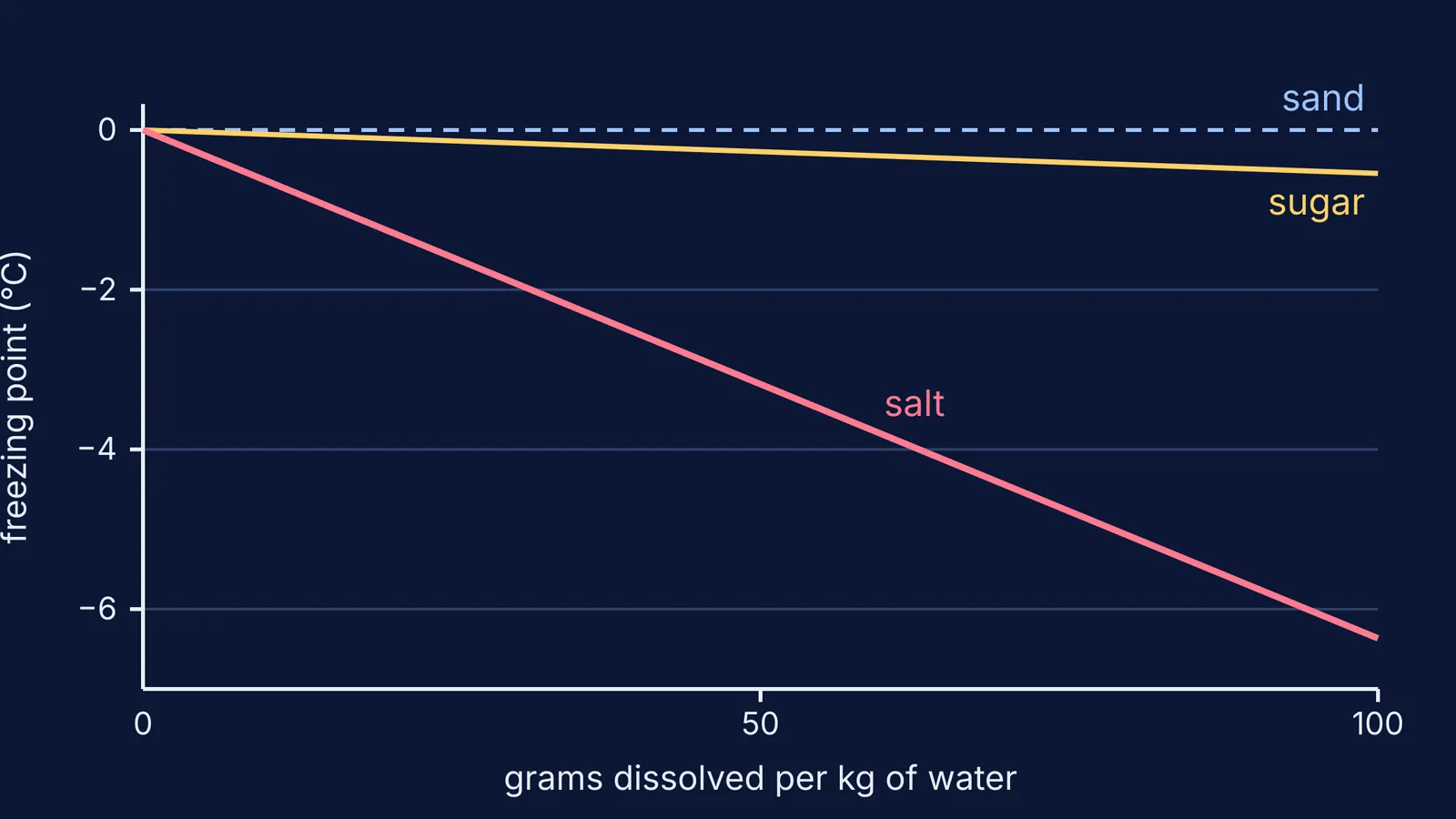
Salt usually wins. When Scientific American ran the experiment with salt, sugar, sand and a plain cube, the cube sprinkled with table salt melted faster than any of the others. A Science News Explores version of the test points to the key difference: salt and sugar dissolve in water and sand does not, so sand cannot lower the freezing point the way they do.
The cloth-wrapped cube is often the surprise. Some children expect a blanket to “warm it up”, but it should outlast the plain cube, because cloth slows the heat coming in from the room.
How do you set up the ice melting race at home?
Take five ice cubes of the same size from the same tray. Put each on its own small plate.
Leave one plain. This is your control, the cube you compare everything else against.
Sprinkle half a teaspoon of salt on one, half a teaspoon of sugar on the second and half a teaspoon of sand or soil on the third. Wrap the last one loosely in a cotton handkerchief.
Before you start the timer, each person writes a guess for the finishing order and one reason.
Check every five minutes. Write down the time when each cube has no solid ice left.
Compare the real order with the guesses and talk about what surprised you.
Keep the plates out of direct sun and away from a fan, so every cube gets the same conditions.
Why does salt melt ice faster than sugar?
Dissolved particles get in the way of water molecules locking together into ice, so salty water can stay liquid below 0°C. Chemists call this freezing point depression. NOAA notes that fresh water freezes at 32°F, but seawater freezes at about 28.4°F because of the salt in it.
The drop depends on how many particles are dissolved, not on what they are made of, as Purdue's chemistry help pages explain with the formula ΔT = Kf × m. For water, Kf is 1.86 °C per mole of particles in each kilogram of water.
A worked example for an older child: a mole of table salt weighs 58.44 g and a mole of sucrose weighs 342.30 g, according to PubChem. Salt also splits into two ions, sodium and chloride, so its van 't Hoff factor is ideally 2.
100 g of salt in 1 kg of water: 100 ÷ 58.44 × 2 × 1.86 ≈ 6.4°C lower freezing point.
100 g of sugar in 1 kg of water: 100 ÷ 342.30 × 1.86 ≈ 0.54°C lower.
Gram for gram, salt gives roughly 12 times the effect. The real figure for salt is a bit smaller, because the same LibreTexts page notes the ideal factor holds only for very dilute solutions, but salt still wins easily. For the full chemistry, see our explainer on how salt melts ice through freezing point depression.
Why does a cloth wrap slow the melting?
Melting takes energy. It takes 334 J to turn each gram of ice at 0°C into water at 0°C, according to the LibreTexts heats of fusion table. That energy has to flow in from the warmer air and plate. While the ice melts, its temperature stays at 0°C, which our post on why temperature stays constant during melting explains.
Cloth slows that flow. Oak National Academy's lesson on thermal insulators puts it simply: materials that contain trapped air insulate well because gases are very poor thermal conductors, and wrapping an object in an insulator keeps a cold object cool. A sweater works the same way: it makes no heat, it only slows heat moving, as our post on why woollen clothes keep us warm explains.
What should you say while the ice melts?
In a 2004 study in the American Journal of Physics, Catherine Crouch, Eric Mazur and colleagues found that students who only watched a demonstration understood the idea no better than students who never saw it. Students who predicted the outcome first understood it significantly better.
Try these lines:
“Write your guess first. There is no wrong guess, only a guess we test.”
“Where is the heat coming from to melt the ice?”
“Why might sugar help a little but sand hardly at all?”
“Was your guess right? What would you change about your reason?”
If your teenager wants to go further, the Fermi Simulation Lab has interactive simulations for ideas that are easier to see than to read.


