

On this page
Children experience a well-documented drop in recreational reading right around age 12. Between middle school workloads, expanding extracurricular schedules, and the arrival of personal smartphones, leisure reading often gets crowded out. Yet reading for pleasure during early adolescence provides critical cognitive foundations: research from the OECD in its PISA report, Reading for Change, established that reading enjoyment is a more decisive predictor of educational attainment than a family's socio-economic status.
Finding the right books for a 12-year-old requires balancing two distinct elements: matching linguistic difficulty to prevent fatigue, and preserving complete personal autonomy to sustain interest.
Why does reading decline at age 12?
The transition to secondary school coincides with a sharp drop in reading frequency. According to the Scholastic Kids & Family Reading Report, while 57% of 8-year-olds read books for fun five to seven days a week, that figure drops to 35% by age 9 and falls to just 21% among 12-to-14-year-olds. At the same developmental stage, increasing smartphone ownership and digital entertainment introduce constant stimulation that competes directly with the sustained cognitive focus books require.
As screen habits solidify, understanding how screen reading compares with printed books helps families establish screen-free routines that protect recreational reading.
At age 12, children also outgrow children's series but frequently find adult fiction emotionally distant. When parents push heavy classics or exam guides, reading starts feeling like homework. The Scholastic survey found that 41% of children struggle to find books they enjoy, yet only 29% of parents recognise this search as a barrier.
How do you test whether a book is at the right reading level?
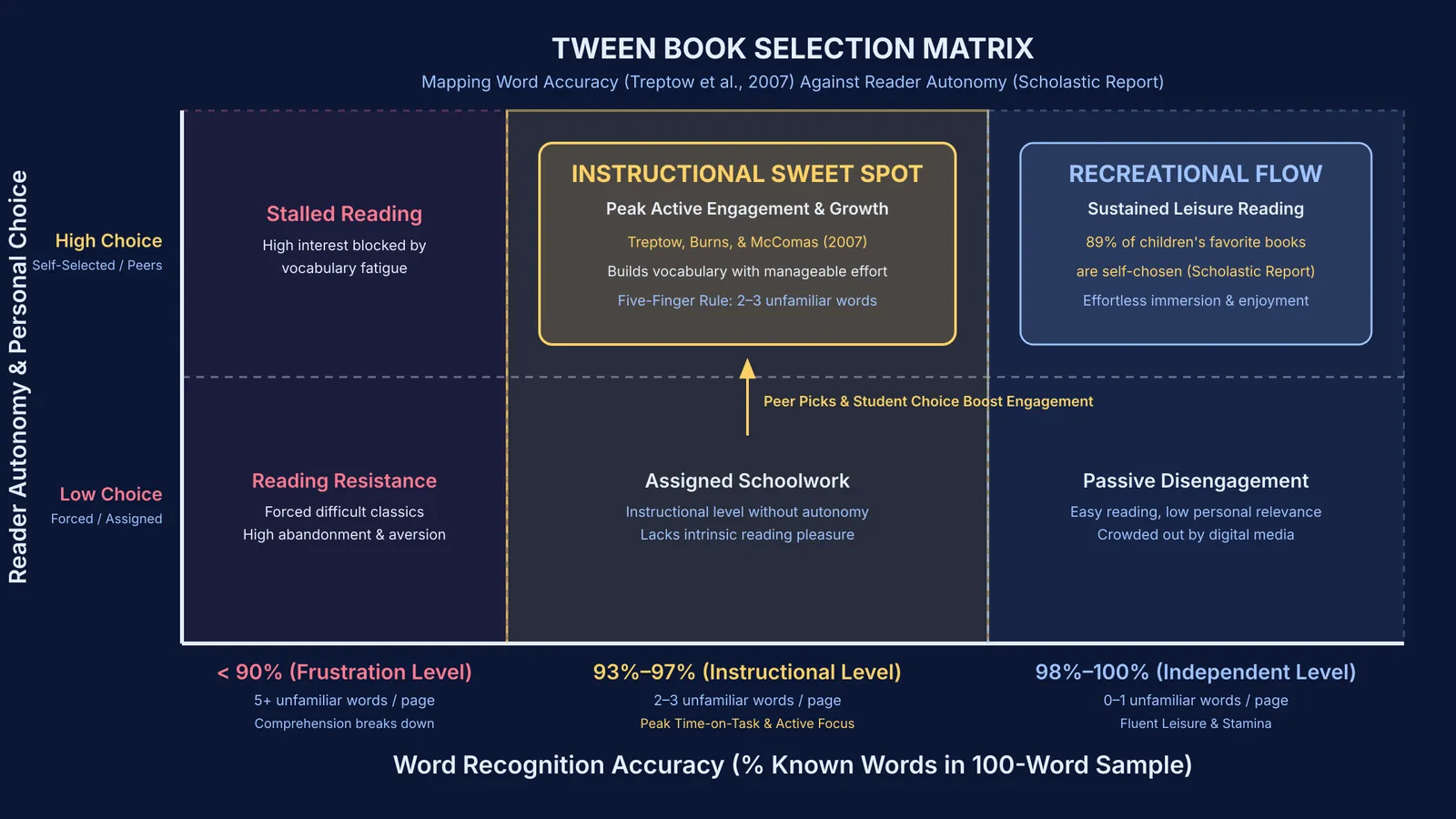
A book fails when its vocabulary demands so much mental effort that the narrative thread unravels. In a foundational study in *School Psychology Review*, Treptow, Burns, and McComas evaluated reading performance across three defined difficulty levels:
Independent level (100% known words): comprehension is highest, reading is fluid, and mental fatigue is minimal.
Instructional level (93% to 97% known words): time-on-task and active engagement reach their peak as readers encounter a manageable learning challenge.
Frustration level (below 90% known words): comprehension drops steeply, reading pace collapses, and readers quickly abandon the text.
You do not need formal testing software to apply these findings. The Five Finger Rule provides an immediate check during bookstore or library visits.
For tweens who read slowly, helping children build reading speed without losing comprehension ensures that challenging vocabulary does not derail chapter-length immersion.
What types of books resonate with a 12-year-old?
Tweens gravitate toward stories featuring capable young protagonists dealing with moral ambiguity, mystery, and high stakes. Curricula initiatives like the CBSE Reading Mission highlight how varied formats and cultural relevance keep middle-school readers engaged.
Effective categories for a 12-year-old Indian child include:
Mystery and detective fiction: Satyajit Ray's *The Complete Adventures of Feluda*, Arthur Conan Doyle's *The Adventures of Sherlock Holmes*, and classic whodunits.
Coming-of-age Indian narratives: Ruskin Bond's *Rusty* series and *The Room on the Roof*, Sudha Murty's *The Magic of the Lost Temple*, and R.K. Narayan's *Swami and Friends*.
High-stakes mythology and fantasy: Rick Riordan's *Percy Jackson & the Olympians*, J.K. Rowling's *Harry Potter*, and Roshani Chokshi's *Aru Shah* series.
Visual and STEM non-fiction: APJ Abdul Kalam's student edition of *Wings of Fire*, graphic novels, and illustrated science compendiums.
When non-fiction or speculative fiction sparks questions about orbital mechanics, rocket propulsion, or cell biology, Fermi's AI tutor can work out what a student already understands and guide their inquiry step by step, while the Concept Library offers structured lessons across science and mathematics.
How can libraries and older peers guide the choice?
While direct parental recommendations often meet resistance from independent-minded tweens, suggestions from peers carry strong social weight. In studies published in the *Journal of Adolescent & Adult Literacy* (DOI: 10.1002/jaal.273) and *The High School Journal* (DOI: 10.1353/hsj.2016.0004), literacy researcher Dr. Margaret K. Merga evaluated social influences across 520 adolescents in the West Australian Study in Adolescent Book Reading. Merga found that peer reading and friend recommendations provide vital social permission, counteracting the perception that reading is socially isolating.
Older siblings, cousins, and Class 9 or 10 students act as powerful reading models. When an older peer says a book kept them up at night, a 12-year-old listens with genuine interest.
Libraries remove the financial pressure of purchasing unread titles. Making a habit of encouraging regular borrowing from school libraries allows tweens to experiment with unfamiliar genres risk-free.
A four-step plan for choosing books together
To build a sustainable reading habit at home, use this collaborative four-step process:
Follow the three-to-one curation rule: Pre-select three suitable books that match their reading level, then let your child choose the one they want to read. The Scholastic survey showed that 89% of children say their favourite books are ones they picked themselves.
Build a fortnightly library basket: Borrow four titles every two weeks—one graphic novel, one fast-paced adventure novel, one science or hobby book, and one peer recommendation.
Establish a 50-page permission slip: Give your child explicit permission to abandon a book after 50 pages if it does not hold their attention. Forced completion turns reading into an obligation.
Ask an older student: Ask a teenage cousin or Class 10 neighbour what two books they could not put down when they were 12, and place those on the table without comment.


