

On this page
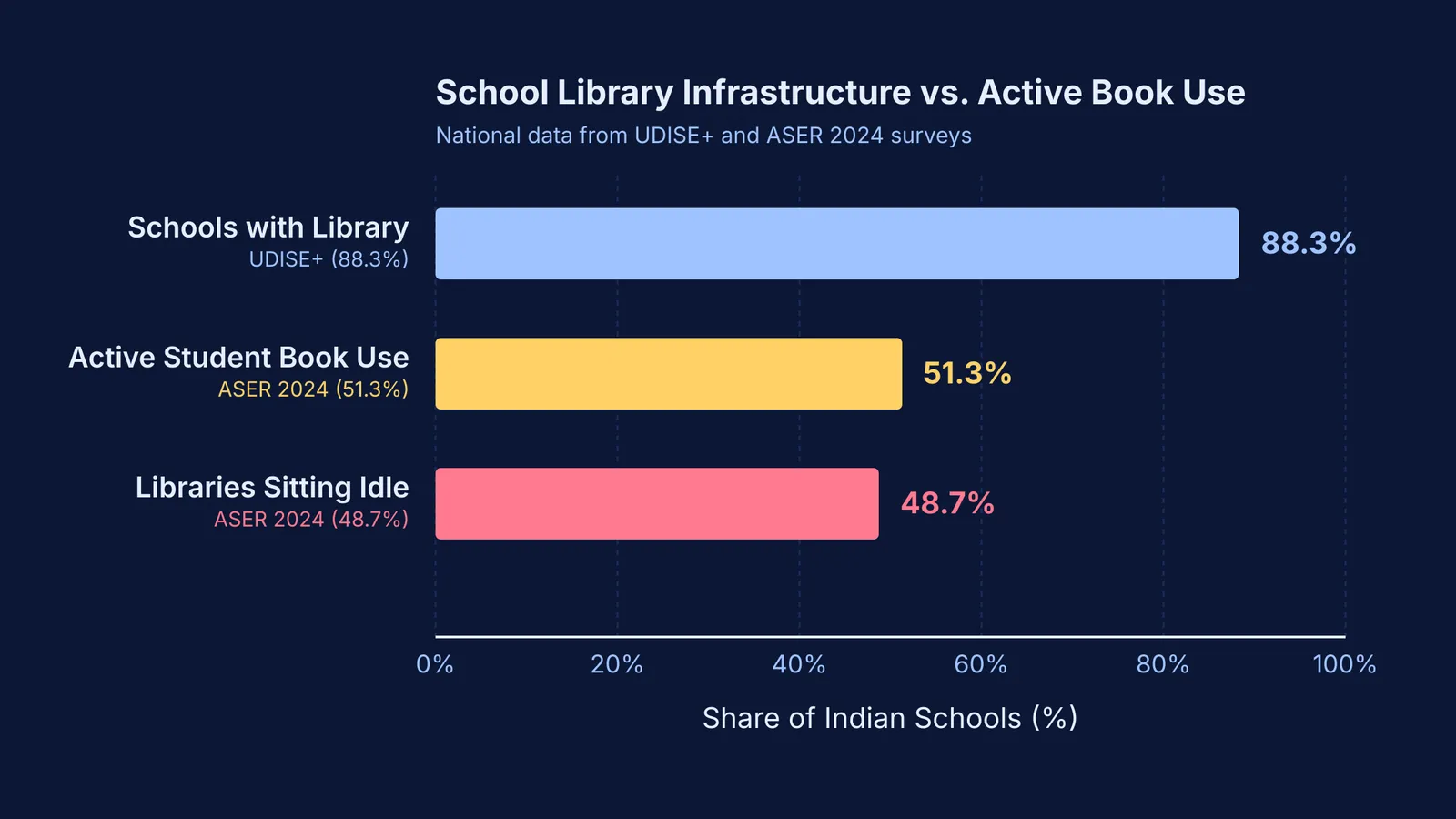
Across India, school libraries are listed on inspection certificates and brochures, but their shelves often remain untouched. National educational data from UDISE+ indicates that 88.3% of schools have a library, book bank, or reading corner. Yet field surveys by the Pratham Education Foundation in the ASER 2024 report found that only 51.3% of schools had non-textbook reading materials actively in use by children. As discussed in our analysis of what ASER 2024 found about school reading habits, children who develop independent reading habits build stronger comprehension across all subjects. When a library functions purely as a showroom, students miss out on a vital free learning resource.
Why do school libraries sit unused?
Most children do not avoid the library because they dislike books; they avoid it because institutional friction makes borrowing difficult. In many secondary schools, designated library periods are frequently reassigned to subject teachers for syllabus completion, test coaching, or substitution. Even when students enter the room, books are often locked behind glass cupboards to prevent loss. A class of 40 to 50 students sharing a single 35-minute period leaves barely 45 seconds per child to browse, select, and stamp a title at the circulation desk.
Punitive policies create another barrier. Many school libraries enforce strict fines for overdue returns or minor wear. Anxious about losing a book or creasing a page, students decide borrowing is not worth the disciplinary risk. Parents often reinforce this hesitation by warning children not to bring school property home. A 2025 survey by the National Literacy Trust revealed that only 32.7% of children aged 8 to 18 enjoyed reading in their free time, with daily reading dropping to 18.7%. When borrowing feels stressful, children retreat to textbooks or screens.
What rights and library rules should parents know?
Under Clause 4.3 of the CBSE Affiliation Bye-Laws 2018, affiliated schools must maintain at least 1,500 books at inception, provide 5 books per student excluding textbooks, and subscribe to 15 magazines. The board mandates that books must be issued regularly to every child, supported by a qualified librarian and a reading room. Furthermore, the CBSE Reading Mission urges institutions to build an active reading culture with open access to supplementary literature.
Decades of educational research demonstrate why physical access to books matters so much. A nationwide study by Keith Curry Lance, Debra E. Kachel, and Caitlin Gerrity in the *Peabody Journal of Education* (DOI: 10.1080/0161956X.2023.2160112) documented stark disparities in school library access, showing that millions of students in under-resourced districts are entirely cut off from certified school librarians. International assessments echo these findings: the OECD PISA 2018 Results (Volume II) found that students who regularly engage in reading for pleasure score roughly 75 points higher on reading assessments than those who rarely read—an advantage equivalent to 2.5 years of formal schooling.
What should you ask at the next parent-teacher meeting?
Parent-teacher meetings are usually consumed by marksheets and syllabus backlogs. However, as outlined in our guide to questions to ask at parent-teacher meetings, asking about the school's reading infrastructure often produces longer-lasting academic benefits. When speaking with the class teacher or school librarian, use these specific questions:
Is our class's weekly library period protected on the timetable, or is it being used for substitution classes and exam revisions?
Can students walk up to open shelves and browse books directly, or are materials kept in locked cupboards?
What is the school's borrowing policy—how many books can my child take home each week, and how many days can they keep them?
What is the process if a book suffers minor wear and tear, and can we agree on simple repairs rather than penalising the child?
How can you help your child build a borrowing routine?
Encouraging your child to borrow starts with removing their fear of getting into trouble. Before sending your child to school with a library card, equip them with practical habits:
First, give them full autonomy over their choices. If your child starts with illustrated science guides, graphic novels, or short biographies rather than classic literature, celebrate that choice. A student who chooses their own book reads with intrinsic curiosity. Second, protect the book physically: place a lightweight zippered cloth sleeve in their backpack to shield borrowed titles from lunch boxes and water bottles. Third, establish a weekly reading rhythm at home, spending 15 minutes discussing an intriguing illustration or idea they brought from school.
When a borrowed book introduces difficult scientific phenomena that are hard to picture—such as orbital mechanics, ray diagrams, or electromagnetic induction—the Fermi Simulation Lab provides interactive simulations for ideas that are easier to see than to read. And as your child's interests widen across disciplines, the Fermi Concept Library maps every concept in physics, chemistry, biology, mathematics and computing, each with its own lesson and its place in the map.
Encouraging your child to borrow from their school library turns a quiet room of shelves into a personal gateway to independent learning.


