On this page
The transition from the kitchen table to a school desk is a significant change for any child. Moving from a flexible, parent-led environment to a structured classroom of thirty students requires mastering new skills, from navigating large peer groups to adjusting to a strict timetable.
However, moving between systems is more common than many families realise. With the right preparation and understanding of the challenges ahead, you can make the shift a positive educational experience for your child.
Is it normal to switch from homeschooling to school?
Yes, for many families, homeschooling is a specific phase rather than a permanent path through to graduation. The "once homeschooled, always homeschooled" belief is largely a myth that does not reflect modern educational trends.
According to the 2023 Cardus Education Survey, about 36% of adults who were ever homeschooled learned at home for only one or two years (Cardus). On average, these individuals spent over eight years in traditional public schools. This data shows that transitioning back into the conventional system is a standard part of many students' educational journeys, often driven by a child's changing academic needs, a desire for extracurricular activities, or shifts in family circumstances.
How can we prepare for the classroom routine?
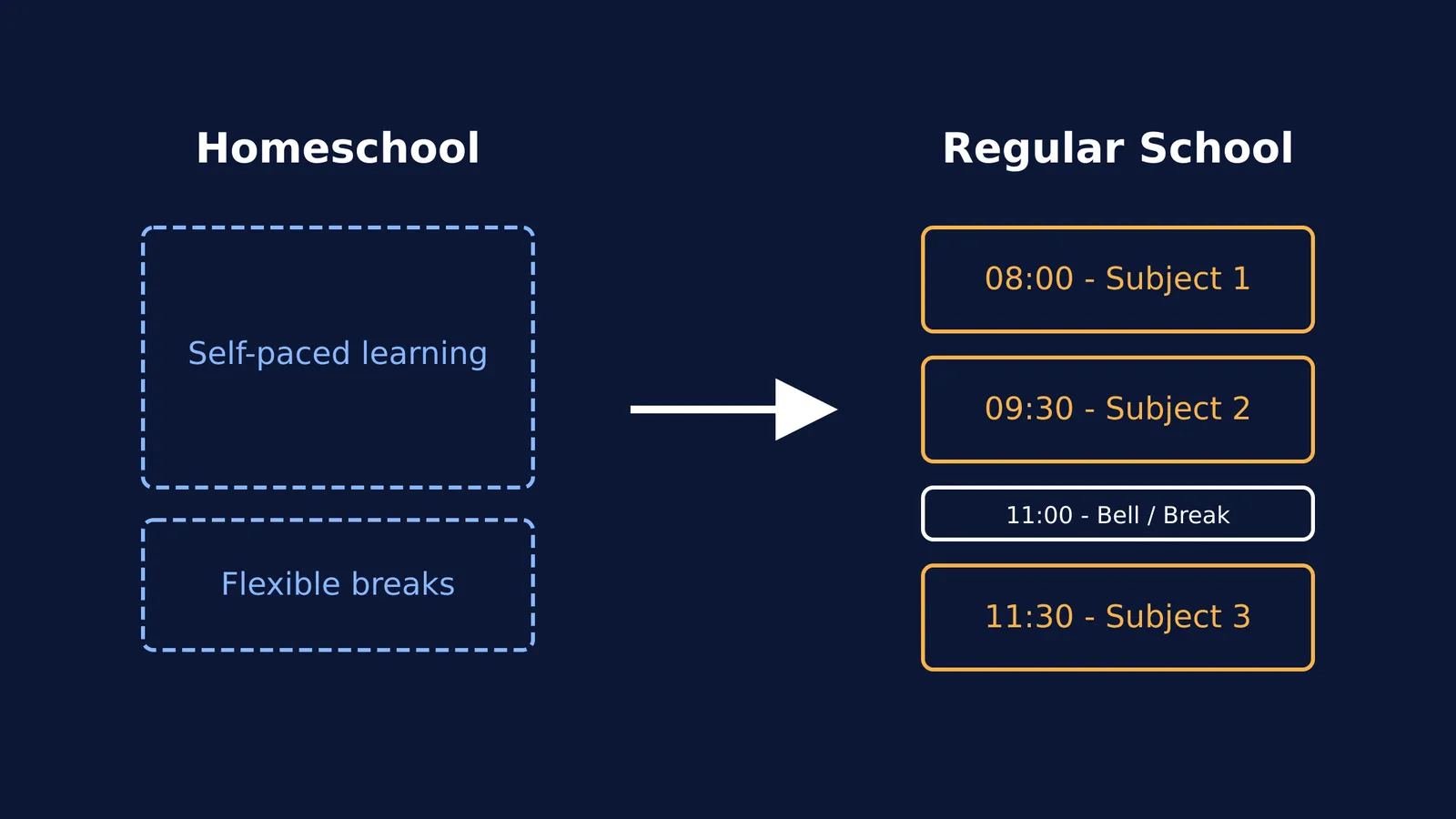
The most immediate hurdle for a transitioning student is often the loss of autonomy. At home, a child might have the freedom to follow their own pace, spend extra time on a fascinating project, and move between subjects organically. In a regular school, they must adapt to the rigid structure of the bell schedule, sitting still for longer periods and switching subjects exactly when the teacher says so.
To ease this shock, parents can simulate the school routine a month before the term begins. Introduce set times for reading, independent work, and breaks. You can read more about setting up these structures in our guide on routines that help the whole family.
Why does the math gap happen?
Research highlights specific academic areas where homeschooled students might face challenges during a transition, particularly in mathematics. While students often enter school well-prepared in reading and humanities, math can sometimes present a stumbling block.
The Coalition for Responsible Home Education reports that while homeschooled students often excel in reading, they can sometimes lag behind their traditionally schooled peers in mathematics, particularly in computation (CRHE). A key factor is parental confidence: as math becomes more complex, parents often find it harder to teach topics like algebra or calculus compared to literature.
Furthermore, transitioning students are used to immediate, one-to-one feedback. In a classroom, a teacher cannot always pause to help a single student who is stuck on a difficult equation. This is a good time to introduce tools that build independent problem-solving. The Fermi Problem Library has worked problems with a step-by-step solver that explains the reasoning rather than printing an answer. If they get stuck on homework, Fermi's AI tutor works out what they already know, builds a plan for the session, and teaches through it — writing on a board, drawing the figure, running the simulation, and checking understanding as it goes.
This approach aligns with Choice and autonomy: parenting that builds real motivation, allowing the child to take ownership of their learning while knowing help is available if they need it.
How do homeschooled students adjust to peers?
Social adjustment is often a parent's biggest concern when moving their child to a regular school. While studies show homeschooled children generally have strong social skills and often engage deeply in their communities, the specific dynamics of a classroom are unique.
A homeschooled child must quickly learn the "unwritten rules" of a school environment. This includes raising their hand to speak instead of just talking, working effectively in assigned groups, and navigating noisy hallway transitions between classes. Encourage your child to ask their teachers and peers for help rather than immediately solving the problem for them, fostering the independence they will need to thrive in a larger group.
Read our guide on when to help with homework and when to step back for more on building this independence at home.