

On this page
Why are car journeys such effective spaces for science talk?
Long drives create a distinct physical environment for conversation. Family members sit closely together for hours, facing forward toward the road rather than confronting each other across a desk or dinner table. Psychologists describe this shared orientation as the side-by-side effect: because children are not under direct eye contact, conversations feel less like an oral test.
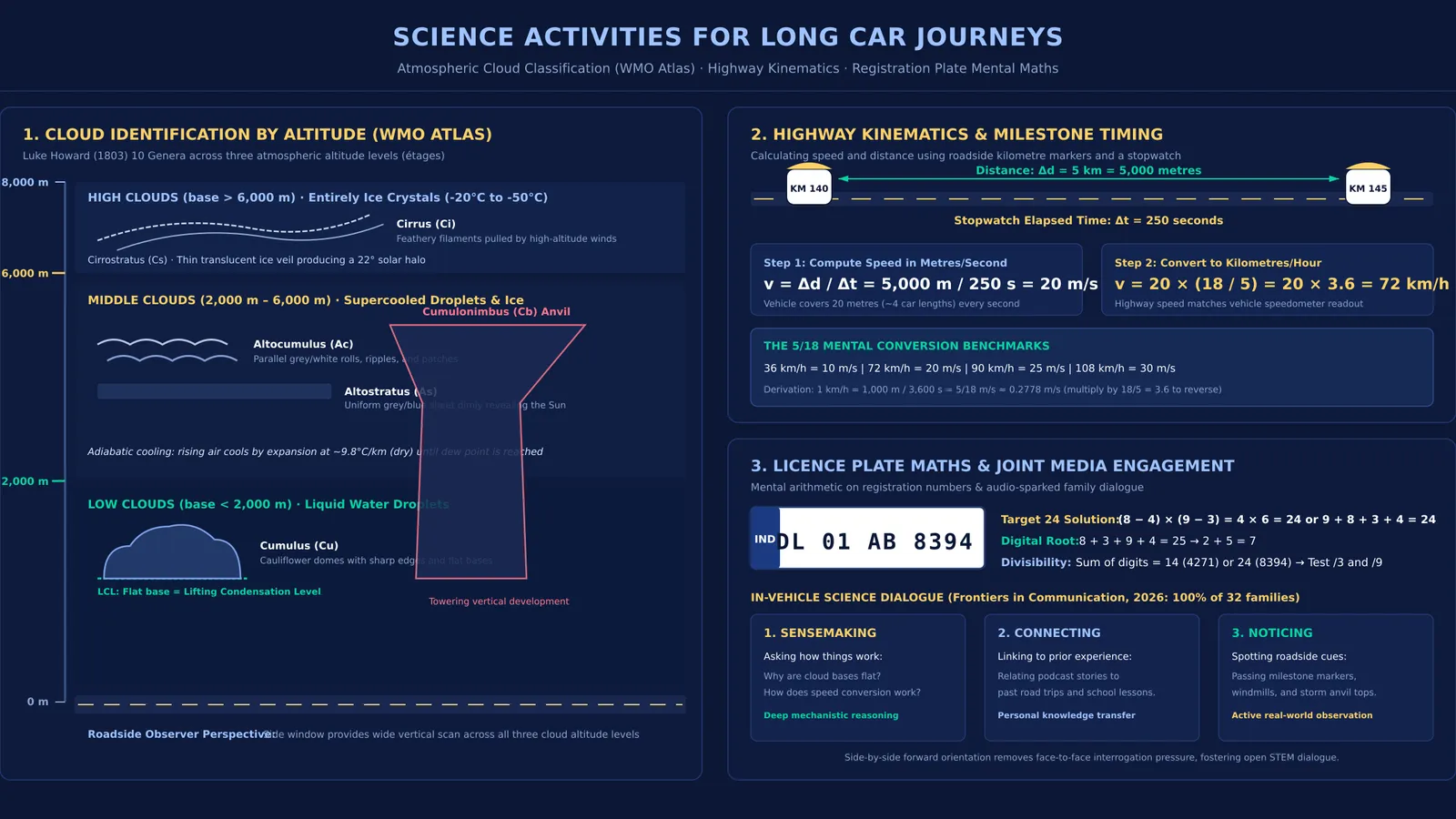
The National Research Council report on informal environments notes that everyday family dialogue helps children link scientific ideas to the world around them. In a 2026 study in *Frontiers in Communication*, researchers investigated in-vehicle learning across 32 families using video and audio tracking. They found that 100% of families engaged in spontaneous science talk when listening to shared audio media. These interactions fell into three categories: sensemaking (asking how mechanisms work), connecting (linking ideas to personal experience), and noticing (pointing out features passing outside the car).
How can you turn licence plates into mental maths games?
Passing vehicles offer an endless stream of four-digit numbers on registration plates. Engaging with these numbers sharpens mental arithmetic and number sense. In a landmark study published in *Science*, researchers found that children whose families engaged in brief mathematical talk at home gained the equivalent of three months of additional maths achievement over the school year compared to peers in a reading control group.
You can adapt several structured number games to the car window:
Target 24: Combine all four digits on a registration plate using addition, subtraction, multiplication, or division to equal 24. For plate 8394, compute (8 − 4) × (9 − 3) = 24, or 9 + 8 + 3 + 4 = 24.
Divisibility check: Call out a four-digit plate number and test divisibility rules. For plate 4271, the sum of the digits is 4 + 2 + 7 + 1 = 14, meaning it cannot be divided evenly by 3 or 9.
Prime or composite: Ask whether a two-digit number is prime. For instance, 73 is prime, whereas 91 is composite because 7 × 13 = 91.
Digital root race: Add all four digits repeatedly until a single digit remains. For plate 7846, 7 + 8 + 4 + 6 = 25, and 2 + 5 = 7.
These quick calculations demonstrate practical maths in daily life without requiring paper.
How do you identify cloud types from the car window?
Looking out of the side window gives passengers an unobstructed view of the sky. Cloud classification rests on the system introduced by Luke Howard in 1803 and codified by the World Meteorological Organization International Cloud Atlas. The WMO groups clouds into 10 basic genera across three altitude levels (étages):
High clouds (base above 6,000 metres): Composed entirely of ice crystals. Look for *Cirrus* (feathery, hair-like filaments blown by jet streams), *Cirrocumulus* (small ripples or grains), and *Cirrostratus* (a thin veil producing a 22-degree halo around the Sun).
Middle clouds (base between 2,000 and 6,000 metres): Composed of water droplets and ice particles. *Altocumulus* forms grey or white rolls and patches, while *Altostratus* produces a uniform grey sheet that dims the Sun.
Low clouds (base below 2,000 metres): Look for *Cumulus* (fluffy heaps with sharp outlines and flat bases marking the condensation level) and *Stratocumulus* (low rolling layers). Towering cumulus with anvil tops become *Cumulonimbus*, signalling thunderstorms.
Discussing why cloud bases are flat lets you introduce condensation and cooling. Students wanting to explore atmospheric pressure and thermodynamics can follow lesson maps in the Fermi Concept Library.
Which highway physics games teach speed, time, and distance?
Highway journeys provide a real-world setting for kinematics and estimation games. In India, National and State Highways feature concrete milestone markers every 1 kilometre, giving a reliable roadside distance gauge.
To turn milestones into a physics challenge:
Note the kilometre marking on a milestone (such as km 140) and start a stopwatch.
Stop the timer when the vehicle passes five markers ahead (km 145).
If the vehicle travels 5 km in exactly 250 seconds, find average velocity: v = d / t = 5,000 m / 250 s = 20 m/s.
Multiply 20 m/s by 18/5 to get speed in kilometres per hour: 20 × 3.6 = 72 km/h.
Practising converting km per hour to m per second helps students visualise motion as concrete spatial intervals. Back home, students can test relative velocity and motion in the Fermi Simulation Lab, which provides interactive simulations for ideas that are easier to see than to read.
What science podcasts should families listen to on road trips?
Audio shows provide an engaging anchor that gets the whole car thinking together:
IndiaAsksWhy: Supported by IndiaBioscience, hosts Shweata N. Hegde and Ruchi Manglunia follow characters Utsuka and Jigyasa as they interview Indian scientists about everyday phenomena, from why monsoons smell earthy to how geckos climb walls.
Brains On!: Produced by American Public Media, this podcast pairs kid co-hosts with scientists. Its signature Mystery Sound segment challenges listeners to identify unfamiliar audio clues.
Smash Boom Best: A debate show that teaches critical thinking by comparing two ideas (such as Bats versus Birds or Lava versus Quicksand).
Tumble Science Podcast for Kids: Explores how scientists make discoveries, interviewing researchers across astronomy, palaeontology, and biology.
Rotating between a thirty-minute podcast episode, a registration plate maths round, and cloud spotting turns travel time into active family inquiry.


