On this page
Your elder child has started JEE or NEET coaching. The fee is the biggest line in the family budget, and your younger child has noticed: the new books, the cab money, the hushed talk about instalments. They may not ask, but they are drawing conclusions. A short, honest conversation now stops them from deciding on their own that they matter less.
Why does the younger child need an explanation at all?
Children notice when a sibling gets more, and if nobody explains why, they fill the gap themselves.
In a 2002 study in the Journal of Family Psychology, Amanda Kowal and colleagues interviewed 135 children and their older siblings separately about how parents shared affection and control. Children who saw preferential treatment as fair had higher self-esteem and fewer internalising problems.
A 2004 study by the same team in 74 families found that unequal treatment was linked to poorer parent-child relationships only when teenagers judged it unfair. The authors encouraged families to discuss their understanding of these differences. Both studies looked at affection and control rather than money, but the lesson carries over: your job is not to make spending equal but to make it understandable.
How much more does coaching cost at the senior stage?
It helps to know the numbers before you explain them. The government's Comprehensive Modular Survey: Education 2025, which covered 57,742 students in 52,085 households, found that 27.0% of students were taking or had taken private coaching that year.
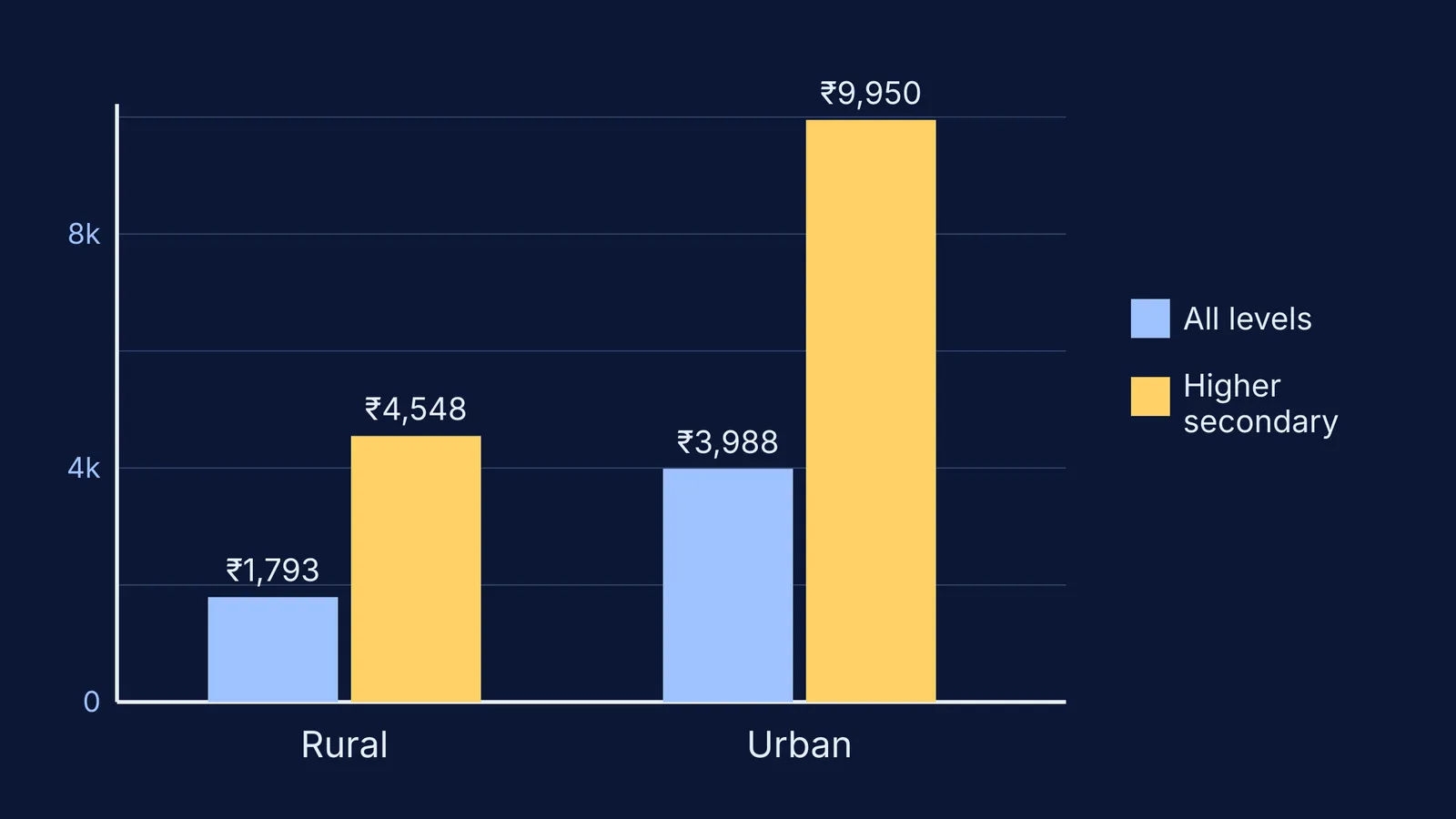
The same survey found that average coaching spending rises with each stage of school, from ₹525 a year for pre-primary to ₹6,384 for higher secondary nationally. In urban areas the higher-secondary average was ₹9,950 a year, against ₹3,988 per urban student across all levels (PIB, 26 August 2025). These are averages across all kinds of coaching, so your own bill may be very different.
This gives you a neutral, true sentence for your younger child: it costs more because of the stage, not because of the person.
What should you say to the younger sibling?
Keep it short, say it once properly, and leave room for questions. Adjust the words to their age.
Under 10: "Didi's classes cost a lot right now because she has a very big exam. When you're in Class 11, we'll look at what you need too."
10 to 13: "Coaching gets expensive in Classes 11 and 12, for every family. We're spending more on Bhaiya this year. That doesn't mean we care about him more. Your turn will look different, and we'll plan it with you."
Teenagers: Share the rough picture: what it costs, what you have cut back on, and what you have set aside for them. If you can, bring them into the family budget conversation.
Only promise what is true. If you cannot fund the same coaching later, say "we'll find the right support for you" rather than "you'll get the same".
Here is how that can sound in practice. Meera's family pays for her NEET coaching in Class 11. Her brother Kabir, 11, asks why he can't join a cricket academy. Their parents explain the cost is tied to Meera's exam year, then add three things: a fixed Sunday hour that is just Kabir's, a cheaper weekend cricket club this year, and a note on the family calendar to revisit the academy when Meera finishes Class 12. Kabir hears no, but also hears when and why.
How do you keep it fair without spending the same?
Use this checklist once a month:
Does the younger child have one regular slot of your undivided time?
Are their events (school play, match, results day) on the family calendar alongside coaching tests?
Have you avoided saying "we're spending so much on you" to the elder child? Using cost as pressure can leave one child feeling guilty and the other resentful.
Can the younger child ask about money without being shushed?
Is there a date when you will plan their own next stage?
If the siblings are already comparing marks, this guide to sibling rivalry over marks has scripts for that too. For the elder child's side of the conversation, see how to tell your child what coaching costs.
The younger child may want something to learn on their own terms. Fermi's Concept Library has every concept in physics, chemistry, biology, mathematics and computing, each with its own lesson, so a curious child can explore an idea at their own pace.
What if one child stays upset?
Some hurt is normal. If a child seems withdrawn, stops eating or sleeping well, or the elder child talks about being a burden, speak to their school counsellor or a doctor. You can also call Tele MANAS on 14416, the government's toll-free, 24x7 mental health helpline.
This week, pick a quiet moment and have the five-minute version of the conversation with your younger child.