

On this page
Why should you tell children about a parent's job loss?
When a parent loses a job, an instinctive reaction is silence. Parents often hope to shield their children from adult stress by keeping layoffs and financial belt-tightening behind closed doors. Developmental psychology demonstrates that secrecy usually backfires. Children are observant emotional detectives who notice changed expressions, hushed conversations, and household tension long before anyone explains why.
Without facts, children construct their own explanations. The American Psychological Association notes that when families keep financial shocks hidden, children fill the vacuum with worst-case fears or self-blame—worrying a recent mistake or purchase caused the crisis. Honest, age-appropriate communication dispels these fears. As explored in our guide on teaching children the value of money by age, kids understand financial realities best when explained with calm clarity and steady boundaries.
How do you explain job loss to children by age?
A constructive conversation does not require disclosing bank balances or mortgage debts. Instead, tailor the message to your child's developmental stage:
Young children (ages 4 to 7): Keep explanations brief and concrete. Avoid confusing metaphors like "I lost my job" (which makes a child wonder why you cannot just find it) or "I got fired." Instead, say: *"My work at that office ended this week, so I will be home more often while I look for a new company. You are safe, our food and home are secure, and we are fine."*
Middle childhood (ages 8 to 12): School-age children understand money basics but worry about peer standing or halted activities. Say: *"My company had to downsize and eliminated my position. It is nobody's fault. We will be thoughtful with extra spending for a few months, like cutting takeout, but school and our home life will stay steady."*
Teens (ages 13 to 18): Adolescents understand economic cycles but worry about college or exam fees. Treat them as family partners without making them emotional caretakers. Say: *"I was laid off yesterday because of company restructuring. We have savings to cover essentials for several months, and I am applying for new roles. We will pause big luxury purchases for now, and your main job is to keep focusing on school."*
How does parental job loss affect school performance?
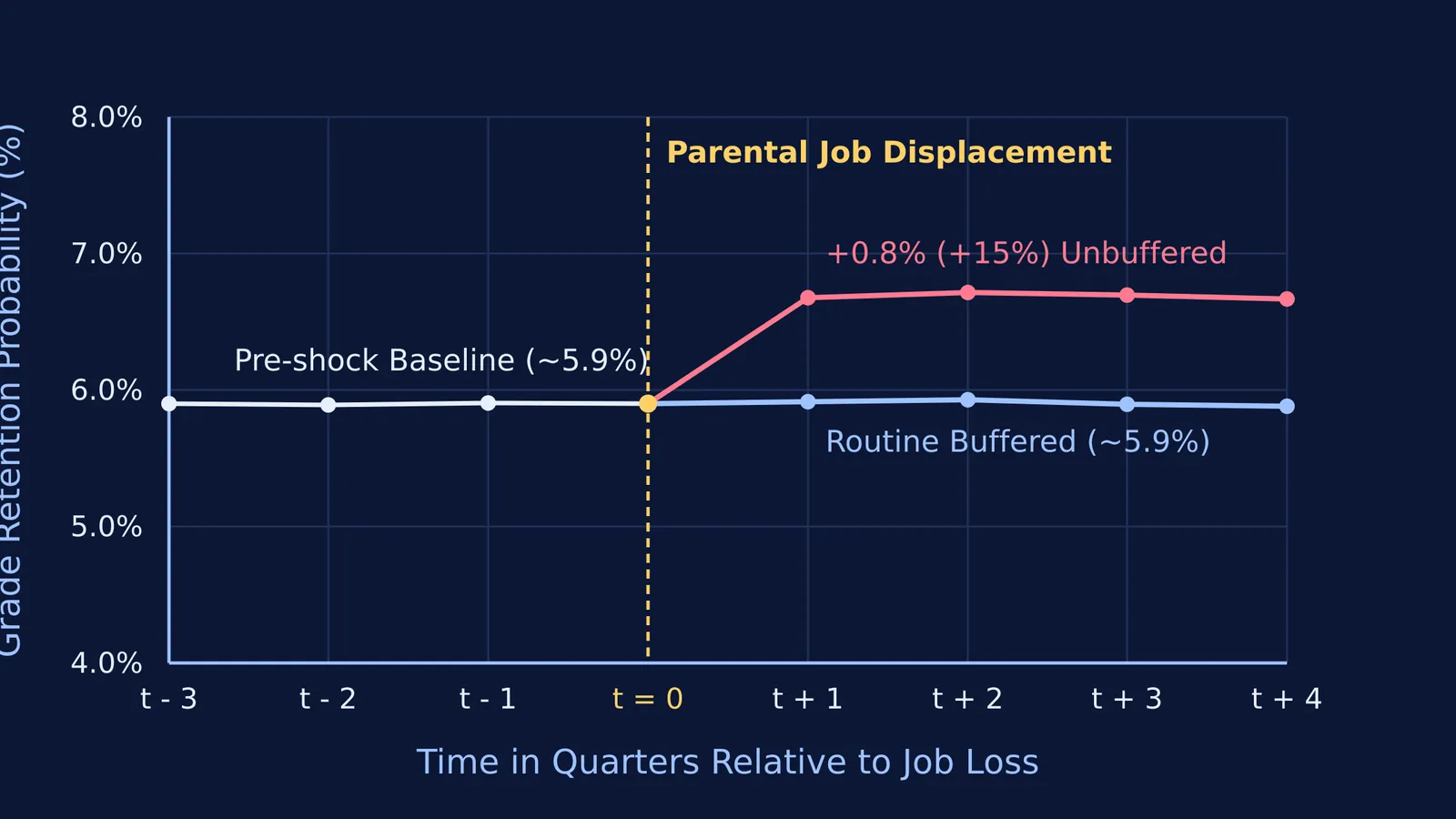
Parental unemployment affects children through emotional and structural pathways rather than simple financial changes. An empirical study by Ann Huff Stevens and Jessamyn Schaller in the *Economics of Education Review* found that parental job displacement increases the probability of a child repeating a grade by 0.8 percentage points—a roughly 15% increase in grade retention risk. By tracking the same children over time using child fixed effects, the authors showed the academic dip was triggered directly by the employment shock rather than prior school difficulties.
The mechanism behind this pattern is mapped by the Family Stress Model, described by Rand D. Conger and Katherine J. Conger in the *Journal of Marriage and Family*. Economic pressure elevates parental anxiety and depression, which can spill over into inconsistent homework monitoring, irritability, and disrupted daily schedules. When home routines dissolve, a child's cognitive focus and school stamina drop.
How can you protect your child's daily study routine?
Longitudinal research confirms that predictable family schedules serve as a powerful protective buffer. When daily habits remain steady, children retain the felt security needed for academic focus:
Keep wake, meal, and study hours identical. Even if an unemployed parent stays home, keep morning routines, study blocks, and bedtimes strictly consistent.
Engage school administration early. If term fees or exam charges present an obstacle, speak privately with the school principal or accounts office to arrange monthly installments or fee deferrals before dues lapse.
Audit academic expenses collaboratively. If expensive coaching or private tutoring must pause, discuss the transition calmly, as outlined in our guide on re-evaluating coaching and tuition together.
Shift to high-quality free learning tools. Pausing paid classes does not mean halting academic momentum. Free resources like the Fermi Concept Library (covering every concept in physics, chemistry, biology, mathematics and computing) and the Fermi Problem Library (featuring a step-by-step solver that explains the reasoning rather than printing an answer) let students maintain structured study at home without financial strain.
Just as with keeping study routines steady during family disruptions, maintaining an unwavering daily study block reassures children that their future remains secure.
When should parents seek outside guidance or support?
If a child shows persistent emotional withdrawal, changes in study enthusiasm, or dropping school engagement, reaching out to a school counsellor or class teacher provides practical academic support. Coordinating with the school ensures teachers understand the family's transition and can maintain a stable, encouraging environment in the classroom.
Parents also benefit from emotional support, because children absorb household tension. In India, parents navigating career stress and anxiety can access free, confidential 24/7 psychosocial support through the national Tele MANAS helpline by dialling 14416 (or 1800-891-4416). Taking time to process changes constructively helps parents model resilience and return to their children with calm reassurance and steady leadership.


