On this page
If your child can tell you every team's position on the IPL points table but groans at a page of fractions, you have a ready-made lesson. Net run rate (NRR), the small decimal beside the points, uses fractions, averages, decimals and negative numbers at once, and your child already cares about the answer.
What is net run rate, in words a child can follow?
Start with the official wording. The ICC Men's T20 World Cup 2026 playing conditions (clause 16.10.7) say a team's net run rate is its average runs per over scored, minus the average runs per over scored against it.
In kid language: how fast did we score, minus how fast did they score against us? Positive means you scored faster than your opponents overall.
Points still come first. Under those ICC playing conditions, a win earns 2 points, a tie or no result 1, and a loss 0. In May 2026, The Telegraph's t2 reported Kolkata Knight Riders on 11 points from 12 IPL matches with an NRR of -0.038; it notes that teams level on points are split by wins, then NRR. Ask your child to check the points: 5 wins and 1 no result give 5 x 2 + 1 = 11.
How do you calculate net run rate step by step?
Use a made-up team, Team A, in three 20-over matches:
Match 1: Team A score 180 in 20 overs. The opponents reply with 160 in 20 overs. Team A win.
Match 2: The opponents score 150 in 20 overs. Team A chase it down, 151 in 16.4 overs.
Match 3: Team A are all out for 120 in 15.2 overs. The opponents get 121 in 12 overs. Team A lose.
Now work through it together:
Add the runs Team A scored: 180 + 151 + 120 = 451.
Add the overs Team A faced: 20 + 16 4/6 + 20 = 56 2/3 overs. The all-out innings counts as 20 overs, not 15.2.
Runs per over scored: 451 / 56 2/3 = 7.959.
Add the runs conceded: 160 + 150 + 121 = 431, off 20 + 20 + 12 = 52 overs.
Runs per over conceded: 431 / 52 = 8.288.
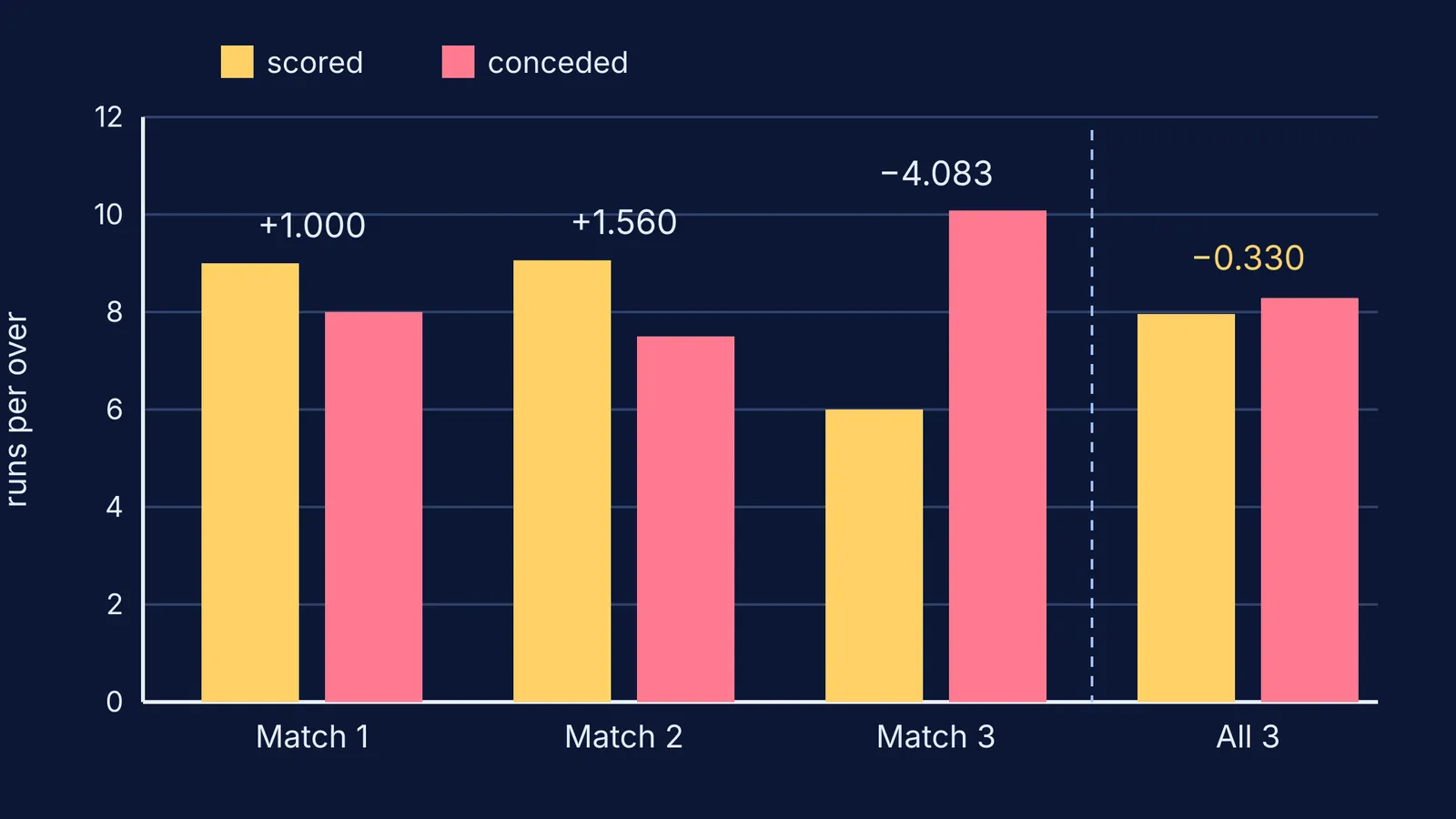
NRR = 7.959 - 8.288 = -0.330.
Two wins from three games, and still a negative NRR. One heavy defeat cost more than the two wins earned.
Why does 16.4 overs not mean 16.4?
This is the decimal trap. An over has six balls, so each ball is 1/6 of an over, even though scorecards write it as ".1" (Wikipedia's net run rate entry explains the notation). So 16.4 overs means 16 overs and 4 balls, which is 16 4/6, or about 16.667 overs.
Divide 151 by 16.4 and you get 9.207 runs per over; divide by the correct 16 2/3 and you get 9.060.
The second trap is the all-out rule. The ICC playing conditions say that a team all out in less than its full quota is charged the full quota of overs, not the overs it actually batted. So Team A's 120 counts as 120 / 20 = 6.000 runs per over, not 120 / 15 1/3 = 7.826. Ask your child why: without it, collapsing early could push a scoring rate up.
Why is NRR not the average of each match's run rate?
This is the averages lesson. Work out each match on its own: +1.000, +1.560 and -4.083. Their simple average is -0.508, not -0.330. As the Wikipedia entry notes, tournament NRR is usually not the average of the individual match NRRs.
The ICC method pools all runs and overs first, so longer innings weigh more. It is the same idea behind why average speed for a round trip is not the average of the two speeds.
How do you turn tonight's points table into a 15-minute maths session?
Pick two teams close together on points. Write down their last match scores from the scorecard.
Your child converts every overs figure with balls into a fraction (4 balls = 4/6 = 2/3).
They work out each team's runs per over for that match, rounding to three decimals the way the table does.
They predict, without a calculator, whether each team's NRR went up or down.
Check the updated table next morning.
What to say when they get it wrong: "Show me which number you divided by." Most slips in this exercise come from the overs, not the division. If a fraction such as 56 2/3 feels shaky, the Fermi Concept Library has a lesson on every mathematics concept, so they can go back to fractions and return to the cricket.
If it turns into a homework fight, try these four changes for a child who hates maths homework. For more, see using cricket to teach your child maths and statistics.