On this page
Fractions are often the first place where maths stops working like counting, so they deserve patient time at home. In a 2012 study of large US and UK data sets, primary school children's knowledge of fractions and division predicted their algebra and overall maths in high school, 5 or 6 years later, even after accounting for general ability and family background. More in what the fractions and algebra study found. All you need is a roti, some paper and a pencil.
What does a fraction actually mean?
A fraction such as 3/4 is one number: the bottom number says how many equal parts the whole is cut into, and the top number says how many of those parts you have.
The word "equal" matters: a roti torn into four ragged bits is not cut into quarters. A fraction also has its own place on the number line; it is not two whole numbers stacked up. The US Institute of Education Sciences (IES) practice guide on fractions says to help students recognise that fractions are numbers and that they expand the number system beyond whole numbers.
How do you show fractions with food, paper strips and a number line?
The same IES guide recommends building on children's informal understanding of sharing and using number lines as a central tool from the early grades. So: food first, then strips, then a line.
Share food fairly. Share one roti between two people, then four. Ask, "Is that fair? How do you know?"
Fold paper strips. Cut five equal strips along the long side of A4 paper. Keep one whole. Fold one in half, one in half twice (quarters), one in half three times (eighths), and the last into three equal parts like an S. Label every piece.
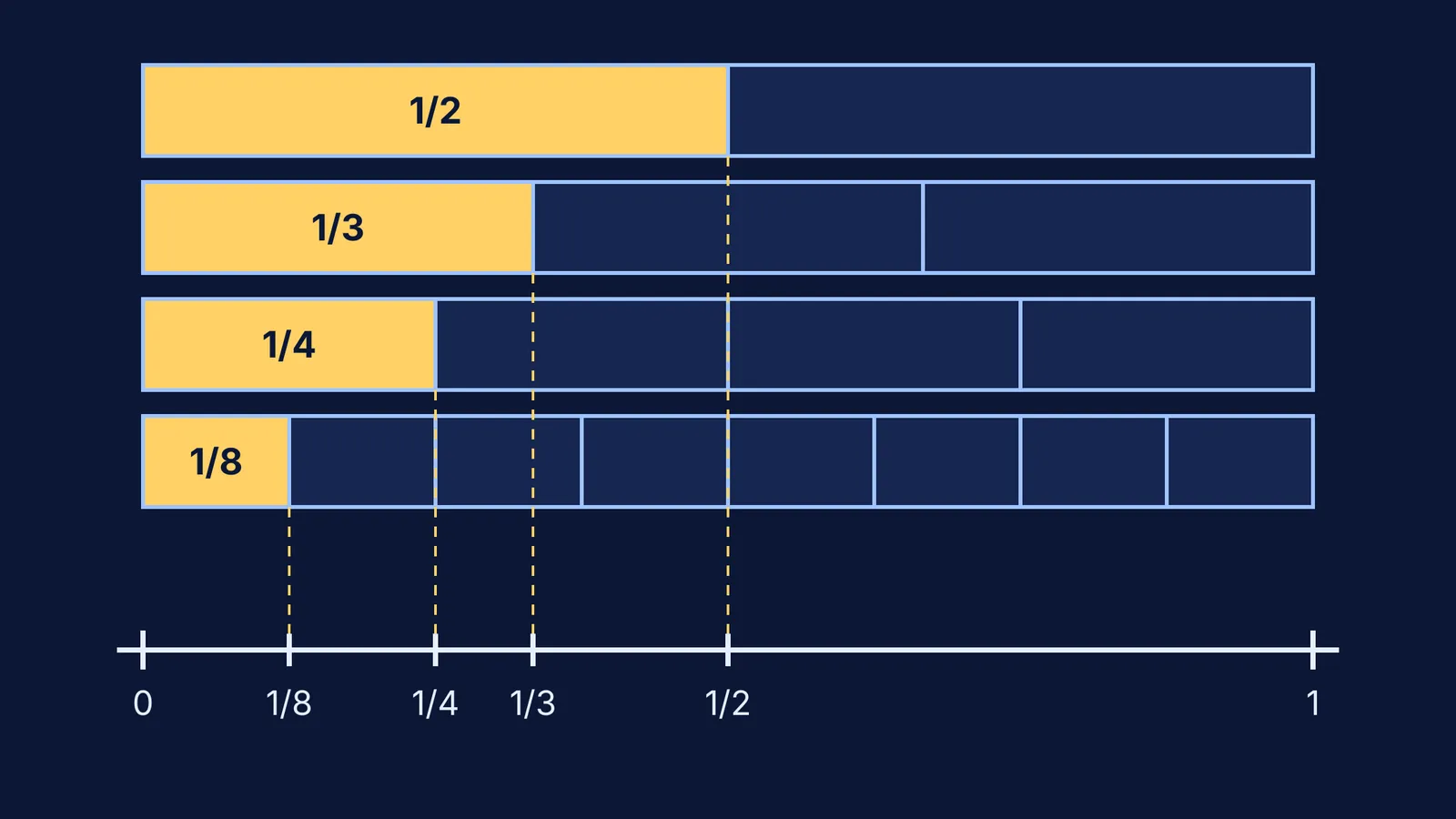
Stack the strips. Lay them one under another, left edges lined up. This "fraction wall" shows that 2/4 covers the same length as 1/2, and that 1/8 is the smallest piece.
Draw a number line. Make it exactly as long as a strip, with 0 at the left and 1 at the right. Mark where each strip's first piece ends. Now 1/4 is a point on the line, just like 3 or 7.
How do you compare fractions like 1/3 and 1/4?
Keep the strips out and let your child predict first.
1/3 or 1/4? Same top number, so ask which piece is bigger. Cutting into more pieces makes each piece smaller, so 1/3 is bigger. The strips agree.
3/4 or 2/3? Each is one piece short of a whole. 3/4 is missing a quarter; 2/3 is missing a third, which is the bigger gap. So 3/4 is bigger.
3/8 or 1/2? Use half as a landmark. Half of 8 is 4, so 1/2 is the same as 4/8, and 3/8 is a little less than half.
Ask "How do you know?" every time. A reason said aloud is worth more than a correct guess.
What are the common fraction mix-ups to watch for?
Researchers call the main trap "whole number bias": using what is true of whole numbers to reason about fractions. Florence Gabriel and colleagues, who tested 439 pupils in Grades 4 to 6 in Belgium, describe typical errors such as judging 1/5 bigger than 1/3 because 5 is bigger than 3. In their own tests, the most common mistake was adding tops and bottoms, so that most pupils answered 3/4 + 2/5 with 5/9. 62% of Grade 4 pupils made this kind of error when adding or subtracting fractions with different denominators, and 22% still did in Grade 6.
Watch for these, with a quick fix for each:
"Bigger bottom number, bigger fraction." Go back to the roti: sharing with more people means a smaller piece each.
Adding tops and bottoms. Ask whether 1/2 + 1/2 can be 2/4. Two halves make a whole strip, and 2/4 is still only half.
Unequal pieces. If the parts are not the same size, they are not quarters or thirds, even if there are four or three of them.
"Fractions are always less than 1." Put two whole strips end to end and find 5/4 on a longer line.
If simple number ideas stay confusing for many months, talk to the class teacher.
What does a short plan at home look like?
Keep each session short, and stop while it is still fun:
Day 1: share food and talk about equal parts.
Day 2: fold the strips and build the fraction wall.
Day 3: place 1/2, 1/3, 1/4 and 1/8 on the number line.
Day 4: do the three comparisons, with reasons out loud.
If maths makes you uneasy yourself, see parents' maths anxiety and what to do about it. For the school version, read our guide to equivalent fractions and comparing them in Class 6. Older children who want a second explanation can try the Fermi Concept Library, where each mathematics concept has its own lesson.
Start tonight with one roti and one question: "Is that fair?"