On this page
Your Class 10 daughter is good at maths. Your Class 5 son is stuck on fractions. Asking her to "just sit with him" seems obvious, and it can work well. It can also end in tears and a slammed door. What decides it is usually how the sessions are set up, not how much the elder child knows.
Does an elder sibling teaching maths actually help?
A 1982 meta-analysis of 65 school tutoring programme evaluations found that tutored students outperformed control students on exams, and the tutors also gained a better understanding of the subject. The Education Endowment Foundation's 2018 Teaching and Learning Toolkit rated peer tutoring at about five months of extra progress, for very low cost, based on extensive evidence. Those figures come from organised programmes in schools, not living rooms, so read them as a sign of what is possible rather than a promise.
The elder sibling gains too. In a 2023 research overview, Logan Fiorella of the University of Georgia reports that a review of 28 studies found a medium average benefit (d = .5 to .6) when students both prepared to teach and actually taught. The same overview describes experiments by Fiorella and Richard Mayer in which college students who actually taught a lesson on video did best on a delayed test. We go deeper in learning by teaching: what the studies show.
Why keep sibling maths help optional and short?
Pressure can cancel out the benefit. Fiorella's overview mentions a study in which students did not gain from preparing to teach, likely because they reported high anxiety at the prospect of teaching. So ask the elder child; don't assign them.
The younger child's feelings matter just as much. A study of first and second graders found that when parents were more anxious about maths, their children learned less maths over the school year and ended it more anxious, but only when those parents helped with maths homework often. That study looked at parents, not siblings, but the lesson plausibly carries over: frequent help from a tense helper can backfire. If maths worry runs in your family, read what research found about parents' maths anxiety.
What ground rules keep sibling tutoring kind?
Agree these as a family before the first session:
Either child can say "not today", no questions asked.
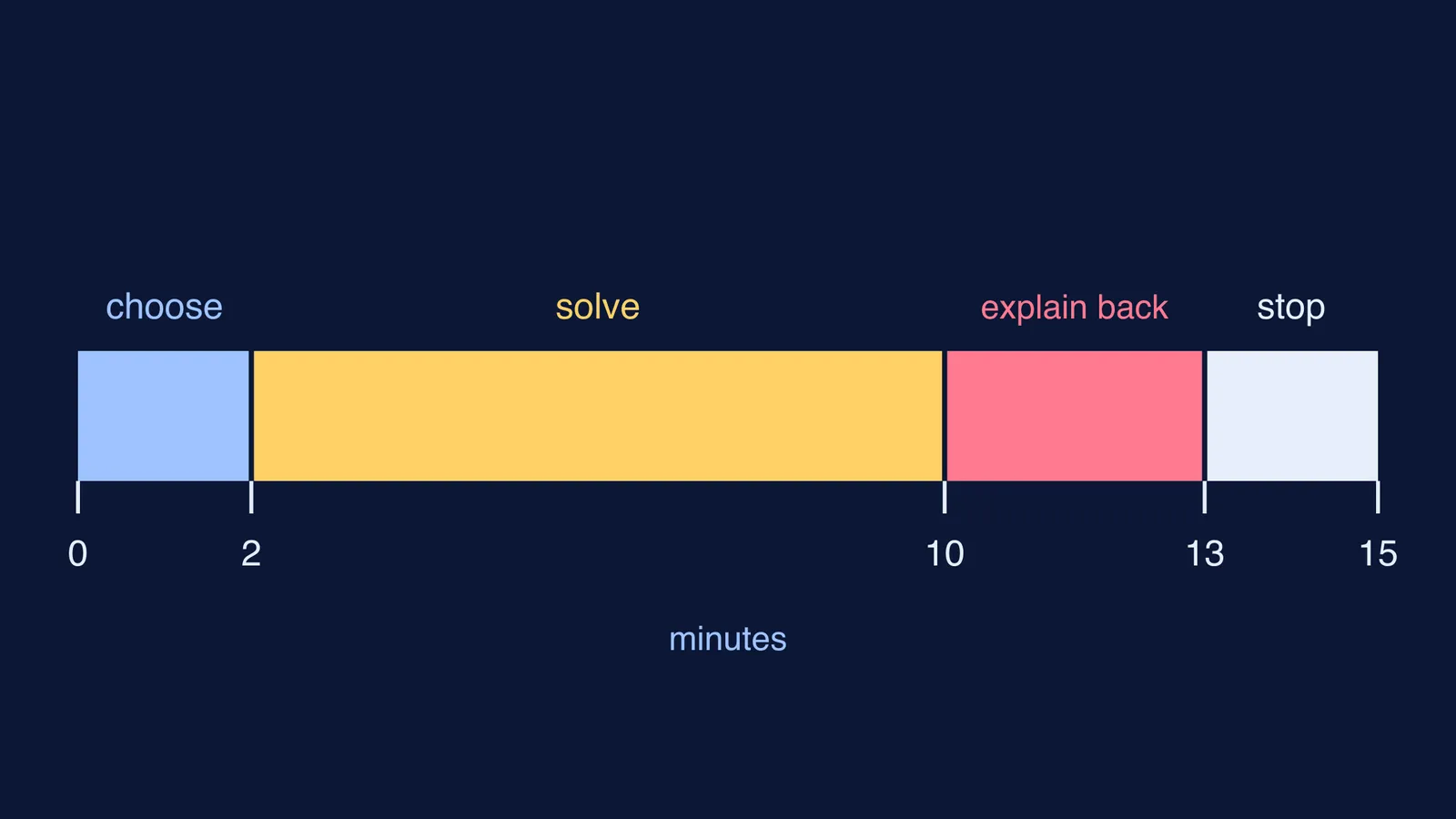
Sessions last 15 minutes on a timer and stop when it rings.
The younger child holds the pencil. The elder one asks and points but does not write the answer.
No comparisons: no "I did this in Class 4", no talk of marks.
Mistakes are called "interesting", never "silly".
Parents still check homework; the sibling is only a helper.
The elder child's own study time comes first, especially in board exam years.
What does a 15-minute session look like?
A worked example with a Class 5 question: "Which is bigger, 3/4 or 2/3?"
Minutes 0 to 2, choose: the younger child picks one homework question that felt hard.
Minutes 2 to 10, solve: the elder sibling asks rather than tells. "What does 3/4 look like as a picture?" "Can you draw both as bars of the same length?" "What could you change so the pieces are the same size?" The younger child draws, shades, and finds 9/12 and 8/12.
Minutes 10 to 13, explain back: the younger child explains the answer to the elder one without looking at the working.
Minutes 13 to 15, stop: each says one thing that went well. Timer off, even mid-flow.
Those step 2 questions help the elder sibling too. Research summarised by Fiorella found that tutees rarely ask deep, conceptual questions, and students asked to explain often just restate or summarise the material, so a few prepared "why" questions make the session better for both.
What should the elder sibling say when it gets tense?
Lines that keep things calm:
"Show me how you started." (instead of "That's wrong.")
"Which part is fuzzy, the first step or the last?"
"Let's draw it."
"I got this wrong lots of times too."
"Good place to stop. We'll try one more tomorrow."
If the elder sibling can't explain an idea, that is useful to know. They can look it up together in the Fermi Concept Library, which has its own lesson for each concept in mathematics, then try explaining it again in their own words.
When should parents step in?
Step in if sessions keep ending in shouting, if either child starts avoiding the other, or if the elder child's own studies slip. If bossiness creeps in, our guide to setting limits when sibling tutoring turns bossy covers it. If the younger child stays worried about maths for weeks, talk to the class teacher or school counsellor.
Tonight, ask both children whether they want to try one 15-minute session this week, and let either of them say no.