On this page
Your 12-year-old has noticed that their 16-year-old sister can stay out until 9 pm, has her own smartphone and plans her own study week. "It's not fair" is a reasonable thing to say. The fix is not identical rules but a visible reason and a clear next step.
Is it unfair to have different rules for siblings?
Not by itself. Research suggests it matters whether children see the difference as fair. In Kowal and Kramer's 1997 study in Child Development, 61 children aged 11 to 13 and their siblings were interviewed separately. Of the children who said their parents treated them differently, 75% did not find it unfair. They explained the difference by age, personal attributes, needs, relationship with parents or behaviour, and those who saw it as justified reported more positive views of their sibling relationship.
A later study looked at well-being. In Kowal, Kramer, Krull and Crick's 2002 paper in the Journal of Family Psychology, 135 children (average age 11.7) and their older siblings took part. Children who felt unequal treatment was fair showed fewer internalising problems, such as worry kept inside, and higher self-esteem. This shows a link, not cause.
So give your younger child a reason they can repeat back; don't erase every difference.
How do I explain different rules by age?
Age alone is a weak reason, because the younger child can do nothing about it. "When you're 16" sounds like "never". Pair age with readiness: things the child can show you now.
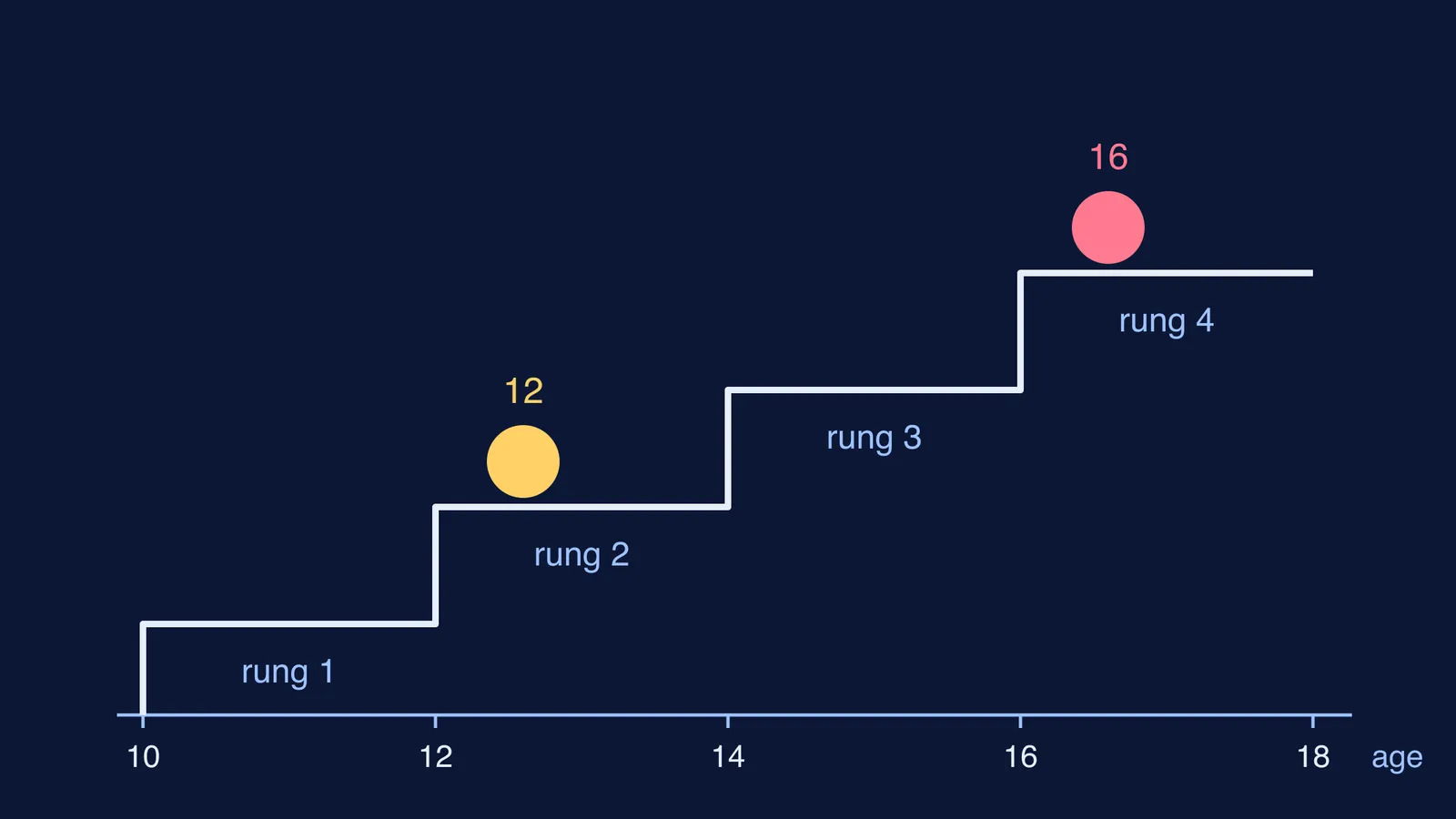
Age sets the earliest rung. Nobody gets a 9 pm curfew at 10.
Readiness decides when a child actually steps up.
Context can move anyone down for a while: exam weeks, a new neighbourhood, a long commute.
What does a written rule ladder look like?
Write one short sheet for the fridge, with the same ladder for both children. Describing the American Academy of Pediatrics Family Media Plan, Moreno and colleagues wrote in Pediatrics in 2024 that families in an earlier study picked so many rules that they may have found them hard to remember, monitor or enforce, so the revised plan encourages families to choose only a few areas at a time. The original plan's list of rules was also separated by child age category rather than one size for all.
A worked example for a 12-year-old and a 16-year-old; adjust the ages for your city, school and commute.
Curfew ladder:
Rung 1 (from 10): home before dark; a parent knows where you are.
Rung 2 (from 12): 6:30 pm on weekends from a known friend's home; call when leaving.
Rung 3 (from 14): 7:30 pm; may share an auto with a friend; share live location.
Rung 4 (from 16): 9 pm on weekends; plans agreed by afternoon.
Phone ladder:
Rung 1: family phone for calls and school groups, used in the living room.
Rung 2: own phone, no new apps without asking, charges outside the bedroom at night.
Rung 3: own smartphone, apps by agreement, out of the bedroom by 10 pm.
Rung 4: sets own study-time limits; parent checks in weekly.
Study independence ladder:
Rung 1: homework checked daily.
Rung 2: plans own week on Sunday; parent reviews it.
Rung 3: plans and runs own study; parent sees test results.
The 12-year-old is on rung 2 for curfew and phone; the 16-year-old is on rung 4. Same ladder, different rungs.
Under each ladder, add two lines. Step up: four weeks of being home on time, answering calls and keeping the phone out of the bedroom. Step down: a broken rule means one rung lower for a week, then you climb back. If a child on study rung 2 doesn't know where to start, Fermi's AI tutor can work out what they already know and build a plan for the session.
For detail on individual rungs, see our guides on what curfew to set for your teenager by age and the right age and rules for a first smartphone.
What do I say when my younger child says "it's not fair"?
Name the feeling: "You're upset that Didi can stay out later. That makes sense."
Point at the sheet: "You're on rung 2. She's on rung 4."
Give the reason: "She's older, and at 12 she was on rung 2 too."
Give the next step: "Rung 3 needs four good weeks. Start today?"
Fix a review date: each birthday and each new school term.
Talk to the elder child too, and ask them not to rub it in. For fairness beyond rules, read our piece on being fair to two children with different strengths.
When is it more than an argument about rules?
If fights go on for weeks, or a child seems withdrawn, sleeps badly or says they feel unloved, speak to the school counsellor or your doctor. For free telephone counselling, Tele MANAS on 14416 is a nationwide toll-free government helpline.
Tonight, draw one ladder with both children at the table, and let each of them mark their own rung.