On this page
Most curfew fights start the same way: a teen walks in at 10:45, a parent has been ringing since 10, and nobody had agreed what “not too late” meant. The fix is not a stricter number. It is a number you work out together, a simple way to stay in touch, and consequences you both agreed on before anyone was late.
What curfew time should I set for my teenager?
Start from sleep, not from what other parents allow. Teens aged 13 to 17 need 8 to 10 hours of sleep a night, according to the CDC's sleep guidelines, and children aged 6 to 12 need 9 to 12 hours.
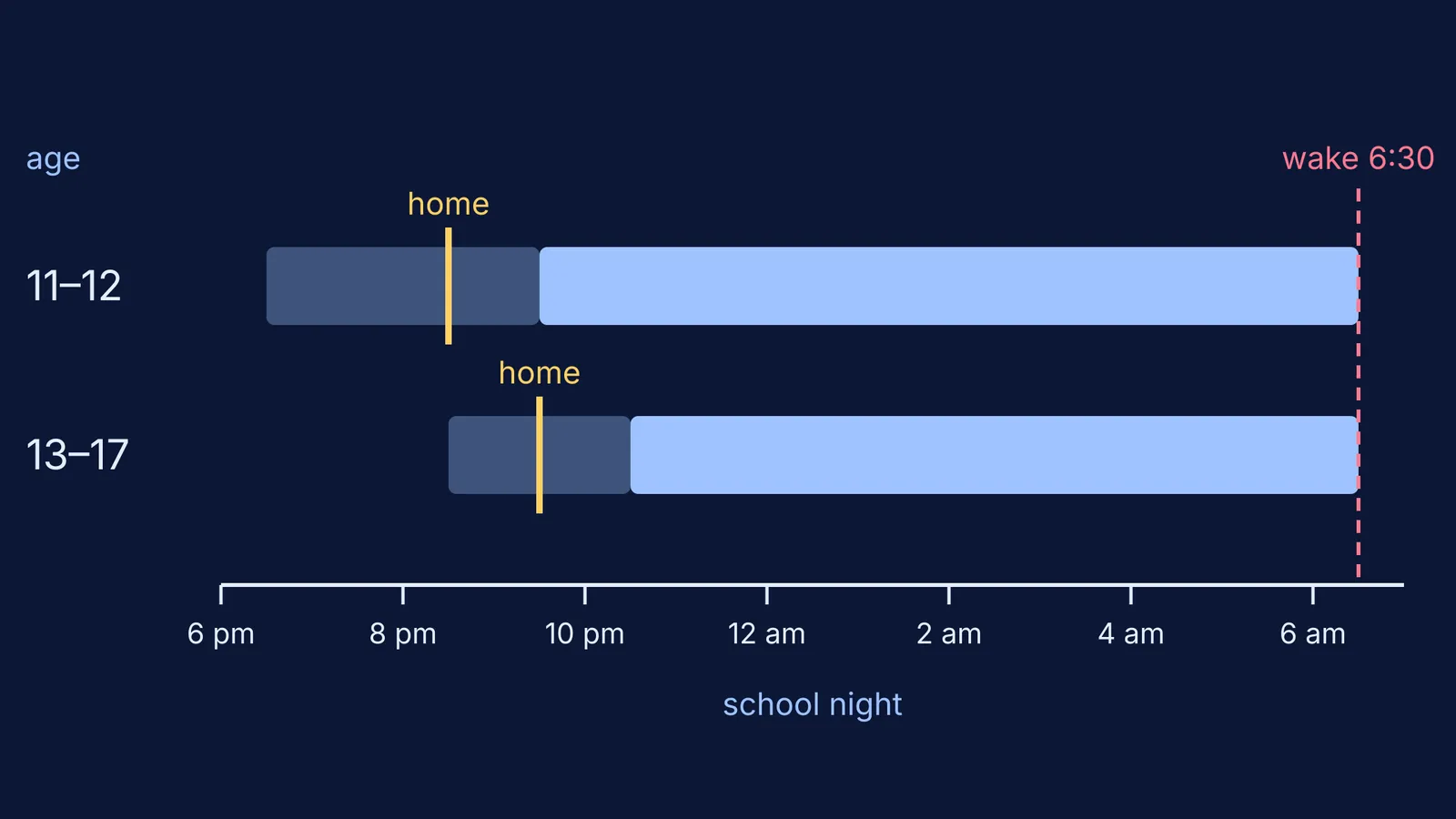
Here is the working. Say your teen wakes at 6:30 am for school. Eight hours back from 6:30 am is 10:30 pm, the latest sensible bedtime for a 15-year-old. Allow about an hour to eat, shower and put the phone down, and the school-night home time lands near 9:30 pm. For an 11-year-old who needs at least 9 hours, the same sum gives a bedtime of 9:30 pm and a home time near 8:30 pm.
Use that as a ceiling, then adjust by age and how far from home they are. A starting point we suggest:
11 to 12: home before dark on school days; evenings out only with a known adult doing pickup.
13 to 14: school nights 8 pm; weekends around 9 pm, at places you know.
15 to 16: school nights 9 pm; weekends around 10 pm.
17: school nights 9:30 pm; weekends 10:30 to 11 pm, agreed event by event.
Then let the situation move it:
Coaching or tuition that ends late: the curfew is “class end plus travel time”, with a fixed pickup or route.
Weddings, festivals, family functions: later is fine if they travel with an adult you trust.
Exam weeks: earlier, by agreement, not as punishment.
Travelling alone by metro, bus or auto: an earlier time until they have done the route in daylight several times. Our guide on teaching your teen to use the metro and bus alone walks through that.
Studying late at a library or friend's house: see our safety plan for late library study.
How should a check-in system work?
Keep it to three messages, so it feels like a habit and not surveillance:
Leaving: “Leaving now, with Riya, taking the metro.”
Arrived or home: one word is enough.
Any change: new place, new people, or running late, sent before the curfew, not after.
The rule underneath is simple: a change of plan is fine, silence is not.
In a study of 703 14-year-olds in central Sweden and their parents, Håkan Stattin and Margaret Kerr found that what parents knew about their children came mainly from what the children chose to tell them, and that this disclosure was the source of knowledge most closely linked to measures of rule-breaking and police contact (Child Development, 2000). So the aim is a teen who wants to tell you, which is why we suggest agreeing on location sharing openly rather than checking a phone in secret (more in should parents check a teenager's phone secretly).
Add one safety rule: if they ever feel unsafe, they call and you come, with no questions that night. For real emergencies, India's single emergency number is 112, and the 112 India app can send an SOS alert to saved emergency contacts, as the government's ERSS project notes.
What are fair consequences if they come home late?
Agree on these on a calm day and write them down. A ladder works because it is predictable:
Up to 15 minutes late, with a message sent before curfew: no consequence.
Late without a message: the next outing's curfew is 30 minutes earlier.
A second time within a month: one weekend outing is skipped, then the slate resets.
A safety call or coming home early because something felt wrong: never a consequence.
Make it two-way. Two weeks of being on time can earn 30 minutes more on weekends, so the curfew is something your teen can work towards.
What should you say when you set the curfew?
Try this, at a quiet time, not at the door at 11 pm:
“I want you to go out and have fun. I also need to know you're safe and that you get enough sleep for school. Let's agree a time for school nights and one for weekends, the three messages, and what happens if it slips. We'll look at it again in two months.”
Then ask, “What time do you think is fair?” A number they proposed is easier for them to keep.
If late evenings are piling up because of extra classes for a subject that isn't clicking, Fermi's AI tutor can work out what your teen already knows and build a plan for a study session at home.
If coming home late comes with low mood, withdrawal or secrecy that worries you, talk to the school counsellor, or call Tele MANAS on 14416, a free 24x7 national helpline from the Ministry of Health (details).