On this page
It is 10 pm on a Thursday. A physics DPP, half a chemistry module and a maths exercise are still open, and new sheets arrive tomorrow. The pile grows faster than anyone can clear it, and skipping anything feels like falling behind. More hours rarely fix this. Deciding together which questions to do, sample or park does.
Does your child really need to finish every coaching sheet?
They need to do the work, but not every question. A review by Harris Cooper and colleagues found generally consistent evidence that homework helps achievement, with a stronger link in Grades 7 to 12. The real question is which part to keep.
In Rohrer and Taylor's 2006 experiment, college students who solved 9 practice problems of one type in a single session scored virtually the same one week or four weeks later as students who solved 3. In the same paper, spreading 10 problems across two sessions a week apart virtually doubled scores on a test four weeks later, compared with doing all 10 at once.
The authors note that many maths assignments include a dozen or more problems of the same type, and they conclude that the way most maths textbooks arrange practice problems minimises long-term retention. Coaching sheets are often built the same way.
Which coaching questions can your child safely skip?
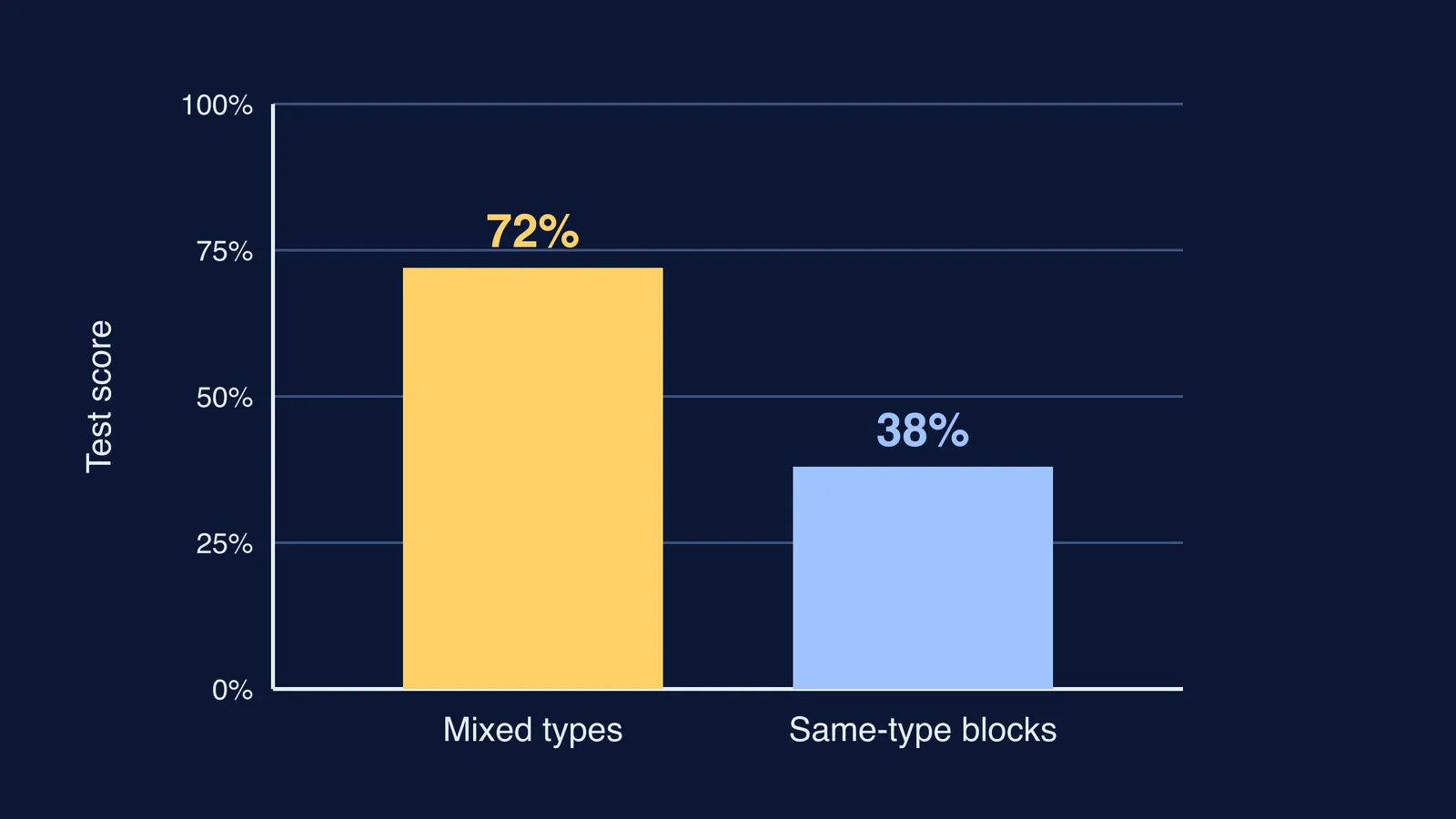
Repetitive ones, once your child has shown they can solve them. In a later classroom study with Grade 7 students, mixing different problem types produced a mean score of 72% on a surprise test, against 38% for material practised in same-type blocks.
Sort each week's sheets into three piles:
Must do: questions on topics in the next test, questions the teacher will discuss in class, and any type your child got wrong last week.
Sample: long runs of the same type. Do three without looking at the solution. If all three are right, tick the type and move on. If one is wrong, do two more on a different day.
Park: questions well beyond what has been taught. Note the number in a doubts list for the teacher.
If a question is still stuck after two honest attempts, the Fermi Problem Library has worked problems with a step-by-step solver that explains the reasoning rather than printing an answer.
For example, say a Class 11 week brings a physics DPP of 30 kinematics questions, a chemistry sheet of 40 mole-concept questions and a maths exercise of 60 questions on quadratic equations. That is 130 questions. After sorting:
Physics: 8 must-do on graphs (the next test covers them), plus 3 from each of four repeated types. 20 to do, 2 parked, 8 skipped.
Chemistry: 10 must-do, plus 3 from each of five types. 25 to do, 15 skipped.
Maths: 12 must-do, plus 3 from each of six types. 30 to do, 4 parked, 26 skipped.
That is 75 questions instead of 130. Spread them across the week and mix subjects within each sitting.
How do you agree on a weekly target with your child?
Set it together, once a week, and make it specific. Edwin Locke and Gary Latham's summary of goal-setting theory covers the effectiveness of specific, difficult goals. It also reports that goal effects generalise across goal sources, whether a goal is self-set, set jointly with others or assigned. "Finish more sheets" is vague. "75 questions, must-dos done by Friday" is a target you can both check.
A short Sunday talk could go like this:
You: "Let's lay out this week's sheets. Which ones does your next test depend on?"
Your child sorts them into must do, sample and park. You only ask questions.
You: "Honestly, how many can you do on a school day? Let's set the number from that."
Agree on one number and one check-in, say Wednesday evening, five minutes, no lecture.
Next Sunday, review what got done first. If the target was missed, lower it rather than adding the backlog.
If your child does not know where to start on a topic, Fermi's AI tutor can work out what they already know and build a plan for the session, so they sit down to a clear next step. If check-ins turn into arguments, see how to stop nagging your teenager to study.
When should you talk to the coaching teacher?
If the must-do pile alone keeps overflowing the week, the problem is the load, not your child's effort. Take the doubts list to the teacher and ask which questions students are expected to attempt; here is how to talk to coaching teachers about your child's progress. If evenings drag, try this timer routine for shorter homework evenings.
Watch your child as well as the pile. If they seem low for weeks, sleep badly or talk about feeling hopeless, speak to a doctor or counsellor. Tele MANAS, the national tele mental health helpline, is free and open 24/7 on 14416.
Start this Sunday with one table, this week's sheets, three piles and one number you both agree on.