On this page
Many students first see 1098 on a school notice board. Fewer know what happens after someone picks up, and knowing that makes it easier to call.
What is Childline 1098?
India's Juvenile Justice Act defines Childline Services as "a twenty-four hours emergency outreach service for children in crisis" that links them to emergency or long-term care, as set out in the Ministry of Women and Child Development's Child Helpline SOP. The same document describes 1098 as a national toll-free, 24x7 number for children in difficult situations.
States and districts now run 1098 under the Centre's Mission Vatsalya scheme, and the helpline is integrated with ERSS-112, the national emergency number, according to the Ministry's covering letter to states dated 31 March 2023 in the same SOP. When the SOP was issued, the service ran in 568 districts, 11 bus stands and 135 railway stations, with a plan to reach every district.
Who can call 1098?
Any child who needs help. The SOP's call types cover emotional support, legal help and education as well as emergencies, so a child does not need a "big enough" reason.
You can also call about a child you are worried about. The emergency list includes a lost or found child, child labour and child marriage, which an adult may notice first.
The call is free. Under the SOP, the caller's identity and location are obtained from telephone subscriber records and location services when a call lands.
What happens after you call 1098?
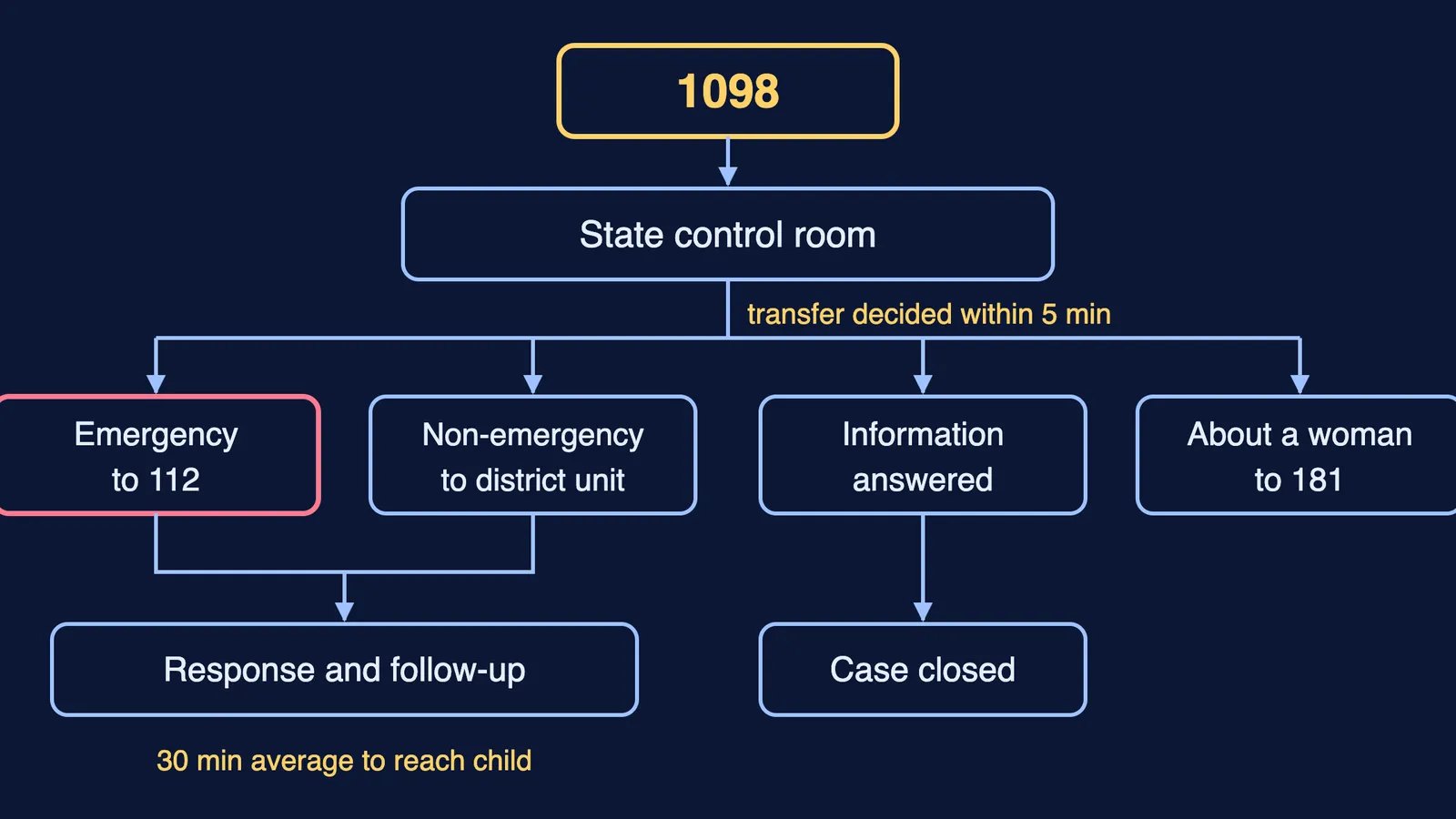
The Child Helpline SOP lays out the path a call takes:
The call goes to your state's Women and Child Development control room, which answers 24x7, all year, and gives it a unique ID.
The call-taker sorts it: emergency, non-emergency or information.
Emergencies, such as abuse, a medical problem, a child marriage, a missing child or child labour, go to ERSS-112, and the district Child Helpline unit is told at the same time.
Non-emergencies, such as emotional support, legal help or education, go to the Child Helpline unit at the District Child Protection Unit. The transfer decision should be made within 5 minutes.
Information requests are answered or passed on; a call related to a woman goes to the Women Helpline, 181.
If a child needs physical intervention, the district unit is expected to reach them within 30 minutes on average, and can bring the child before the Child Welfare Committee for care and protection.
The control room seeks follow-up from 112 or the district unit before it closes the call.
What should you say when you call 1098?
Call-takers ask questions, but having these five lines ready makes the first minute easier:
"My name is ___ and I am ___ years old." Or: "I am calling about a child."
"I am at ___." Give a landmark, school name, or station and platform.
"What is happening is ___."
"Someone is hurt or in danger right now", or "No one is in danger right now, but I need help."
"It is safe or not safe to call me back on this number."
You can say you are scared. You can pause. If the line drops, call again.
How do schools use 1098?
CBSE's circular on the POCSO Act says the centralised child helpline number 1098 "must be popularised and displayed at prominent places in the schools". It also asks for the names of teachers designated to handle such cases on the notice board, a complaint box, and a School Complaints Committee that includes a female and a male student. Staff must be made aware that Sections 19 and 21 of the POCSO Act cast a duty on them to report child abuse.
At the next parent-teacher meeting, you can check:
Is 1098 on a board children actually walk past?
Do students know the designated teachers by name?
Where is the complaint box, and who opens it?
Has anyone told the children that 1098 is for smaller worries too?
If your child finds it hard to speak up, our guides to a child who is afraid to tell a teacher about bullying, a teen being blackmailed with photos online and a child who calls home crying from hostel walk through the first conversation.
Not every worry is an emergency. If a backlog of chapters feels too big to start, Fermi's AI tutor can work out what you already know and build a plan for the session, so the next step is small.
When should you call 1098, 112 or Tele MANAS?
1098: a child is unsafe, being harmed, lost, pushed into work or marriage, or needs support and does not know where to turn.
112: someone is in danger right now. Under the SOP, child-related calls to 112 can be sent on to the state's child helpline control room.
Tele MANAS, 14416 or 1-800-891-4416: the Health Ministry's free mental health helpline, with multi-language support, for feeling low, anxious or unable to cope.
Save 1098 in your phone today, and tell one younger child what it is for.