

On this page
Your child has started doing homework on the floor, or keeps asking for a standing desk. You may worry about posture, or wonder if they are just avoiding work. The useful question is not which position is right, but which position suits which task, and how often to switch.
Is floor seating or a chair and table better for studying?
For long stretches of writing, such as maths problems, board-exam answers or JEE Main numericals, a chair and table that fit your child usually work best. Fit matters more than price. A 2014 paper in Applied Ergonomics by Castellucci, Arezes and Molenbroek, which applied furniture-fit equations to 2,261 students from 14 schools, notes that a mismatch between students and school furniture is likely to cause uncomfortable body posture and pain, and may affect learning.
At home, a fit looks like this:
Feet rest flat on the floor or on a box, not dangling.
Thighs are roughly level, with knees not jammed under the table.
The table is close to elbow height, so shoulders stay relaxed while writing.
The book or screen sits in front, not twisted off to one side.
Floor seating, on a mat with a low table or chowki, is common in Indian homes and has real uses. It is good for reading, spreading out notes, drawing a mind map or sorting flashcards. The trouble starts when a child writes for an hour with the notebook on the floor and their back curled over it. We found little direct research comparing floor sitting with chairs for children's study, so treat the floor as one good option among several, not a cure or a danger.
Does a standing desk help a child concentrate?
The research is promising but early. A 2016 systematic review in Pediatrics of eight school-based studies found that standing time increased in every study that measured it, and some studies reported improved classroom behaviour. The same review notes that half the studies were not randomised and most were pilot or feasibility studies.
A second 2016 review in Preventive Medicine Reports, covering 11 studies, all in primary schools, concluded that standing desks in classrooms appear feasible and not harmful to learning, but that the evidence is not strong enough for firm conclusions.
Most of these studies looked at younger schoolchildren in classrooms, not teenagers revising at home. Before buying anything, test the idea with what you have: a kitchen counter, a sturdy shelf, or a tall cupboard top. Standing suits revision, reading aloud and flashcards better than long written work.
How long should a child sit before changing position?
The WHO 2020 guidelines on physical activity and sedentary behaviour recommend reducing sedentary time for all age groups, and say children and adolescents benefit from an average of 60 minutes a day of moderate-to-vigorous activity. The same guidelines say the evidence was not enough to set a specific limit for sitting. So there is no proven number of minutes. What helps is building changes of position into the session, so your child does not have to notice discomfort before moving.
A worked example: one two-hour evening block
Here is a plan for a Class 10 student with maths homework and a science chapter to revise. Each task gets the position it suits.
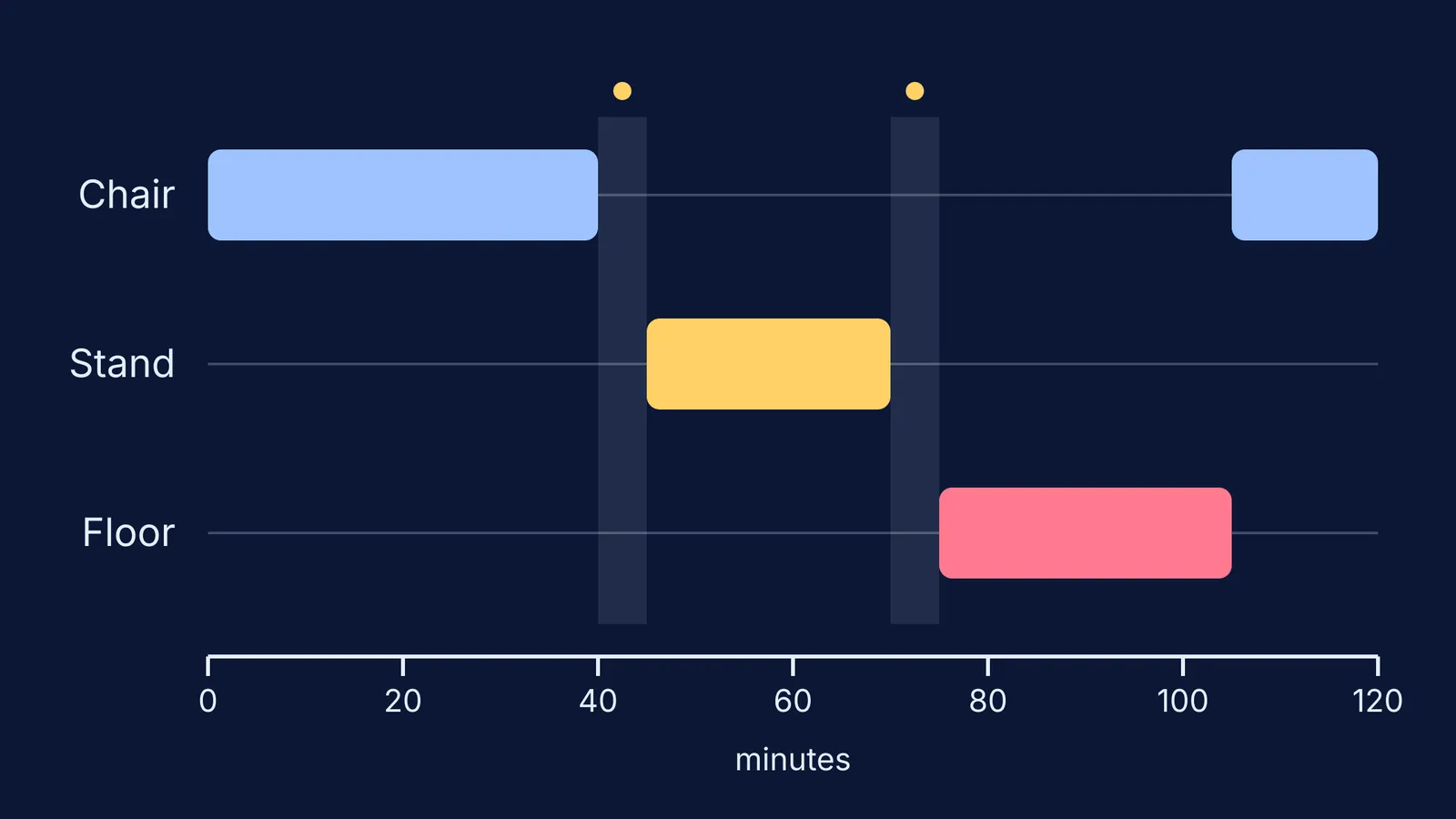
Minutes 0 to 40, chair and table: written maths problems.
Minutes 40 to 45, break: walk, water, look out of a window.
Minutes 45 to 70, standing at a counter: flashcards and saying definitions aloud.
Minutes 70 to 75, break.
Minutes 75 to 105, floor with a low table: read the science chapter and draw a one-page mind map.
Minutes 105 to 120, back at the chair: a short self-test, written from memory.
The hero diagram above shows this same block as a timeline. If your child sits down not sure what to work on, Fermi's AI tutor can work out what they already know and build a plan for the session, so each block starts with a clear task to match to a position.
If a quiet corner is the harder problem, our guide to finding a quiet study space in a joint family home has room-by-room ideas. For a younger child who cannot stay still at all, see movement-friendly homework ideas for a restless 7-year-old.
What should you check after a week?
Did written work get done neatly, and on time?
Which position did your child pick for reading, and did they stay with it?
Any neck, back or wrist ache at the end of the session?
Did breaks stay short, or turn into phone time?
Adjust one thing at a time. If the floor works for reading but not writing, keep it for reading.
Tonight, sit with your child for five minutes and match tomorrow's tasks to a place: table, floor or counter.


