On this page
Your child sits with the chapter open for an hour, turns every page, and says they have studied. Then the class test comes back with half the answers blank. Often this is not laziness. Reading a familiar page feels like knowing it. Writing an answer with the book shut is how they find out whether they actually do.
Why does reading the chapter again not stick?
Rereading is a habit many students fall back on. When researchers surveyed 177 college students about how they study, a majority said they repeatedly read their notes or textbook, and relatively few tested themselves. The authors suggest many students experience "illusions of competence": a page you have seen before reads smoothly, so it feels learned.
A large 2013 review of ten study techniques by John Dunlosky and colleagues rated rereading as low utility. Practice testing, which means answering questions from memory, was one of only two techniques it rated high utility.
If your child also forgets class lessons by evening, see our guide on helping a child who forgets what the teacher said.
Does writing answers actually help recall?
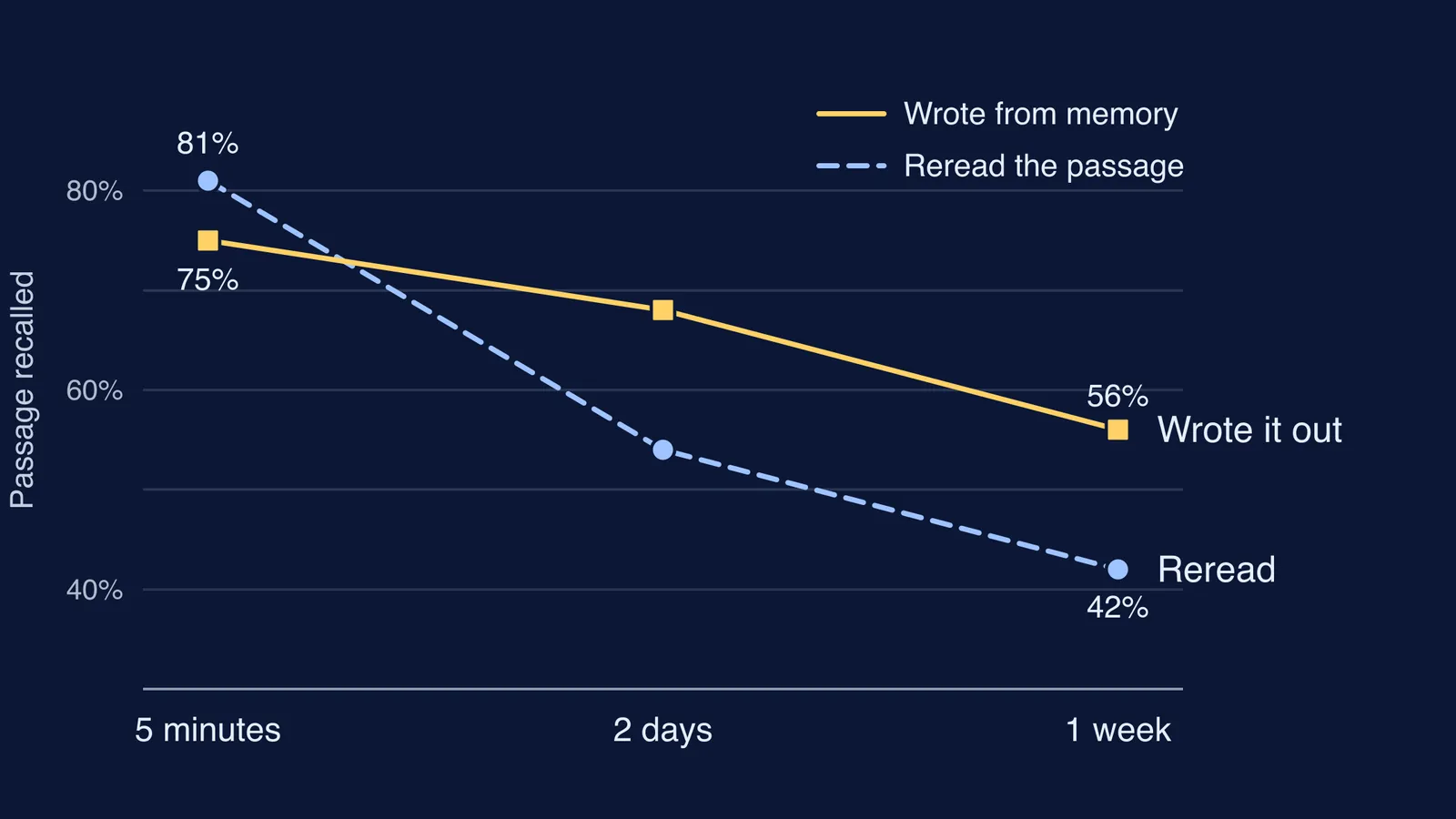
In a well-known experiment, Henry Roediger and Jeffrey Karpicke had 120 university students study two short passages (Psychological Science, 2006). Each student reread one passage and, for the other, wrote down everything they could remember. Five minutes later, rereading did slightly better: 81% of the passage recalled against 75%. A week later the result had flipped: 56% of the passage written from memory was recalled, against 42% of the reread one.
In a second experiment in the same paper, students who read the passage once and then wrote it out from memory three times recalled 61% a week later, against 40% for students who spent all four periods studying it. The rereaders had read it through about 14 times in total, the writers about 3. The rereaders also predicted they would remember it better.
A 2011 study in Science found that retrieval practice produced more learning than making concept maps, including on questions that needed students to draw inferences.
One honest caveat: the ink itself is not magic. A 2013 set of experiments found that recalling answers silently, in your head, helped later memory as much as producing them openly. What matters is pulling the answer out of memory. At home, writing has two practical advantages. It proves the recall happened; "I know this one" is easy to fake, even to yourself. And it leaves a page you can check. Copying from the book does not count, as our piece on whether rewriting notes is useful explains.
How much should a child write each day?
Keep it small enough to happen every day. This is our suggestion, not a figure from a study:
Read the day's section once, properly.
Close the book. Write answers to three questions from the end of the chapter or the class notes.
Write one line headed "Couldn't remember" for anything that came out blank.
Open the book and correct the answers in green pen. Do not erase the first attempt.
For Classes 3 to 5, two short answers is plenty. For Classes 6 to 8, three answers. For Classes 9 to 12, three answers plus one numerical or one labelled diagram from memory.
A worked example for a Class 8 chapter on friction. Instead of a second read, your child closes the book and writes: why tyres have treads, one way friction is useful and one way it is a nuisance, and why ball bearings are used in machines. The second answer comes out thin, so the "Couldn't remember" line says "ways to reduce friction". The green-pen corrections fill it in. Tomorrow, that line becomes the first question.
If the blank page shows your child cannot even start a numerical, the Fermi Problem Library has worked problems with a step-by-step solver that explains the reasoning rather than printing an answer. Have them read the reasoning, close it, then write the solution themselves.
How do you check homework without asking "is it done"?
"Is it done?" usually gets "Yes". The notebook tells you more in two minutes. Look for:
today's date on the page
answers in your child's own words, not lines copied from the book
green-pen corrections, which show the checking happened
a "Couldn't remember" line, even a short one
Then try one of these instead:
"Show me the one you got wrong first time."
"What's on your couldn't-remember line today?"
"Tell me the friction answer without looking, then we'll check it."
Praise the corrections, not the neatness. A page full of green ink means the method is being used. If your child also has coaching assignments, see our guide for parents checking coaching homework.
Start tonight with one chapter and three answers. Check the notebook tomorrow, not the clock.