

On this page
Every day, thousands of Indian families face a high-stakes question: how involved should you be in your teenager's JEE or NEET coaching assignments? When a child is struggling with advanced physics or chemistry, a parent's instinct is often to sit down, check the work, and point out the mistakes. After all, if you are investing significant time and money into their education, ensuring that homework is completed flawlessly seems like a natural responsibility.
But as students move into higher secondary education and tackle highly competitive entrance exams, the rules of parental support fundamentally change. What worked well in early schooling—like checking daily math worksheets or spelling tests—can actively harm a teenager's confidence and problem-solving skills in their final years of high school. The transition from middle school to the intense preparation required for national exams requires a shift in how parents approach daily assignments.
Should parents check coaching homework?
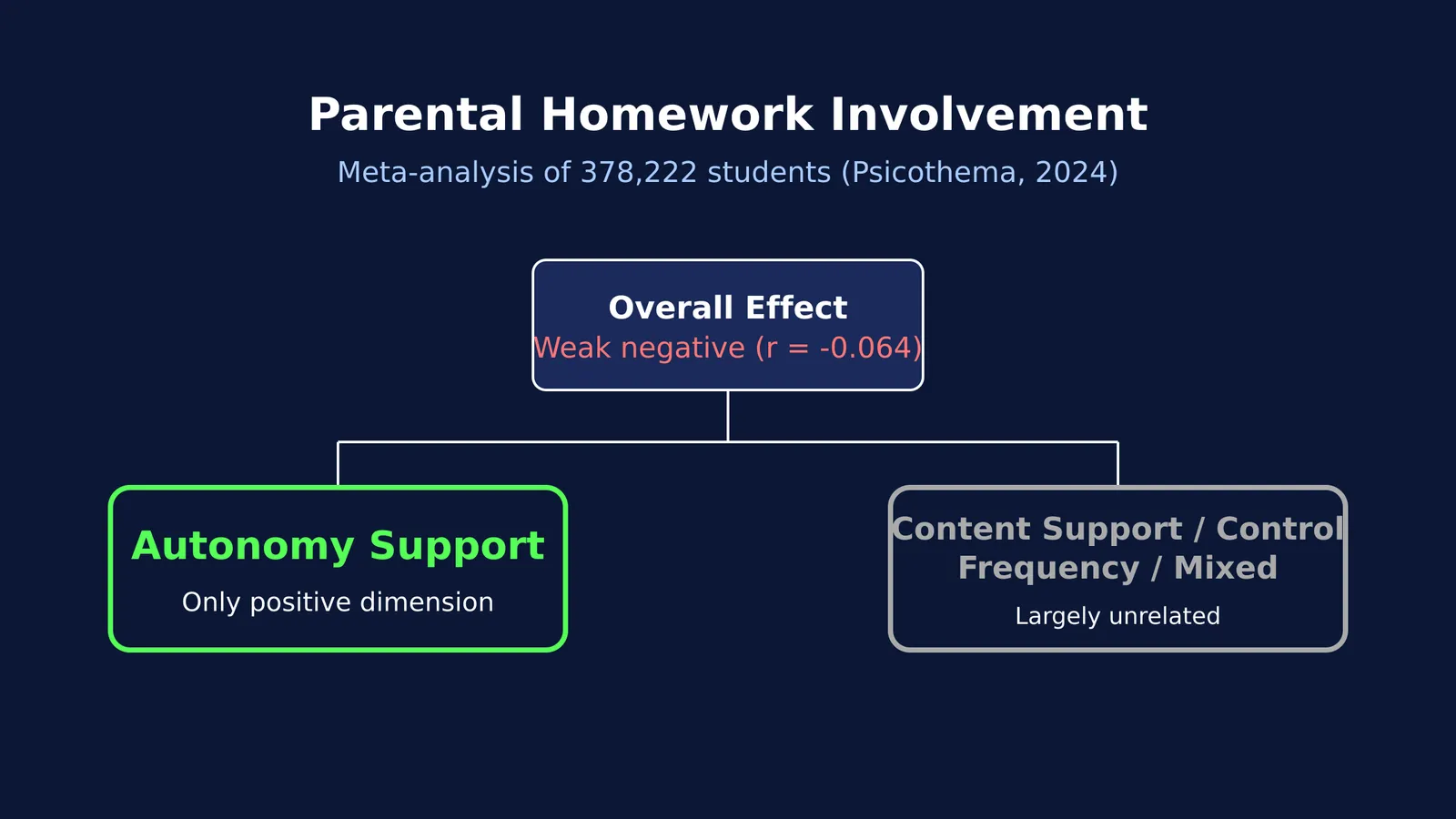
The short answer is no. Directly checking, correcting, or managing a high school student's homework often backfires. A 2024 meta-analysis of 28 studies involving 378,222 participants found that the overall relationship between parental homework involvement and student achievement is actually weakly negative (10.7334/psicothema2023.92).
When parents take on the role of an inspector—pointing out errors or taking over when a problem gets hard—it signals to the teenager that they are not capable of managing their own workload. It replaces the student's intrinsic motivation to learn with a fear of disappointing their parents, which only adds to the heavy emotional burden of coaching. Furthermore, as subjects like organic chemistry and rotational mechanics become highly advanced, parents who attempt to teach or check the work may inadvertently introduce outdated methods or confusion, further frustrating the student.
However, the same meta-analysis revealed a clear and crucial exception: "autonomy support" is the only dimension of parental involvement that has a consistent positive relationship with academic achievement.
What does autonomy support look like?
Autonomy-supportive involvement means creating an environment where the student takes the lead and assumes ownership of their learning. You act as a supportive stage manager rather than a strict director. It involves acknowledging their feelings when a chapter is incredibly difficult, encouraging them to find their own solutions, and explicitly valuing their effort and resilience over their immediate mock test scores.
If your child is stuck on a difficult concept, stepping in to solve the equation for them removes the productive struggle they desperately need to learn. Instead of handing them the answer, you can provide tools that encourage them to work through it on their own terms. For example, the Fermi Problem Library has worked problems with a step-by-step solver that explains the reasoning rather than printing an answer. This allows the student to keep their independence while still getting the essential scaffolding they need to move forward and understand the core concept.
How does parental pressure affect students?
The Indian coaching system is famously intense, often requiring students to spend many hours a day in classrooms, followed by heavy homework and self-study loads. When parents add strict oversight and constant performance monitoring on top of this, the home ceases to be a place of rest and recovery.
If a student's self-worth becomes tied entirely to their mock test ranks and daily performance, a bad week can feel like a total collapse of their identity. The anxiety of being constantly monitored can severely limit a student's ability to think critically, trapping them in rote memorisation out of a desperate need to perform. Teenagers need a safe harbour where they are allowed to make mistakes without judgment.
If a student is struggling to picture complex spatial ideas in physics or chemistry, they might need a different pedagogical approach rather than more repetitive drilling. The Fermi Simulation Lab provides interactive simulations for the ideas that are easier to see than to read, helping them build intuition independently and without external pressure.
How can you stay involved without checking homework?
So, if directly checking homework is off the table, what should you do instead? You can still be highly involved and deeply supportive of your teenager's education by focusing entirely on logistics, environment, and emotional support. Here is a framework to guide your involvement:
Provide the resources: Ensure they have a quiet, dedicated study space, nutritious food, and the study materials they request. Removing logistical friction is one of the most powerful things a parent can do.
Listen actively: Let them vent about a frustrating chemistry chapter or a difficult coaching teacher without immediately offering a solution or telling them they just need to study harder. Sometimes they just need to be heard.
Model resilience: Share stories of your own professional or academic setbacks. Show them that failure and struggle are a normal, expected part of learning and growth, not a catastrophe.
Help with structure, not content: You can help them plan their week, establish a healthy sleep routine, or organise their desk, but the actual intellectual heavy lifting must remain theirs.
For more insights on navigating these challenging years, read when to help with homework and when to step back and Choice and autonomy: parenting that builds real motivation.


