On this page
Your 14-year-old tells their mother about the fight with a friend, the bad unit test and the teacher who was unfair, and gives their father a one-word answer at dinner. If you are the parent on the outside, it can sting. It is also very common, and it can change.
Why does a child only share things with one parent?
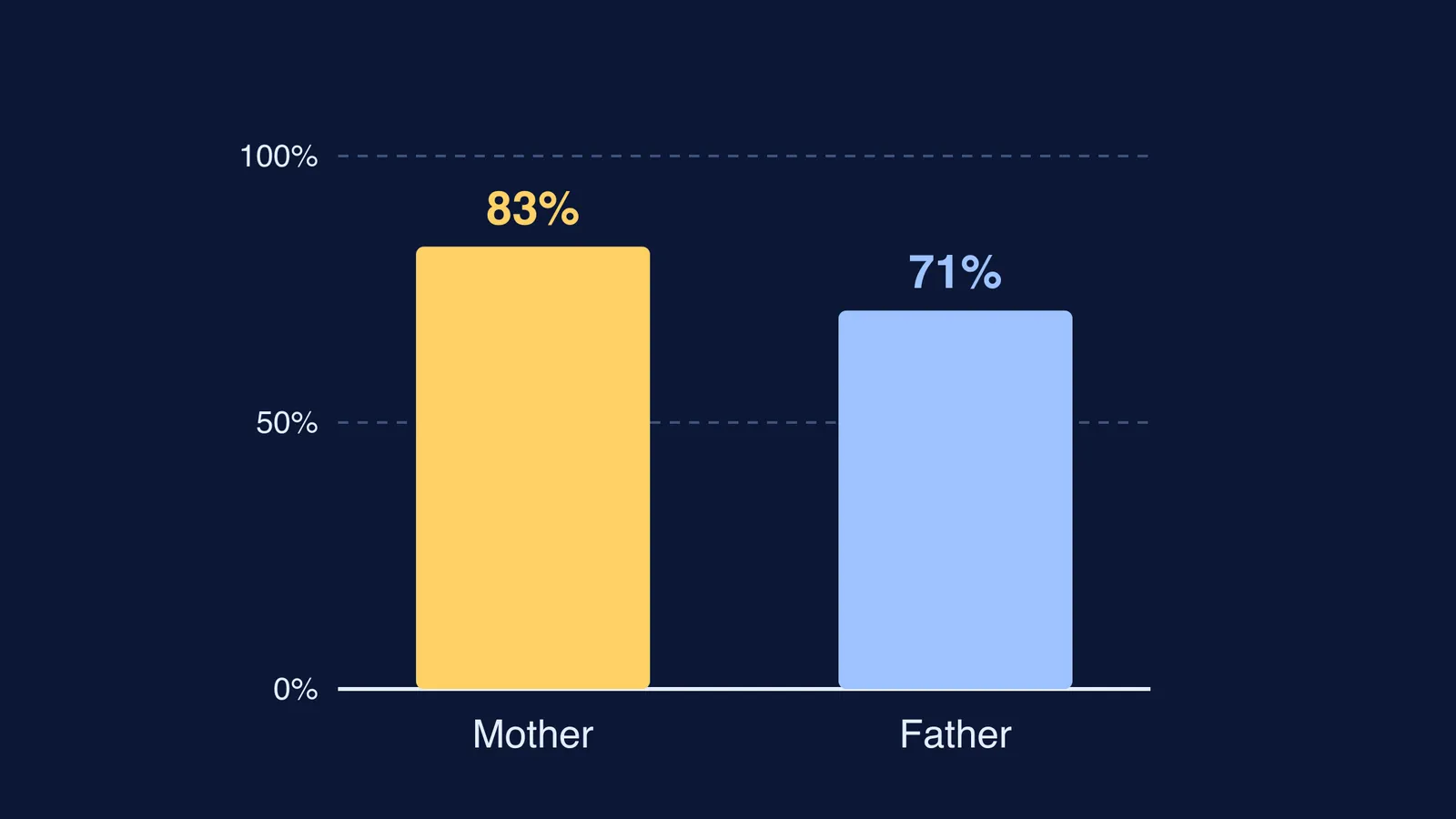
More adolescents find it easy to talk to their mother than to their father. In the 2021/2022 Health Behaviour in School-aged Children survey of 11-, 13- and 15-year-olds across 44 countries and regions, 83% found it easy to talk to their mother about things that really bother them and 71% to their father (WHO Regional Office for Europe, 2024). The same report found that boys reported easier communication with both parents than girls did, and that the gender difference was particularly pronounced for talking to fathers.
A study of 276 high-school students and 249 parents found that teens disclosed more to mothers than to fathers, especially about personal matters (Smetana and colleagues, Child Development, 2006). Greater trust predicted more disclosure, and for personal issues so did parental acceptance.
In everyday terms, children usually pick a confidant for ordinary reasons:
That parent is around at the moments when talk happens: the ride home, the kitchen, bedtime.
That parent reacted calmly the last time something went wrong.
The other parent is linked in the child's mind with marks, rules or consequences.
None of these means the child loves one parent less.
Is it a problem if my child confides in only one parent?
Usually not. What matters most is that your child has someone they tell. In a study of 703 Swedish 14-year-olds and their parents, parents' knowledge of their children's lives came mainly from the child choosing to tell them, not from checking up on them (Stattin and Kerr, Child Development, 2000). One open channel in the house is already doing a lot of work.
Watch for a different pattern: a child who stops talking to both parents, or who seems withdrawn, unusually low or anxious for weeks. That is a reason to speak to the school counsellor or a doctor. In India you can call Tele MANAS on 14416 for free, round-the-clock mental health support.
How can the other parent build a connection?
How you react to what your child tells you matters. A study following 982 young people found that negative parental reactions to what they disclosed were linked to feeling more controlled and less connected, which in turn predicted more secrecy; positive reactions predicted feeling closer and telling more (Tilton-Weaver and colleagues, Journal of Adolescence, 2010).
Here is a four-week plan for the quieter parent:
Week 1: show up, don't ask. Pick one regular 20-minute slot that is yours: the school drop, an evening walk, chai on the balcony, match highlights. No questions about marks.
Week 2: share first. Tell a short story from your own day, including something that went wrong. It shows the kind of easy back-and-forth you are hoping for.
Week 3: ask about their world, not their results. Swap "How was the test?" for questions about friends, a funny moment or a teacher. These after-school questions that get real answers are a good start.
Week 4: practise the calm first sentence. When your child does tell you something, your first words are "Thanks for telling me." Advice, if needed, comes later.
Doing something side by side often feels easier than sitting face to face. Homework can be that activity if you help without taking over; these tips on how fathers can help with homework show how. If your teen enjoys science, open an interactive simulation together in the Fermi Simulation Lab and let them explain what is happening to you.
What to say, and what to avoid
Instead of "Why do you only tell your mother?", try "I'd like to hear about your day too, whenever you feel like it."
When they share something hard: "Thanks for telling me. Do you want help, or do you just want me to listen?"
When they shut down: "No problem. I'm around after dinner."
Why does forcing a child to talk backfire?
Pressure to talk tends to produce less talk. Avoid turning the trusted parent into a messenger ("Ask her what happened, then tell me"), comparing ("You tell Mummy everything"), or reading your child's chats to make up the gap. Older children need some private space, and this guide on how much privacy to give your teenager can help you draw the line.
The confidant parent has a part to play too: keep small confidences, and speak warmly about the other parent so the child never feels they must pick a side.
Start this week with one regular slot, one story of your own and one calm reply.