On this page
If your child's name is not on the JEE Advanced qualified list, the IIT door is shut for this year. Engineering is not. Seats at NITs, IIITs and many other government-funded colleges are filled on a different number: the JEE Main rank your child already has.
Does missing the JEE Advanced cutoff end engineering plans?
No. The NTA's JEE (Main) 2026 Information Bulletin says Paper 1 is conducted for admission to undergraduate engineering programmes at NITs, IIITs, other Centrally Funded Technical Institutions and institutions funded or recognised by participating state governments.
JEE Advanced, in the same bulletin's words, is the separate exam "conducted for admission to IITs". For the NITs, IIITs and other institutes above, your child's JEE Main rank is still what counts.
What options remain after missing the Advanced cutoff?
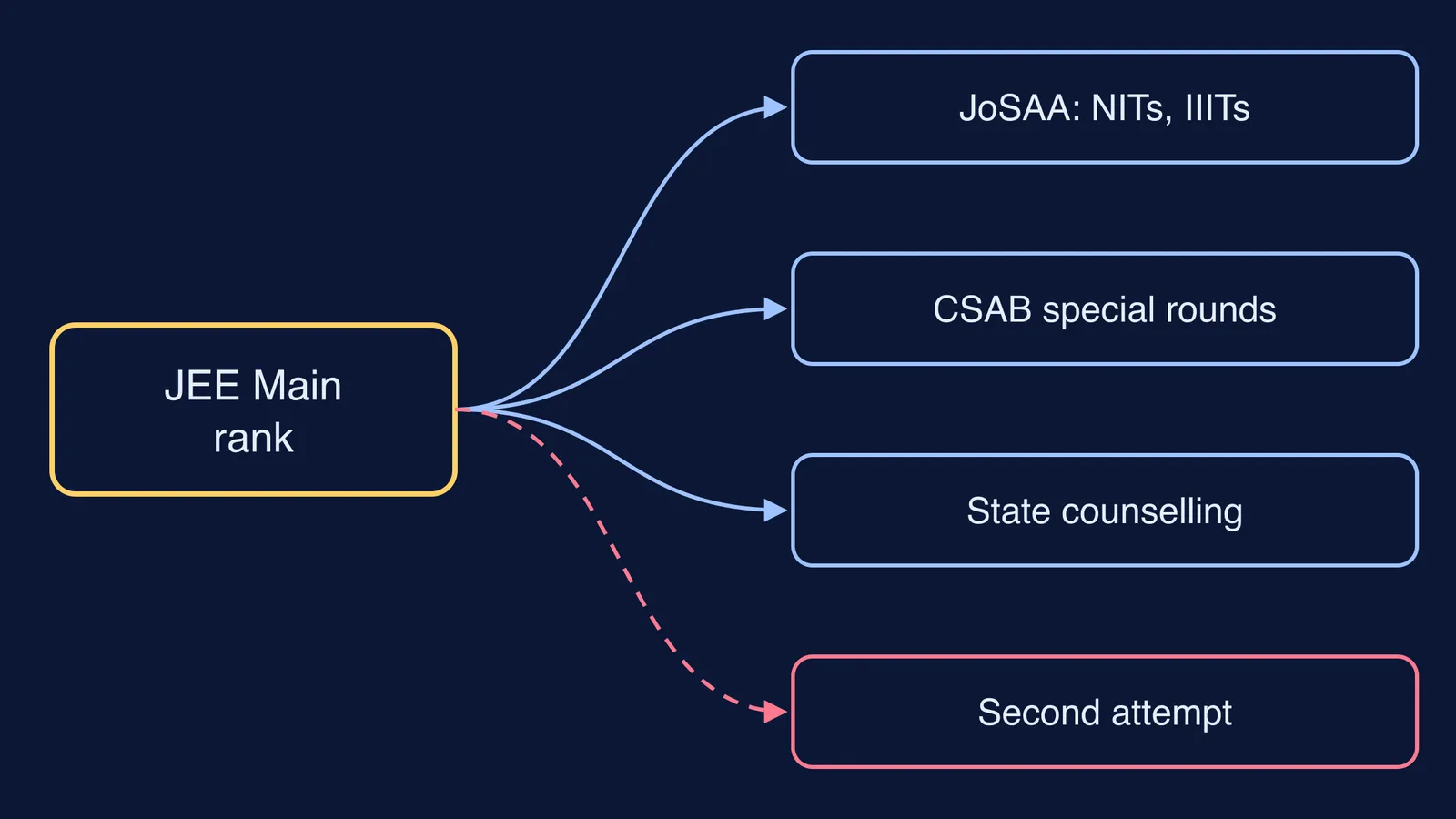
There are four main routes, each with its own official timetable.
JoSAA counselling for the NIT+ system. JoSAA managed seat allocation for 138 institutes in 2026, including 31 NITs, 26 IIITs and 56 other government-funded technical institutes. IIT seats need JEE Advanced, but NIT, IIIT and other GFTI seats go on JEE Main rank.
CSAB special rounds. The Central Seat Allocation Board runs its own special rounds for the NIT+ system, with a separate information brochure.
State counselling. The NTA bulletin notes that a state "may prepare a separate rank list based on criteria decided by them" for colleges affiliated to state universities. Some states use JEE Main ranks and others run their own entrance test, so check your state's technical education department.
A second attempt. The JEE (Advanced) 2026 eligibility rules say a candidate can attempt it a "maximum of two times in two consecutive years", and only in the two years after first sitting Class 12. A student who first took Class 12 this year would usually get one more try, but must again finish in the top 2,50,000 of JEE Main. One who first took Class 12 a year earlier would not. Confirm in next year's brochure.
One rule catches families out. For NIT+ admission, the NTA bulletin requires at least 75% aggregate across five Class 12 subjects (65% for SC, ST and PwD candidates), or a place in the category-wise top 20 percentile of successful candidates on your board.
If relatives keep asking why an NIT is "settling", our guide on explaining IIT vs NIT to your family can help.
Should my child take a seat now or prepare for another year?
These five questions usually show which way your family leans:
Is there a college-and-branch pair within reach that your child would be glad to join?
Does your child want an IIT in particular, or the subject itself?
Is a second Advanced attempt still allowed under the eligibility rule above?
Can the family manage another year of fees, routine and waiting?
Did this year's score fall short because of gaps your child can name, or for reasons they can't explain yet?
If most answers point to another year, read our guide on whether to take a drop year together before anyone commits. A second attempt works best when it starts with a plan, not a restart of the whole syllabus. Fermi's AI tutor can work out what your child already knows and build a plan for the session, so each day starts with a clear next step.
What should you say to your child after the result?
Here is a script you can adapt.
On the day: "I'm sorry. I know how hard you worked for this. We don't have to decide anything today."
A day or two later: "Can you show me what your Main rank opens? I'd like to understand it the way you do." Let your child lead.
When relatives ask: "They're looking at NIT and state options. We'll know more after counselling."
What to avoid: comparisons with cousins or classmates, "I told you so", and sharing the result in family groups before your child is ready.
Disappointment is normal. If your child stops eating or sleeping, withdraws for days, or talks about feeling hopeless, speak to a doctor or counsellor. Tele MANAS, the government's toll-free mental health helpline, is on 14416 or 1800 891 4416.
A seven-day plan for the week after the result
Day 1: Rest. No decisions and no rank predictor apps.
Day 2: Gather documents: the JEE Main scorecard, the Class 12 marksheet and any category certificate.
Day 3: Check NIT+ eligibility against the Class 12 rule in the NTA bulletin, and look up your state's counselling rules.
Day 4: Write every registration and choice-filling deadline from the JoSAA, CSAB and state sites on one sheet.
Day 5: Build a shortlist of colleges and branches together, with your child holding the pen.
Day 6: Go through the five seat-or-second-year questions above.
Day 7: Register for every process you might use. Registering keeps options open.
Our guide to supporting your child through counselling rounds covers what to expect in each round.