

On this page
Your child has told you they want to study physics, chemistry, maths or biology for its own sake, not take the engineering seat everyone expected. Feeling a jolt is normal. This guide sets out the three main routes into a science degree in India, how each leads to research, and what to say at home while you decide together.
Is a BSc a step down from engineering?
Not in the government's eyes: it pays students to choose basic science. The INSPIRE Scholarship for Higher Education, run by the Department of Science and Technology, announces 12,000 scholarships a year, each worth Rs 80,000 a year, for students in BSc, BS and integrated MSc courses in basic and natural sciences (INSPIRE-SHE FAQs, DST). Students whose Class 12 marks are in the top 1% of their board are among those eligible, and every scholar must do a summer research project under an active researcher.
So the real question is not “BSc or engineering” but “does my child want a career that runs through research, teaching or science-based work?” That needs a different plan, not a lesser one.
What are the routes to a BSc in pure science?
There are three, each with its own entrance test.
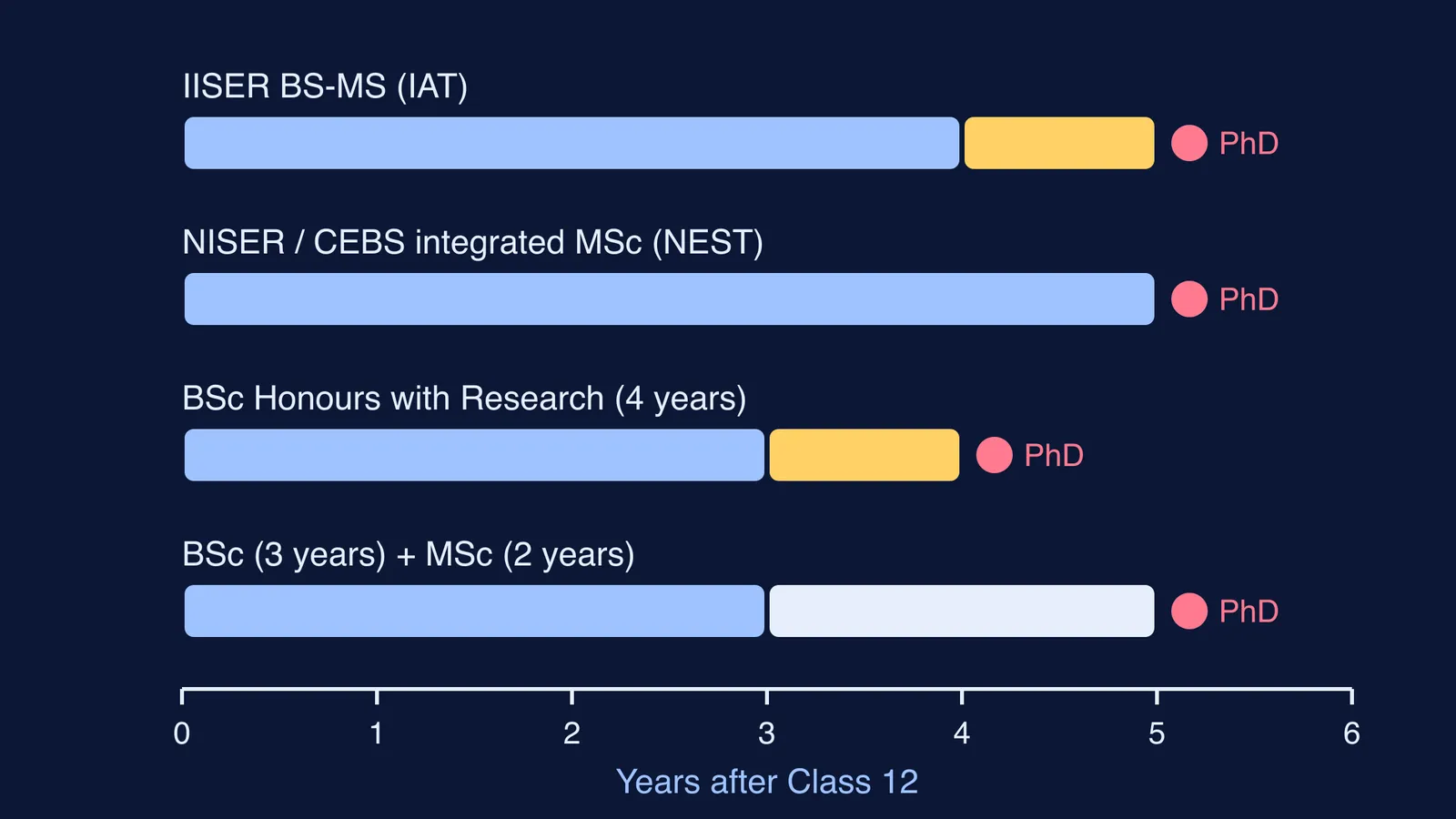
IISERs, through the IISER Aptitude Test. The Indian Institutes of Science Education and Research admit BS-MS students through a common test. IISER Pune states that from 2024 candidates are admitted only through the board channel, by writing the IISER Aptitude Test (IAT); JEE Advanced is no longer a separate route (IISER Pune admissions).
At IISER Kolkata, for example, the BS-MS lasts 5 years, with all basic sciences in the first year and a fifth year “almost completely devoted to full time research” towards a dissertation (IISER Kolkata programmes). Your child does not have to pick one subject at 17.
NISER and UM-DAE CEBS, through NEST. The National Entrance Screening Test admits students to a five-year integrated MSc in biology, chemistry, mathematics or physics at NISER Bhubaneswar and UM-DAE CEBS Mumbai, both Department of Atomic Energy institutions (NEST official site). The NEST site lists 200 seats at NISER and a tentative 57 at CEBS for 2026, and the 2026 test was held on 6 June. NEST and the IAT are separate tests, so your child can apply for both.
A university BSc, through CUET or state admissions. Central universities and many state, deemed and private universities admit undergraduates through CUET (UG), run by the National Testing Agency (CUET (UG), NTA). Many state universities also run their own admissions.
Under the UGC's undergraduate framework, a 3-year degree needs 120 credits and a 4-year Honours degree needs 160 (UGC Curriculum and Credit Framework). Students with 75% or more in the first six semesters can choose Honours with Research, which includes a 12-credit research project or dissertation in the fourth year. Ask each college whether it offers that fourth year in your child's subject.
Can a BSc student become a scientist?
Yes. A research career usually starts with a PhD. Under the UGC PhD Regulations, 2022, a four-year bachelor's degree with at least 75% marks is enough to apply; otherwise a master's with at least 55% is needed, with a 5% relaxation for reserved categories (UGC PhD Regulations, 2022%20Regulations,%202022.pdf)). The same rules set a minimum PhD length of 3 years and allow admission through a UGC-NET, CSIR-NET or GATE fellowship plus an interview, or through the university's own entrance test.
So every route above can reach PhD eligibility within four to five years of Class 12. For what comes next, read how to become a scientist in India after Class 12 and the career options after BSc physics.
How do you talk to your child about choosing a BSc?
Have one calm conversation about evidence, not verdicts. You could open with: “I want to understand what you love about this. Show me what you've been reading, and let's look at the entrance tests together.”
Then work through this checklist side by side:
Ask which topics they study when nobody asks them to. Curiosity that survives hard chapters is a better sign than one good mark.
Let them sample a university-level course. Fermi Courses are university-level courses taught by working scientists, with the AI tutor available on every lecture, so your child can test their interest before Class 12 ends.
Put the NEST, IAT and CUET dates on one calendar, and check each official site for when registration opens.
Check INSPIRE-SHE eligibility once board results arrive.
Agree a back-up: if the IAT and NEST don't work out, which universities near you offer a 4-year Honours with Research?
Revisit the plan after mock tests, not after relatives' comments.
If the subject turns into a fight, our guide on talking to your teenager about their future without lecturing has more scripts. If your child seems persistently low or anxious about the decision, speak to a counsellor or call Tele MANAS on 14416.
This week, sit down with the three official sites open and build that calendar together.


