On this page
Your child says they sat alone at lunch again, and weeks in you have not heard a single new name. The research is calming: friendships at a new school usually take months, not weeks, and there are small things you and the class teacher can do.
How long does it take a child to settle at a new school?
The clearest evidence comes from the School Transition and Adjustment Research Study (STARS) at University College London, which followed about 2,000 pupils in South-East England from their last term of primary school to the end of their first year of secondary school (STARS report, Nuffield Foundation). Worries about getting lost fell within the first term; worries about losing old friends did not go down until the end of the first year.
Friendships also changed a lot. Only 38% of pupils kept the same best friend from the end of primary school to the start of the new school, and that fell to 28% by the end of the first year (STARS report). So if your child is still looking for their people after a few months, they are in large company.
A child who joins a school in India mid-session, after a move, faces the same thing: groups that have already formed.
Why do friendships take so long?
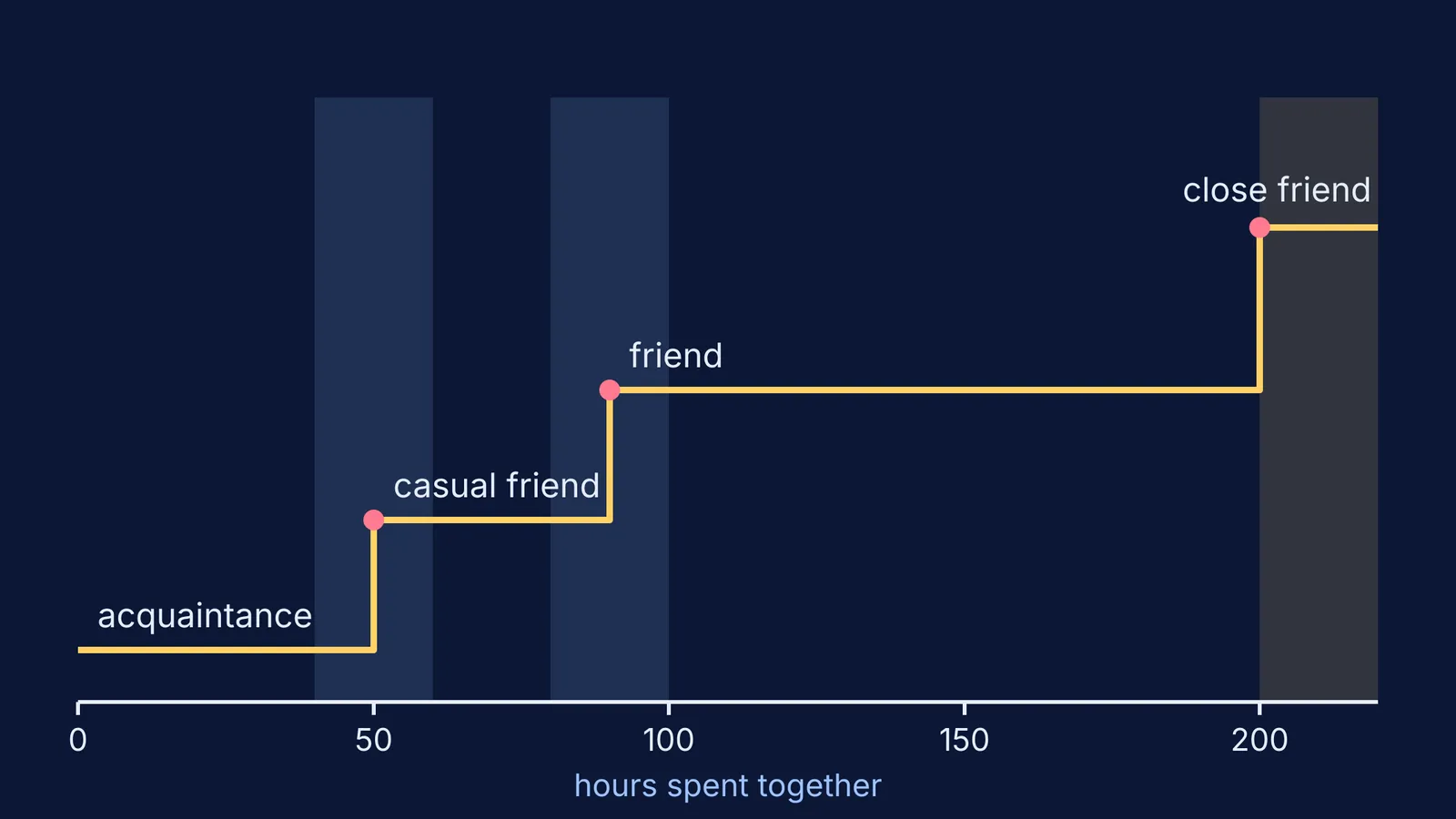
Friendship is built from time together. Communication researcher Jeffrey Hall at the University of Kansas surveyed 355 adults who had recently moved and followed 112 first-year university students (Hall, 2019). The University of Kansas summary of that work says it takes roughly 40 to 60 hours together to become casual friends, 80 to 100 hours to become friends, and more than 200 hours to become close friends (University of Kansas). Hall found that relaxed time, such as hanging out and joking around, mattered more than time spent working side by side.
Hall studied adults, not school children, so treat the numbers as a rough guide. Try the arithmetic: at 30 minutes of real free time with one classmate each school day, 50 hours takes about 100 school days, roughly half an academic year. Break time, the bus, clubs and weekend visits count; sitting in the same classroom counts for little.
What small things help a child make friends at a new school?
You cannot make friends for your child, but you can add hours and lower the stakes.
Look for one name, not ten. Ask who they sit near, who made them laugh, who is also new.
Turn class time into free time. Invite that classmate over, or meet at a park on Sunday. A short visit with a shared activity beats a big party.
Add one regular activity. A sports team or science club brings the same faces every week; our post on whether sports and hobbies hurt marks helps you weigh the time.
Keep old friends going. STARS found that children whose friendships stayed stable did slightly better academically and in behaviour (STARS report). A weekly call with an old friend helps.
Talk, and keep your own worry low. STARS suggested it helps parents and children to talk about their worries, but children whose parents were highly worried settled in less well academically. Listen more than you fix.
If the new school has also left gaps in maths or science, Fermi's AI tutor can work out what your child already knows and build a plan for the session, so catching up takes less of the evening that could go to a friend.
When should you talk to the class teacher?
Talk to the class teacher if, after about half a term, your child still eats alone, mentions no names, or does not want to go to school, and straight away if they are teased or left out on purpose.
STARS schools supported friendships with team-building and balanced class groups, clubs, peer mentors, and telling parents about difficulties (STARS report). A three-step plan for the meeting:
Ask what they see: 'Who does my child spend break with? Do they join in during group work?'
Ask for one step: a group-work partner who is kind, a buddy, or a nudge towards a club.
Agree a check-in in two or three weeks.
Our guide to parent-teacher meeting questions that lead to follow-up has more ideas.
What if your child stays lonely or very unhappy?
Report bullying to the school in writing. If your child seems low for weeks, sleeps or eats poorly, or refuses school, speak to the school counsellor or your family doctor. Our post on when to get help for stress in teenagers explains the signs. In India, Tele MANAS offers free mental health support on 14416 or 1800-891-4416.
For most children, the answer is time and a few good hours with the right classmate. Start this week with one name and one invitation.