On this page
When a teenager asks, "Can I stay home this week and just study?", it usually comes from a real place: school feels slow, the syllabus feels huge, and home feels like more time. Sometimes a day or two of leave is sensible. Often it costs more than it gives.
Does missing school before an exam hurt marks?
Missed lessons have a measurable cost. In a study of middle and high school students in the US, Liu, Lee and Gershenson found that missing 10 classes lowered maths or English test scores by 3-4% of a standard deviation and course grades by 17-18% of a standard deviation (later published in the Journal of Public Economics).
That research measures lessons lost, so the cost is highest while school is still teaching new chapters, practicals or internal assessments. A day in the final revision week is a different trade. Ask what will actually happen in class on the days your child wants off.
What does CBSE say about attendance before board exams?
In Class 10 and 12 at a CBSE school, attendance is an eligibility rule. CBSE's circular of 4 August 2025 says a minimum of 75% attendance is mandatory to sit the board examinations.
The same circular says:
Leave without a written request is treated as unauthorised absence.
Students found absent without proper leave records during a surprise inspection may be treated as non-attending or dummy candidates and barred from the exam.
Attendance is calculated as of 1 January of the session, and schools must send shortage cases to the regional office by 7 January.
A shortage can be condoned only for reasons such as prolonged illness, the loss of a parent, authorised national or international sports, or something similarly serious, each backed by documents.
Exam preparation is not on that list. State boards, CISCE and individual schools set their own rules, so check with the class teacher first. Our guide to short attendance rules for board exams has more.
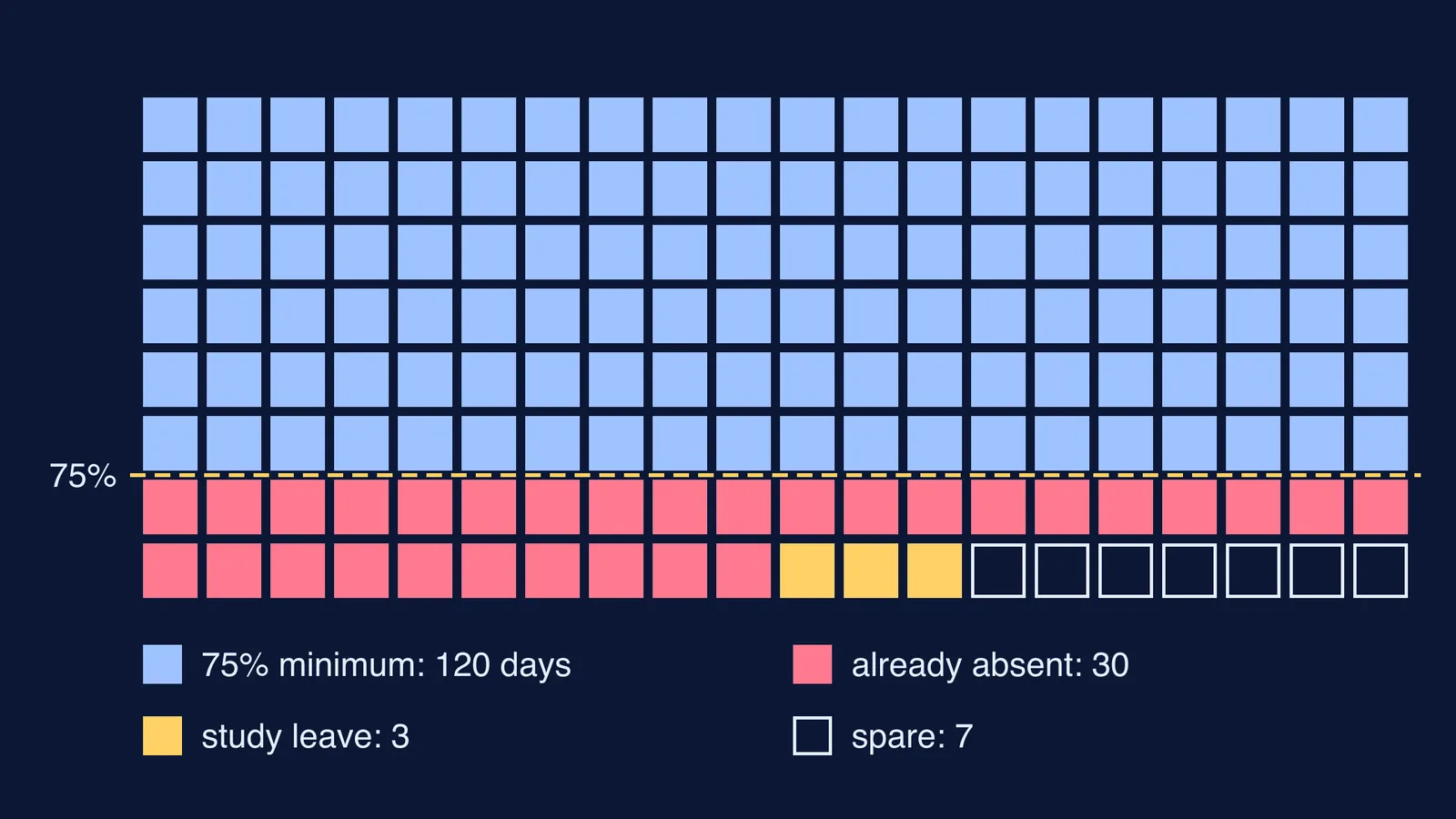
A worked example: say the school will hold 160 teaching days up to 1 January. 75% of 160 is 120, so your child can miss at most 40 days. If they have already been absent for 30, only 10 remain, and one December flu could use them up. Three study days would leave a spare of seven.
Because CBSE counts attendance up to 1 January, its rule matters most for leave before then, such as ahead of half-yearly or pre-board exams. After that, your school's own rules apply.
When does a short study leave make sense?
Leaning yes:
The syllabus is finished and classes are revision your child has already done.
They can say exactly what they will do each day, chapter by chapter.
It is one to three days, not a week, and the attendance sum leaves a clear margin.
Leaning no:
New chapters, practicals or internal assessments are still running.
The plan is "I'll study the whole day" with no list.
Days at home tend to slide into phone time and late sleep.
They want to get away from something at school, not get to something at home.
If the request is really about a falling-out with a friend, trouble with a teacher, or feeling overwhelmed, leave will not fix it. Talk first. If your child seems anxious or low for more than a few days, speak to the school counsellor or a doctor; Tele MANAS, the government's free mental-health helpline, is on 14416.
How do you ask the school for leave before exams?
Ask in writing, before the day. A short note to the class teacher works:
"Dear Ma'am/Sir, my child, [name] of Class [class and section], would like leave on [dates] to revise for the coming exams. We have checked that their attendance stays above the required level. Could you let us know if a test, practical or anything important is planned on those days? Thank you."
Keep a copy. If a test or practical falls on those dates, your child goes to school.
How should you plan the study days at home?
Treat a day at home like a school day:
Start at the usual school time, at a desk, phone in another room.
First block: the hardest subject, solving past-paper questions rather than rereading notes.
A short break, then a second block on the next subject.
After lunch, mark the morning's answers and fix the idea behind each mistake.
Late afternoon, attempt one timed section of a sample paper.
In the evening, a short check-in with a parent against the morning's list, then sleep at the normal time.
If your teen does not know where to start, Fermi's AI tutor can work out what they already know and build a plan for the session, so the first block begins with a clear next step. When a worked answer does not match the key, the Fermi Problem Library has a step-by-step solver that explains the reasoning.
For more detail, read how to help your teen plan a full self-study day and our day-by-day plan for using board exam study leave.