On this page
Most parents only talk about studies when something has gone wrong: a low test score, an unfinished worksheet, a phone at midnight. A weekly check-in changes the timing. Once a week, at a fixed time, you and your child look back at what went right, then pick one small thing to do next. It takes 15 minutes and one notebook.
Why do small, near goals motivate better than big ones?
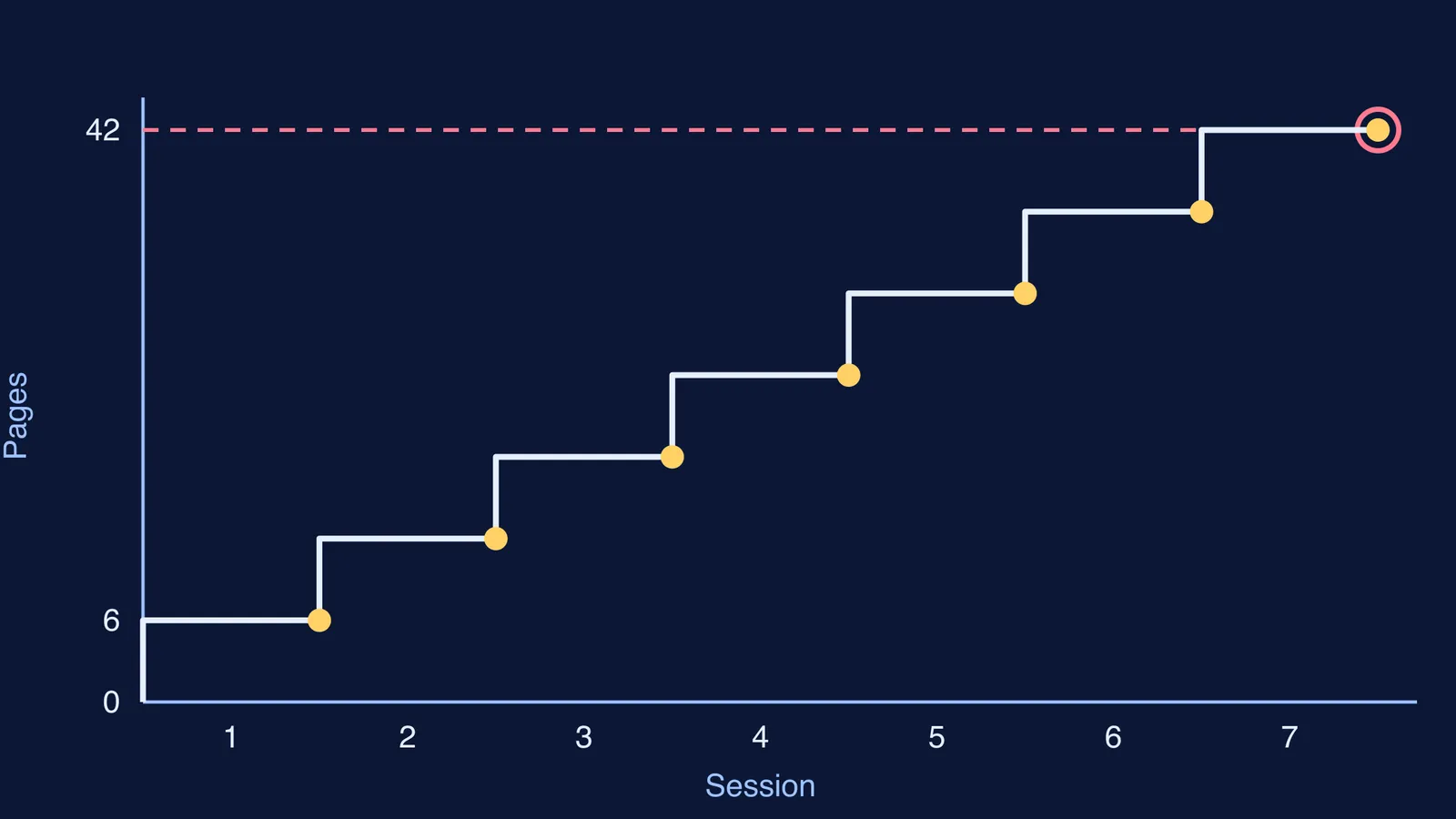
A classic experiment comes from Albert Bandura and Dale Schunk at Stanford University, published in 1981 (Journal of Personality and Social Psychology). They worked with 40 children aged about 7 to 10 who had big gaps in arithmetic and little interest in it. Over seven 30-minute sessions on consecutive school days, children worked on their own through 42 pages of subtraction material.
The experimenter suggested that one group might set themselves a goal of at least six pages each session, and that another might aim to finish all 42 pages by the end of the seventh session. Same material, same total.
Children with the session-sized goals made rapid progress, reached substantial mastery, and developed confidence and real interest in arithmetic; the single distant goal had no demonstrable effect (Bandura and Schunk, 1981). A near goal shows you what to do today, and that you did it.
In that study, the distant goal was only seven school days away. So break a weekly goal into daily steps, as in the example below.
Seeing progress matters too. A 2016 review of 138 studies with 19,951 participants found that monitoring progress towards a goal helped people reach it, and helped more when progress was physically written down or shared with others (Harkin and colleagues, Psychological Bulletin). A weekly check-in does both: the win goes into a notebook, and a parent hears it.
What should you praise when your child does well?
Praise the process, not the brain. In six studies, Claudia Mueller and Carol Dweck found that praising children for intelligence had more negative effects on motivation than praising them for effort (Mueller and Dweck, 1998). After a failure, fifth graders who had been praised for intelligence persisted less, enjoyed the task less and performed worse than those praised for effort.
So skip “You’re so clever.” Try “You did all ten questions before checking the answers.” Good praise names something your child did and can do again.
How do you run a 15-minute weekly check-in at home?
Pick a fixed slot, such as Sunday after dinner. Phones away.
Look back (5 minutes). Ask, “What’s one thing from this week you’re glad you did?” Then add two specific observations of your own: “You asked your teacher about the doubt in Chapter 3.”
Check last week’s goal (2 minutes). Done, partly done or not done. No lecture. Ask, “What made it easier or harder?”
Set one small goal (5 minutes). Let your child propose it. Your job is to shrink it until it is concrete, doable in seven days and broken into daily steps.
Write it down (3 minutes). Date, wins, goal and when it will happen. Your child writes, not you.
If check-ins keep turning into arguments, our guide on how to stop nagging your teenager to study has ways to hand the planning back to them.
What does a good small goal look like?
Take Meera, a Class 9 student, after a week where she missed two maths homeworks but finished a science chapter early.
Wins her parent names: “You finished the motion chapter two days early. You also redid the three sums you got wrong in Tuesday’s class test.”
Her first idea: “Full marks in the next maths test.” That depends on the paper, not just on her.
Shrunk: “Do maths homework the same evening it is set, before dinner, on at least four school days.”
Next Sunday: she managed three days. A partial win; next ask what got in the way on the other two.
The pattern is to move from an outcome to an action she controls, with a number and a time attached. If your child sets huge targets, see how to keep a big goal but add checkpoints.
Sometimes the goal is a stuck topic and your child does not know where to begin. Fermi’s AI tutor works out what a student already knows and builds a plan for the session, so the week’s goal can be “two sessions on quadratic equations” rather than “understand quadratics”.
Should you reward the wins?
Keep rewards small and occasional, and keep the noticing constant. For more on prizes and marks, read our guide on whether to give rewards for good marks.
If your child seems overwhelmed for longer than a bad week, Tele MANAS, India’s free 24x7 mental health helpline, is on 14416 or 1800-891-4416 (Tele MANAS).
Start this Sunday with one notebook and one question: what went right this week?