

On this page
Your Class 11 child comes home and says they are going for a top-100 rank in JEE Advanced. Most parents want to say "be realistic", but that usually starts an argument and changes nothing. A better move is to keep the goal and add checkpoints: points every few weeks where you both find out whether the plan is working.
Is a top-100 rank an unrealistic target?
It is a rare result. To sit JEE Advanced 2026, candidates had to be among the top 2,50,000 successful candidates in the B.E./B.Tech. paper of JEE Main 2026, according to the official JEE Advanced eligibility page. A top-100 rank means finishing at the very front of a group that has already been filtered.
But neither you nor your child can know today whether they will make it. The goal itself is not the problem. The real problem is a goal with no feedback, because it cannot tell anyone the plan is off track until results day.
Why do checkpoints work better than arguing about the goal?
Because tracking progress has been tested directly. A 2016 meta-analysis in Psychological Bulletin pooled 138 studies with 19,951 participants and found that interventions which got people to monitor their progress also helped them reach their goals (Harkin and colleagues, 2016). The same review found larger effects when progress was physically recorded and when it was reported to someone or made public.
A second idea helps with what happens when a checkpoint goes badly. An if-then plan says in advance when, where and how you will act ("if X happens, I will do Y"). A meta-analysis of 94 independent tests found that these plans had a positive effect of medium-to-large size on reaching goals (d = 0.65) (Gollwitzer and Sheeran, 2006).
Together they point to a plan that is written down, checked on fixed dates, with the fix decided in advance.
How do you turn a big goal into checkpoints?
Use three layers:
The goal. Top-100 stays on the wall. Don't renegotiate it every week.
Outcome checkpoints every six weeks. A full-length mock under exam conditions, compared with your child's own starting score, not with friends or toppers.
Process checkpoints every week. Things fully in their control: chapters finished, problems attempted, errors from the last test redone.
Then add one if-then rule for each layer, agreed in a calm week.
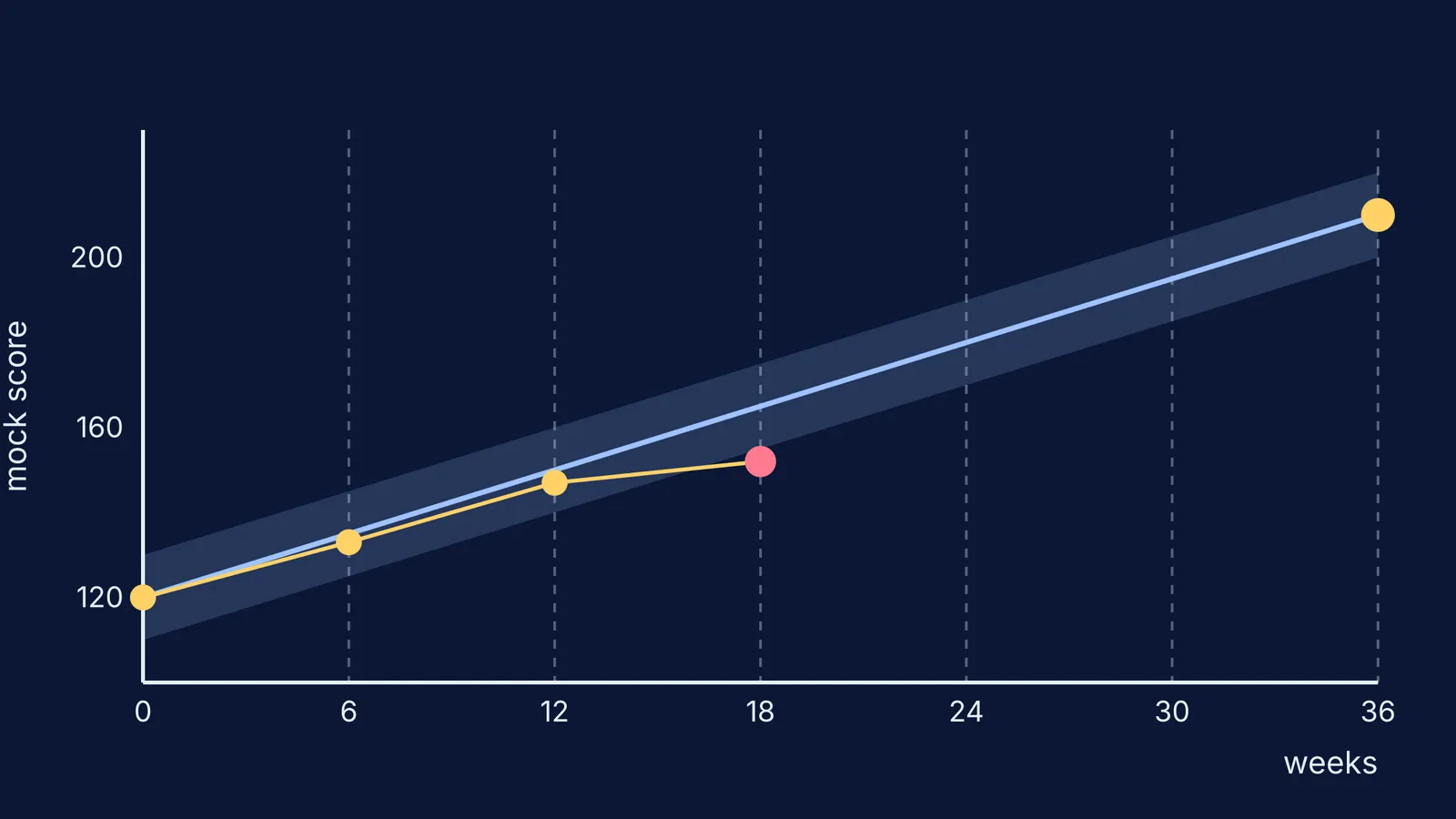
A worked example. These numbers are only an illustration. No mock score maps neatly onto a rank, so set the starting point and the rate of improvement with your child and their teachers.
Week 0: first full mock, 120 out of 300. The plan is to gain 15 marks per six-week block, reaching 210 by week 36. "On track" means within 10 marks of the planned line.
Week 6: 133, against a plan of 135. On track.
Week 12: 147, against a plan of 150. On track.
Week 18: 152, against a plan of 165. Below the band, so the pre-agreed rule kicks in: a review, not a lecture.
The review starts with one question: was the weekly process actually done? If not, the plan was too heavy, so shrink it to fit a real week. If it was done and scores still stalled, change the method: go through the mock chapter by chapter (our guide on how to analyse a mock test walks through it) and spend the next block on the chapters losing the most marks. If a checkpoint shows gaps in a few chapters, Fermi's AI tutor can work out what your child already knows and build a plan for the session, so the next block starts with a clear task.
What should you say when your child names a huge target?
Try something like this:
"That's a big goal, and I like that you're aiming high."
"How will we know in six weeks whether it's working?"
"What would you change if you're behind at a checkpoint?"
"Where do you want to write the scores so we can both see them?"
Leave out "be realistic", comparisons with cousins, and any hint that your approval depends on the rank. Let your child own the numbers: it is their plan, and they should be the one checking it. For more, read about where expectations turn into pressure and how to teach planning skills.
When is it more than ambition?
Sometimes a huge target sits on top of a lot of fear. Watch for lost sleep, panic before tests, or talk of being worthless if they miss the rank. If you see these signs, talk to a school counsellor or a doctor. Tele MANAS, the government's free mental health helpline, is available on 14416 or 1800-891-4416, around the clock (PIB, Ministry of Health and Family Welfare).
For most families, though, the fix is simpler: keep the dream, write down the next checkpoint and agree now what you will do if you miss it.


