On this page
A home library needs a shelf your child can reach, a steady trickle of new books, and a mix that keeps up with their age. Most of those books can come second-hand, swapped or borrowed. Here is what the research says, where to find books cheaply in India, and a 12-month plan.
How many books does a home library need?
The best-known evidence comes from sociologist M.D.R. Evans and colleagues, who compared families across 27 nations in Family scholarly culture and educational success (2010). In that study, children who grew up with a 500-book home library went on to 3.2 more years of education, on average, than children from homes with no books (University of Nevada, Reno). The same summary notes that having as few as 20 books at home still made a significant difference.
A 2019 follow-up by Joanna Sikora, Evans and Jonathan Kelley used adult skills tests from 31 societies and found that books at home in adolescence were linked to better adult literacy, numeracy and technology skills, beyond what parents' education explained (Social Science Research). The authors report that the gains are largest when small libraries grow (ANU abstract). Adults who grew up with around 80 books tended to have average literacy scores, and scores kept rising up to about 350 books before levelling off (Mental Floss summary).
One caution: these studies observe families rather than run experiments, so books may partly stand for a home where reading is valued. Still, the gains are steepest early, which is good news on a budget.
Where can you find cheap or free books in India?
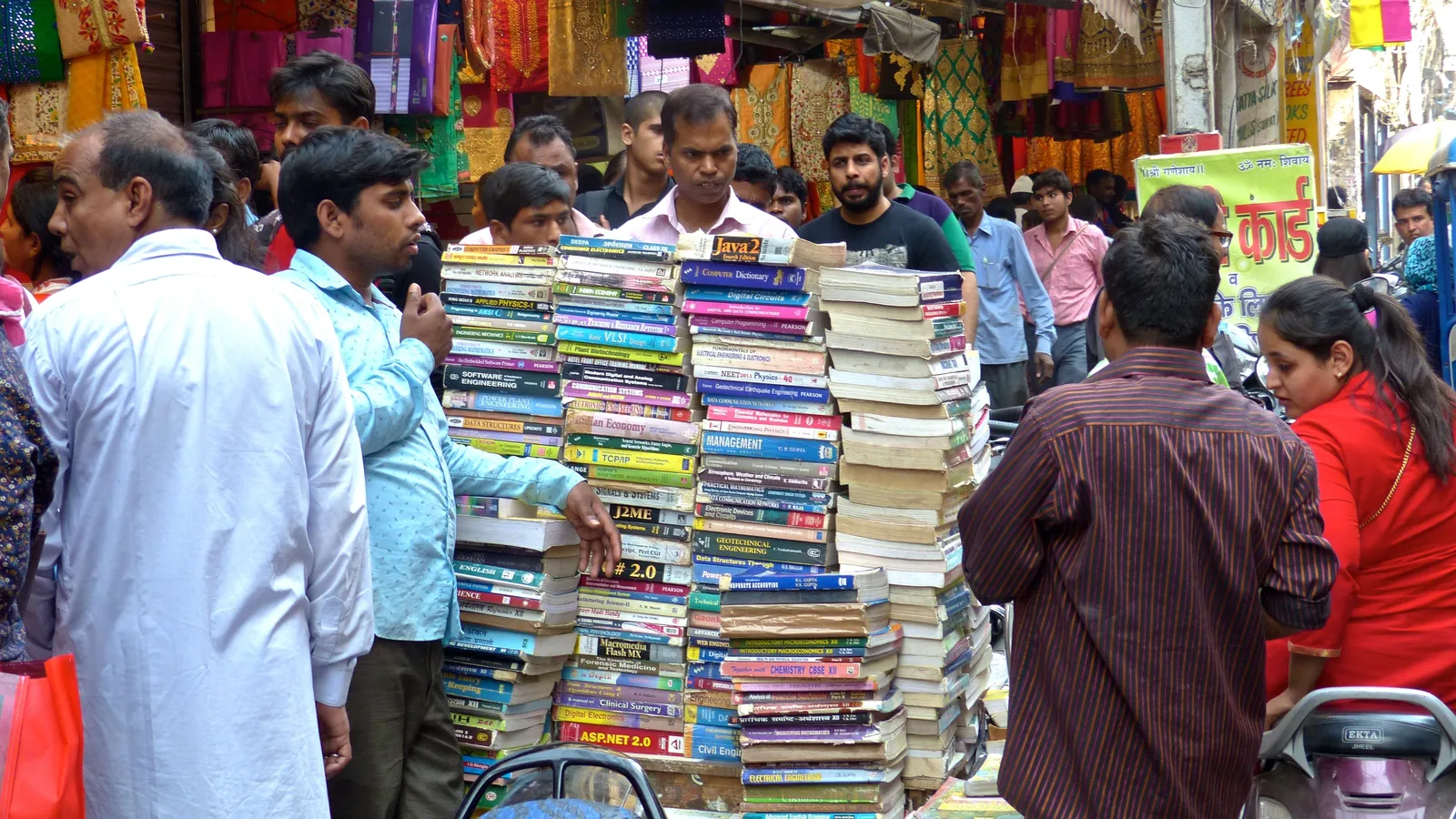
Second-hand markets. Street stalls such as Delhi's Nai Sarak sell used books (Wikimedia Commons), and so do Kolkata's College Street sellers (Wikimedia Commons). Check that no pages are missing.
National Book Trust. The Government of India set up the NBT in 1957 to publish good books in English, Hindi and other Indian languages at moderate prices, including books for children (NBT citizen's charter). Look for its stalls at book fairs and its mobile exhibition vans.
StoryWeaver. Pratham Books' StoryWeaver offers openly licensed children's stories that are free to read, download and print; its storybook collection with Pratham Education Foundation is CC BY 4.0 and covers languages including Hindi, Bangla, Marathi, Telugu and Urdu (StoryWeaver).
National Digital Library of India. NDLI is funded by the Ministry of Education, hosted by IIT Kharagpur, free to register, and has a separate school education section (NDLI).
Public and school libraries. Ask what children can borrow and for how long; a membership turns a fixed shelf into a rotating one.
What mix of books should a child's library have?
Think in three shelves, and let the balance shift with age. This is our suggested split, not a research finding.
Stories (about half). Picture books and folk tales for under-8s; series and adventure for 8 to 12; novels, biographies and graphic novels for teenagers. Stories build the habit, so let your child pick most of these.
Science and how things work (about a third). Books on animals, space, the body and machines for young children; experiment books and lives of scientists for middle school; popular science for teens.
Reference (the rest). A good dictionary, an atlas, a bilingual word book if you speak another language at home, and, for teenagers, a sound reference text in the subjects they find hardest.
Reference books answer “what is it?” but not always “why does it work?”. For a teenager stuck on a science idea the textbook explains in one dry paragraph, the Fermi Concept Library has a lesson for every concept in physics, chemistry, biology, mathematics and computing.
How do you run a book swap with other families?
Swaps bring new books onto the shelf for free. Keep the rules simple:
Each child brings books they have finished and would recommend.
One book in, one book out, chosen by the child.
Meet monthly, at a housing society hall or after school.
A script for the first message: “We're starting a small book swap for children aged 8 to 12. Bring two or three books your child has finished; each child takes home the same number. First Saturday of the month, 5 pm, in the society hall.”
What does a 12-month plan look like?
Month 1: Clear one low shelf. Count what you own. Join one library.
Months 2 to 4: One second-hand market trip a month; buy two stories and one science book each time.
Month 5: Start or join a swap.
Months 6 to 9: Add one reference book, print a few StoryWeaver titles in your home language, and keep borrowing.
Months 10 to 12: Prune books your child has outgrown into the swap, and ask them to choose next year's wish list.
Once the shelf exists, the habit matters more than the count; our guides to building reading for pleasure, shared reading with young children and setting up a home study space take it from there.