

On this page
Class 5 annual exams are often the first time a child sits several papers in a fortnight. The good news: a ten-year-old does not need long hours. They need to know exactly what is coming, practise pulling answers out of memory, and sleep well. Here is how to set that up in four weeks.
Class 5 also matters to the system, not just your child. India's National Education Policy 2020 says that, to track students' progress through school, examinations will be conducted in grades three, five and eight (PRS summary of NEP 2020). How your school runs and grades its Class 5 exam depends on your board and state, so treat the school's own circular as the final word.
What should you collect before revision starts?
Spend one evening gathering three things.
The exact syllabus for each paper. Ask the class teacher or check the school app for the annual exam portion list. Note which chapters are in, and whether any term-one chapters come back.
The exam timetable, including gaps between papers. A two-day gap before maths changes your plan.
Sample questions. Use the textbook's end-of-chapter exercises, last year's school papers if the school shares them, and the class tests and notebooks from this year. NCERT textbooks for Class 5 can be downloaded as PDFs from the NCERT textbooks page.
Then sit with your child and sort every chapter into three piles: "I know it", "a bit shaky" and "help". Let them sort; it shows where the next four weeks should go.
If the school reports grades, our guide on reading primary-school grades instead of marks explains what they tell you.
How should a Class 5 child revise?
Use quizzes, not rereading. In a large review of ten study techniques, John Dunlosky and colleagues rated practice testing and distributed practice (spreading study over days) as high utility, and rated rereading and highlighting as low utility (Dunlosky et al., 2013). In an earlier experiment, students who took recall tests remembered more of a passage a week later than those who restudied it, even though restudying made them feel more confident (Roediger and Karpicke, 2006).
For a Class 5 child, a daily session can look like this:
Recall first: book closed, "Tell me three things you remember about the water cycle."
Check and fill gaps: open the book and look at only what they missed.
Three questions: from the exercise or a sample paper, answered in the notebook.
Stop while it still feels easy. Two short blocks with a break beat one long sitting.
If you want a refresher on how a maths topic like fractions or area builds up before you explain it, the Fermi Concept Library has its own lesson for every concept in mathematics, physics, chemistry and biology.
What does a four-week plan look like?
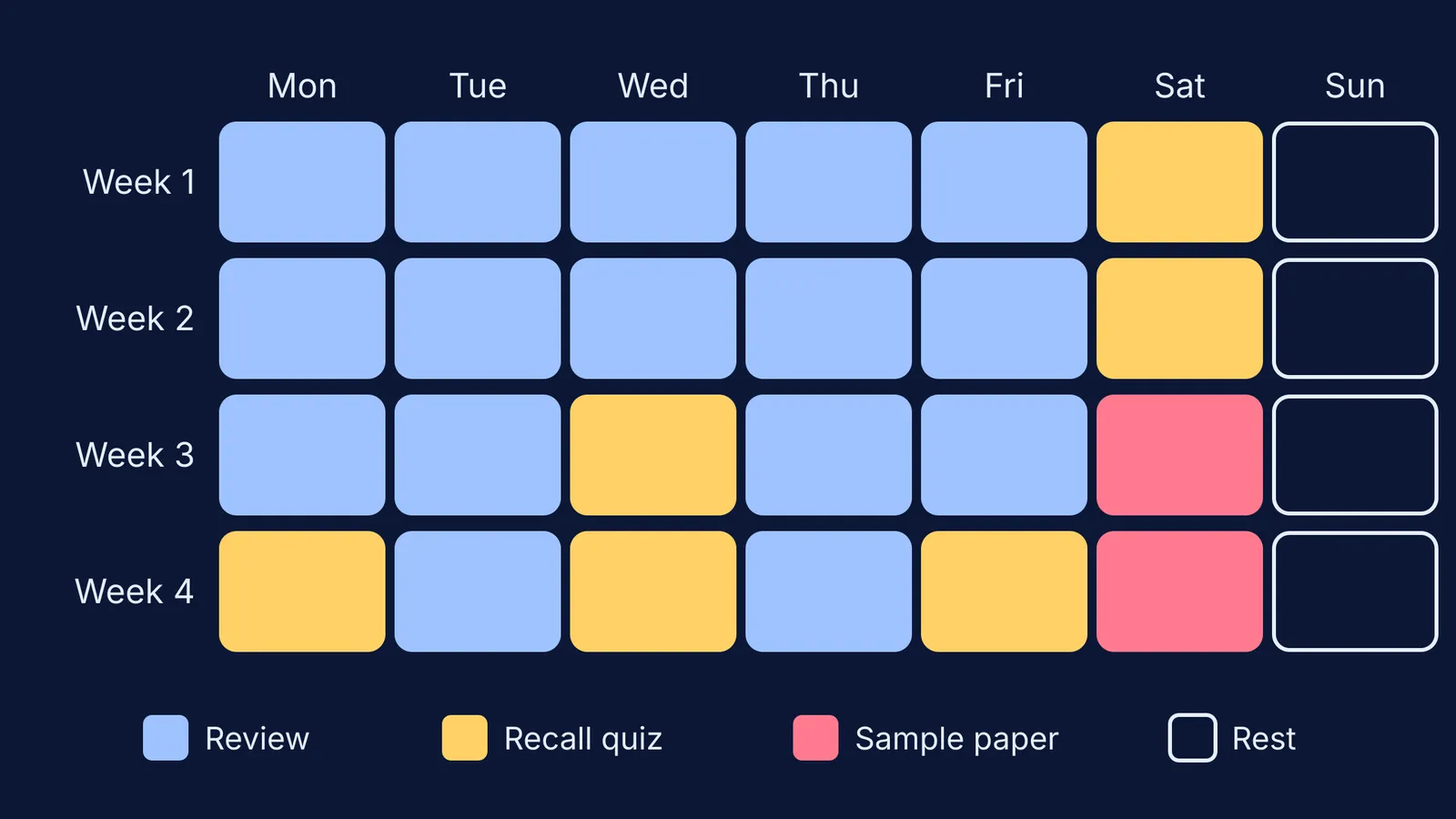
This is the plan in the diagram above. Adjust the days to your timetable.
Weeks 1 and 2: Monday to Friday, one chapter a day using the recall routine, starting with the "help" pile. Saturday, a mixed quiz on that week's chapters. Sunday, rest.
Week 3: revise shaky chapters on Monday, Tuesday, Thursday and Friday. Wednesday, a mixed quiz. Saturday, one sample paper at the table, timed like the real exam.
Week 4: alternate quiz days and review days. Saturday, a second sample paper. Sunday, rest.
During exams: the evening before each paper, a light recall quiz and the bag packed. No new chapters.
When you mark a sample paper, circle the mistakes together and ask "what would you write now?" rather than correcting it yourself. For short tests during the year, see our three-day plan for a class test.
How do you keep the routine calm?
Sleep is part of revision. The American Academy of Sleep Medicine says children 6 to 12 years of age should sleep 9 to 12 hours per 24 hours, and links enough sleep with better attention, learning and memory (AASM advisory). Do not cut it to fit in more study.
Keep the rest of the day ordinary: play outdoors, meals at the usual time, screens off well before bed. What you say matters too. Try:
"Let's see what you remember, not what you've forgotten."
"That one was hard. Which question would you like to try again?"
After a paper: "What was the easiest question?" instead of "How many marks will you get?"
If the worry is mostly yours, our piece on managing your own anxiety about your child's exams has practical steps. If your child has stomach aches, tears or trouble sleeping that last beyond exam week, speak to their doctor or school counsellor. Tele-MANAS, the government's free 24x7 mental health helpline, is on 14416 or 1800-891-4416 (IIT Kanpur counselling centre).
Tonight, start with step one: ask for the syllabus and sort the chapters together.


