

On this page
Weekly class tests are small, but the panic before them usually starts the same way. On Thursday night your child remembers that Friday is the science test, rereads the chapter, feels fine, and then goes blank in class. Doing more hours doesn't fix this. What helps is three short evenings, each with one job.
Why does rereading feel ready but fail in the test?
Rereading makes a chapter feel familiar, and familiar feels like learned. Henry Roediger and Jeffrey Karpicke tested this in a 2006 study in Psychological Science: students either reread prose passages or took recall tests on them without feedback. On a test 5 minutes later, the rereaders did better. On tests 2 days and 1 week later, the students who had tested themselves remembered substantially more, even though the rereaders felt more confident.
Practice testing means pulling answers out of memory with the book closed. A 2013 review by John Dunlosky and colleagues rated ten study techniques and gave practice testing and distributed practice (spreading study over several sessions) its highest utility rating. Rereading and highlighting were rated low.
What does a three-day test plan look like?
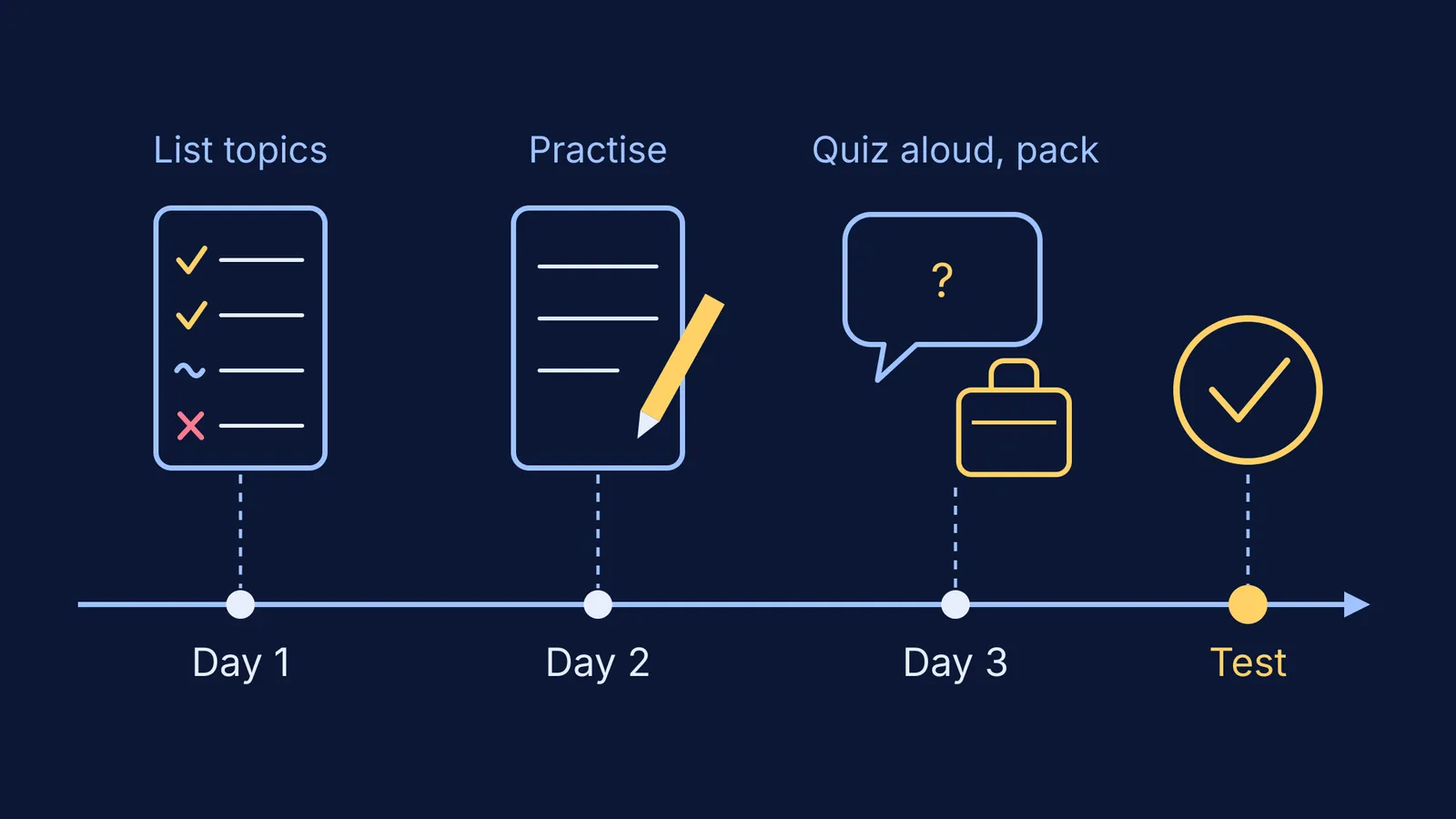
The plan is distributed practice in miniature, built on recall rather than rereading, the two habits the Dunlosky review rated highest. For a weekly test, a short session each evening is usually enough; adjust the length to the chapter and to your child.
Day 1 (three evenings before): list the topics
Your child finds out exactly what the test covers from the school diary, the teacher's announcement or the class group.
They write every topic on one page: "Refraction through a glass slab", "Laws of refraction", "Numericals on refractive index".
Next to each topic they mark one of three signs: a tick for "I can explain it", a wavy line for "shaky", a cross for "lost".
Your job is to ask, not tell: "Which of these could you teach me right now?" A short list on paper replaces "I have to study everything".
Day 2: practise questions with the book closed
Start with the crosses. Reread that part of the textbook once, then close it.
Answer questions from memory: the chapter exercise, old worksheets, or questions your child writes.
Check against the book and copy every mistake onto a short "fix list".
If a mistake comes from using the wrong method, the Fermi Problem Library has worked problems with a step-by-step solver that explains the reasoning rather than printing an answer.
Day 3 (the night before): quiz aloud and pack the bag
Your child gives you the topic list and the fix list. You ask questions; they answer out loud, as if explaining to a younger cousin. You don't need to know the subject. These work for any chapter:
"Explain this one in your own words."
"Can you give me an example?"
"Which question on the fix list still feels unsure?"
Then pack the bag together: pens, pencils, eraser, geometry box, a calculator if allowed, the ID card and any notebook to hand in. Stop by bedtime. The CDC's sleep guidance recommends 9 to 12 hours of sleep for children aged 6 to 12 and 8 to 10 hours for teenagers aged 13 to 17. Here is why sleep before an exam beats an all-nighter.
What should I say when my child panics before a test?
On a bad night, words matter more than the plan. Try:
"Let's look at the list. How many ticks do you already have?"
"You don't have to know everything tonight. Just the crosses on this page."
"Teach me this one, and I'll tell you if it makes sense."
Try not to say "You should have started earlier" or compare your child with a cousin or classmate. Neither is likely to help them recall anything at 9 pm.
If worry about tests brings stomach aches, lost sleep or tears most weeks, talk to the class teacher or school counsellor. Tele MANAS, the government's free 24/7 mental health helpline on 14416, offers counselling that covers exam anxiety, says a Press Information Bureau note.
How much should a parent do?
Less each month. At first you might sit through all three evenings; later your child makes both lists alone and you only run the Day 3 quiz. See when to help with homework and when to step back.
If a cross won't go away because a whole idea is missing, the Fermi Concept Library gives every concept in physics, chemistry, biology, mathematics and computing its own lesson. For half-yearly and board exams, stretch the same three steps over weeks with a 4-week spaced revision schedule for any chapter.
Tonight, ask your child one question: "When is your next test, and what's on it?" Then you have your Day 1.


