

On this page
When parents open a primary school evaluation to find letter grades, colour bands, or descriptive statements instead of marks out of 100, it often triggers anxiety. Without percentages, comparing results across a classroom feels impossible. Yet developmental psychologists and curriculum boards deliberately avoid numerical scores in primary grades. In India, this shift is codified under the National Education Policy 2020 through the official CBSE Holistic Progress Card portal, which evaluates progress across cognitive, affective, and psychomotor domains without exam stress, aligning with Section 29(2) of the Right of Children to Free and Compulsory Education Act, 2009.
Why do primary schools give grades instead of marks?
Young children rarely separate intellectual ability from self-worth. When a child receives a low mark, they do not interpret it as a signal to review multi-digit subtraction. Instead, they view it as a global verdict on their intelligence. This fosters fear of failure, encouraging children to avoid challenging questions to protect self-esteem.
Descriptive feedback replaces rank with progress milestones. Rather than comparing pupils, descriptive reporting identifies what a child achieves independently, what requires prompting, and which concept needs consolidation next. This keeps attention focused on task mastery rather than social standing.
What does educational research say about marks versus comments?
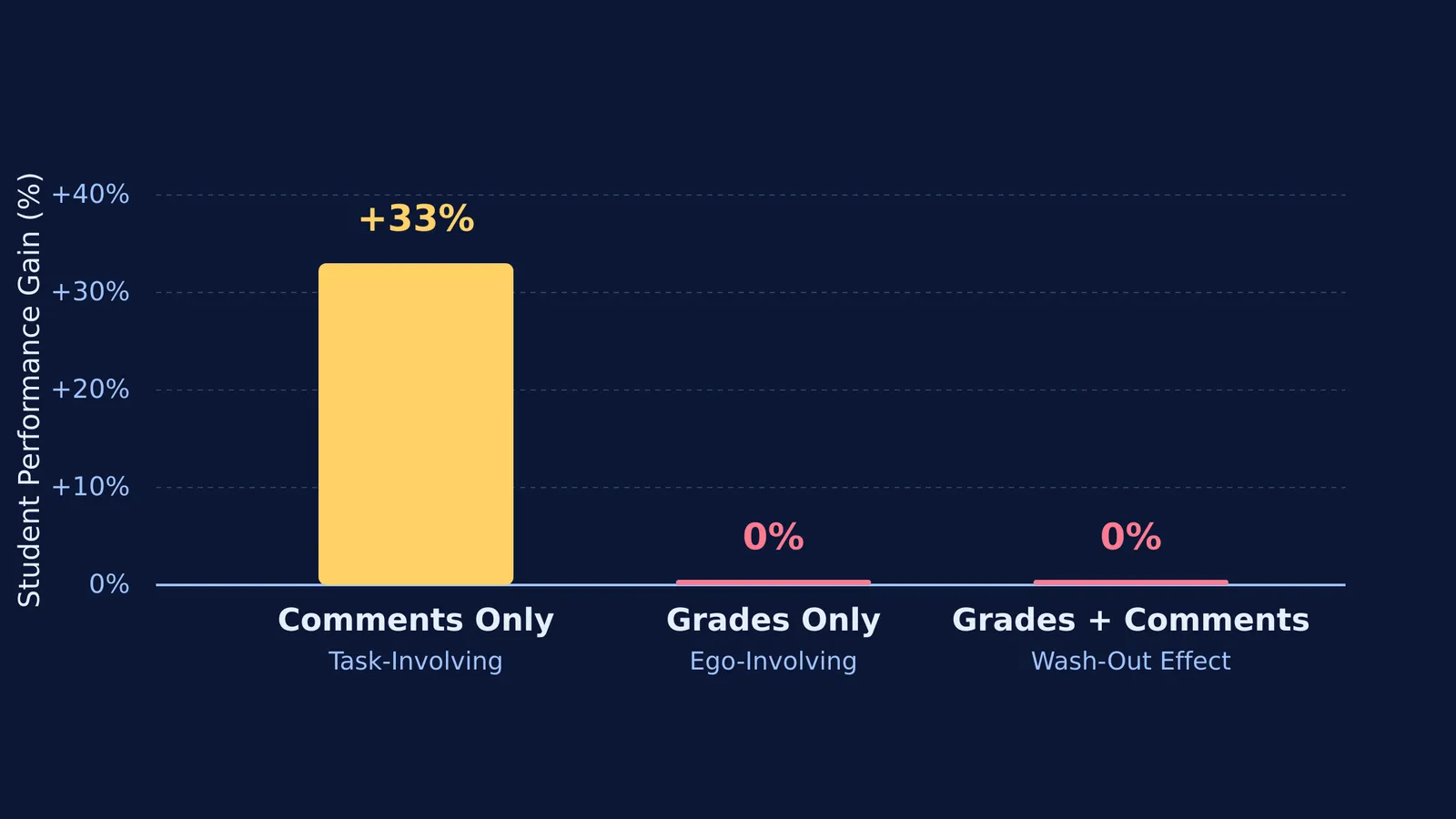
The pedagogical decision to remove numerical marks rests on robust experimental findings. In a seminal 1988 study published in the *British Journal of Educational Psychology* (DOI: 10.1111/j.2044-8279.1988.tb00874.x), educational psychologist Ruth Butler examined feedback across 132 fifth- and sixth-grade pupils in 12 classrooms. Students completed problem-solving tasks under one of three conditions: diagnostic comments only, numerical grades only, or grades plus comments.
The results showed a striking divergence:
Pupils receiving diagnostic comments only achieved a 33% performance gain on subsequent tasks and maintained high intrinsic interest.
Pupils receiving numerical grades only showed zero net improvement in performance, fixating on comparing scores against peers.
Crucially, pupils receiving both grades and comments performed no better than those receiving grades alone.
Educational researchers describe this finding as the "wash-out effect." When a mark appears on the page, a child fixates on the score. The number triggers ego-involvement—anxiety over rank—causing them to ignore constructive guidance.
In their 1998 review of over 250 assessment studies published in *Assessment in Education* (DOI: 10.1080/0969595980050102), Paul Black and Dylan Wiliam found that formative, descriptive feedback raises achievement by 0.4 to 0.7 standard deviations, whereas competitive marks undermine lower-achieving students. A meta-analysis of feedback interventions by Avraham Kluger and Angelo DeNisi (DOI: 10.1037/0033-2909.119.2.254) confirmed that in 38% of feedback cases, feedback directed at the ego rather than the task reduced performance.
When a report identifies a foundational concept gap in mathematics or science, Fermi's AI tutor works out what a student already knows, builds a plan for the session, and checks understanding as it goes. If a child needs to revisit core principles, the Fermi Concept Library maps every concept in physics, chemistry, biology, mathematics and computing, each with its own lesson and its place in the map.
How do you read a descriptive Holistic Progress Card?
Modern primary school cards designed under the CBSE Holistic Progress Card framework replace marks with developmental stages and descriptive rubrics. In the Foundational and Preparatory stages, boards typically use a three-tier descriptor scale:
Beginner: The child understands the objective only with direct teacher guidance.
Progressing: The child performs the task independently in familiar contexts but requires prompting with unfamiliar variations.
Proficient: The child applies the concept independently across novel tasks and can explain their reasoning.
To extract actionable insight, focus on the specific learning outcome described rather than the category. For example, consider this remark: "Adds two-digit numbers without carrying independently; requires physical counters when regrouping across tens."
A conventional percentage mark obscures this insight entirely. The descriptive sentence tells you that while addition mechanics are secure, your child's mental model of base-ten place value still relies on concrete objects. Rather than assigning repetitive worksheets, you simply need visual bundling practice with straws or blocks.
Understanding how to interpret these observations also changes home support. Instead of drilling timed tests or over-monitoring errors, parents can calibrate when to step in on homework mistakes and decide when running low-stakes practice tests at home serves a diagnostic purpose rather than an evaluative one.
What questions should you ask the teacher at a parent-teacher meeting?
When a report card offers descriptive indicators, parent-teacher meetings become diagnostic check-ins. To turn observations into practical home routines, ask these four questions:
"Which classroom tasks show my child progressing independently, and where do they still need teacher guidance?"
"Can we look at portfolio samples—one completed with confidence and one where they hesitated?"
"Is that hesitation rooted in reading comprehension, procedural memory, or concept understanding?"
"What is one specific activity we can practice together each day over the coming month?"
If a teacher mentions that your child takes longer to grasp specific units, explore what questions to ask when a teacher flags learning pace before jumping to conclusions about overall academic potential. Primary school assessments are designed to map the learning journey as it unfolds, ensuring children develop the resilience and confidence required for later academic years.


