On this page
If you are preparing for NEET-UG, you have probably heard someone say that AI will make doctors unnecessary by the time you finish your MBBS. It is a fair worry: AI already reads X-rays and mammograms in real hospitals. But look closely and AI is taking over parts of tasks, not the job of being a doctor.
What does AI actually do in medicine today?
Most working medical AI reads images or sorts patients by risk so that urgent cases are seen first.
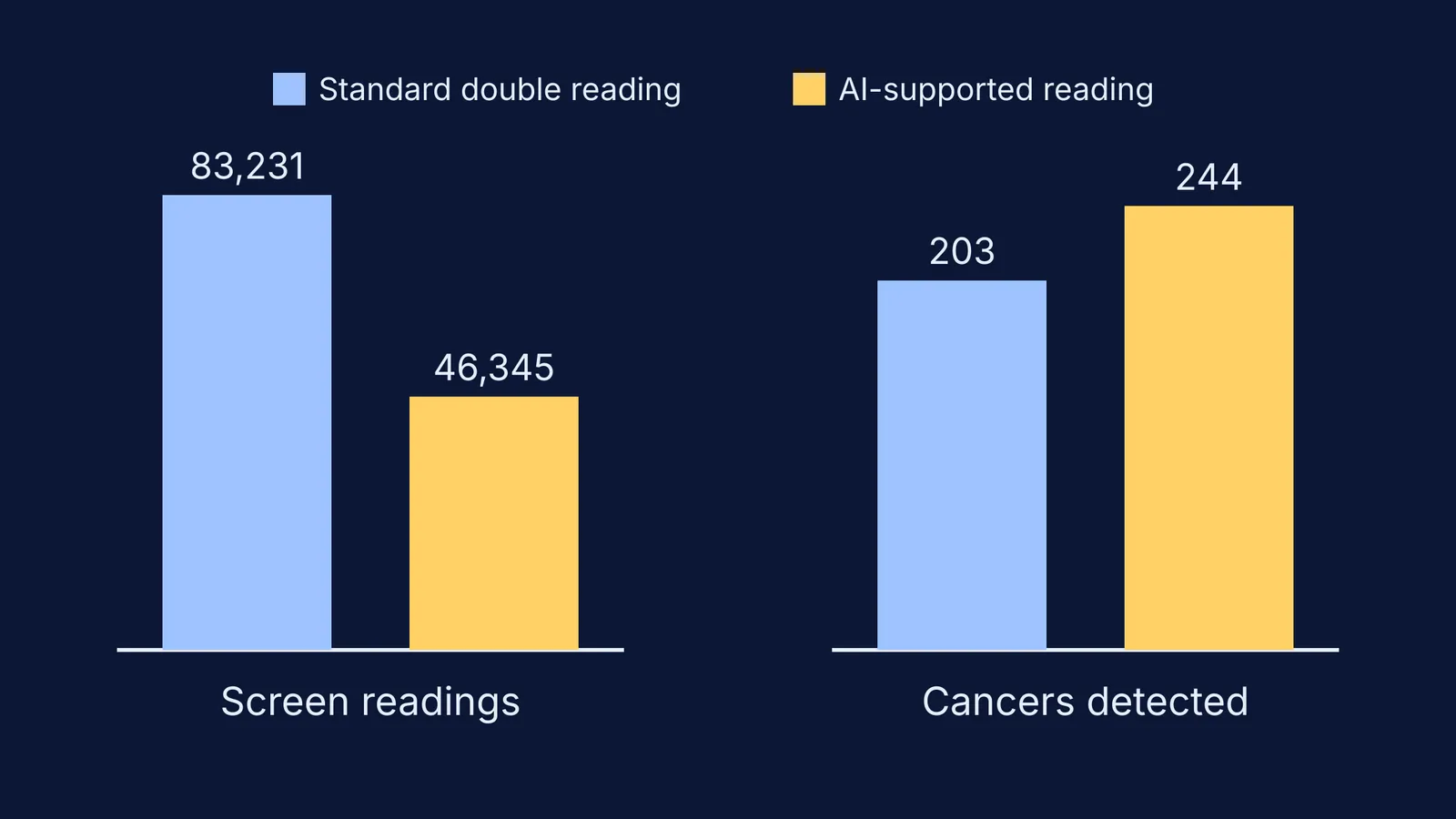
The strongest evidence comes from breast cancer screening. In the MASAI trial in Sweden, 80,033 women were randomly assigned either to AI-supported screening or to standard reading by two radiologists (Lång and colleagues, The Lancet Oncology, 2023). The AI gave each mammogram a risk score. Lower-risk scans went to one radiologist, and the highest-risk scans went to two.
The AI-supported group had 244 cancers detected against 203 in the standard group (a gap that was not statistically significant), and the screen-reading workload fell by 44.3%. What did not change: a radiologist still read every scan.
India has a direct stake in a second use. WHO reports that six computer-aided detection products met its performance standards for screening for tuberculosis on chest X-rays in people aged 15 and older (WHO policy statement, 2025). WHO does not yet recommend these tools for children under 15. A flagged X-ray is a reason for further testing, not a diagnosis.
Where does medical AI go wrong?
AI tools can look impressive and still fail with real patients. Researchers at the University of Michigan tested a sepsis prediction model used in hundreds of US hospitals on 38,455 hospital stays (Wong and colleagues, JAMA Internal Medicine, 2021).
The model missed 1,709 of the 2,552 patients who developed sepsis (67%), while raising alerts for 18% of all hospitalised patients. Too many false alarms train staff to ignore alerts. For why accurate-sounding tests still produce false alarms, read why a positive on a 99% accurate test may be a false alarm.
What still needs a doctor?
The World Health Organization's guidance on AI in health says that humans should remain in control of health-care systems and medical decisions (WHO, June 2021). In India, the ICMR's 2023 ethical guidelines on AI in healthcare cover ethics review, governance of AI use and informed consent (ICMR).
Here is a worked example of where the human work sits. Say an AI tool flags a chest X-ray at a district screening camp as possible TB:
Someone has to take the history: how long the cough has lasted, weight loss, contact with TB.
Someone has to decide which confirmatory test to order and whether it can wait.
Someone has to explain the result to a worried family in their own language, and get real consent.
Someone has to notice when the picture does not fit, such as a scan that looks normal in a patient who is clearly very ill.
Someone has to take responsibility if it goes wrong.
AI may help with parts of step 2. The rest is judgement, conversation and accountability.
Which skills can NEET aspirants build that AI does not replace?
Indian medical education already treats these as core skills. The National Medical Commission's AETCOM modules (attitude, ethics and communication) were rolled out for the 2019-2020 MBBS cohort, and they train graduates to be clinicians, communicators, leaders, health-care team members, lifelong learners and professionals (Udgiri and Ganganahalli, Cureus, 2024).
You can start now. A weekly plan that fits around NEET preparation, about 20 minutes each:
Explain it plainly. Pick one NCERT biology topic, such as why insulin lowers blood sugar, and explain it to a parent in the language you speak at home. If they cannot follow, you have found a gap.
Ask "how could this be wrong?" When a chatbot gives you an answer, find one condition under which it would fail.
Reason with uncertainty. Do one probability or test-result problem each week, not only recall questions.
Understand, do not just memorise. If you can say why each step in a physiology chain happens, you can reason about cases that do not match the textbook.
See real work. Our guide on whether NEET aspirants can shadow doctors at a hospital explains what to ask for and what to expect.
When a biology concept feels memorised rather than understood, the Fermi Concept Library gives every concept in biology, chemistry and physics its own lesson and its place in the map. Fermi's AI tutor can also decide whether to explain, ask or show, so you practise answering questions instead of only reading answers.
Should you still choose medicine?
AI changes how doctors spend their time; the evidence so far does not show it removing the need for them. If medicine draws you, see what happens after an MBBS in India to plan the longer road.
If worry about the future is making it hard to study or sleep, talk to someone you trust, or call Tele MANAS on 14416.