

On this page
Preparing for NEET is an intense grind. Between mock tests and thick biology textbooks, it is easy to forget why you are putting yourself through it. Many aspirants want to see what actually happens behind a clinic door. Watching a doctor work gives you a look at the real job.
In India, this is usually called an observership or a clinical attachment.
Is shadowing required for NEET?
Unlike the application process for US medical schools—where the Association of American Medical Colleges (AAMC) expects applicants to have clinical exposure—shadowing is not a requirement for NEET-UG. You do not get extra marks for it. Instead, you do it for yourself: to see the long hours, the paperwork, and the way a doctor listens to a patient.
If you are struggling with a concept gap in your studies, you might turn to the Fermi Concept Library, where every concept in physics, chemistry, biology, mathematics and computing has its own lesson and its place in the map. But to understand the career itself, you need to see it in action.
How do you find an observership?
There are two ways to get into a hospital or clinic to observe:
Structured hospital programs. Large private chains sometimes run formal programs. For example, Max Healthcare offers a 4-to-12-week Observership and Clinical Elective program that is open to Class 11 and 12 students. You must apply with a "No Objection Letter" from your school.
Informal arrangements. Government hospitals rarely let high school students shadow because of high patient volumes. Your best chance is a local private clinic or a family doctor. A personal connection goes a long way.
What are the rules of observing?
If a doctor agrees to let you watch, you must follow the rules of medical ethics.
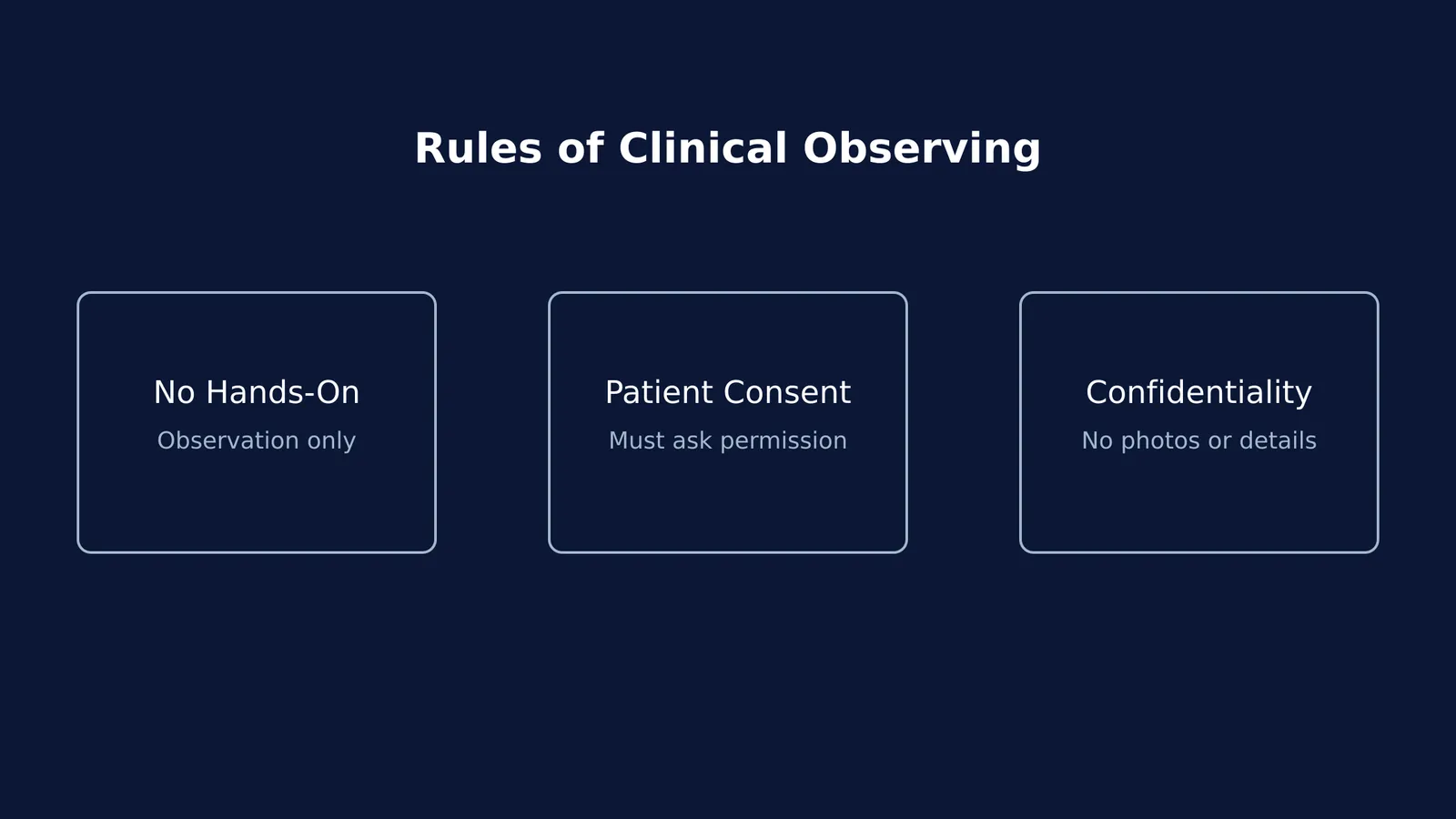
No hands-on work. Under National Medical Commission rules, only a registered practitioner can treat a patient. You cannot take blood pressure, touch a patient, or give advice.
Patient consent. The doctor must ask the patient if they are comfortable with a student being in the room. If the patient says no, you must step out.
Confidentiality. You cannot discuss a patient's medical details outside the clinic. Taking photos of patients or their notes is strictly forbidden.
How do you ask a doctor for an observership?
Approaching a doctor can feel intimidating. Here is a simple framework to make your request professional and clear:
State who you are: "I am a Class 11 student preparing for NEET."
State your goal: "I am considering a career in medicine and want to understand the daily reality of a doctor's work."
Keep the request small: "Would it be possible for me to shadow you in your clinic for a few hours next week? I promise to stay quiet, respect patient privacy, and not get in the way."
By keeping the commitment short, the doctor is more likely to say yes. You are showing that you respect their time.
What should you look for while shadowing?
When you are finally in the room, it is easy to get distracted by the medical terminology. While studying the formed elements of blood from a textbook is necessary for your exam, seeing a doctor explain a blood test report to a worried patient gives that knowledge real-world weight.
However, as an observer, you should be paying attention to the broader skills required in medicine.
Communication: Watch how the doctor breaks down complex medical jargon into words the patient can understand. Notice their body language when delivering difficult news.
Problem-solving: Observe the line of reasoning the doctor takes. Notice how they rule out certain conditions based on the patient's answers.
Administrative load: Pay attention to how much time is spent updating files, writing prescriptions, and handling paperwork. Medicine is not just about diagnosing; it is also about meticulous record-keeping.
How do you balance shadowing with exam prep?
Preparing for NEET takes most of your waking hours. If you are stuck on hard numericals and relying on a step-by-step solver in the Fermi Problem Library to explain the reasoning, you cannot afford to take a month off.
When you are tired of memorising parts of the human brain or working through complex physics problems, a few hours in a clinic can renew your motivation. Instead of a long formal program, ask a local clinic for a short attachment. A few hours a week for one or two weeks is enough to show you the reality of the job. It breaks the routine of endless mock tests and reminds you why you are studying in the first place.


