

On this page
A water rocket packs two jobs into one bottle: compressed air stores the energy, and water is the mass it throws backwards to move forwards. As Air Command Water Rockets' guide to how much water to use explains, water barely compresses, so it stores little energy, while air stores plenty but is too light to push against. Every millilitre you give to one, you take from the other.
Why not just fill the bottle with more water?
Almost empty. Plenty of compressed air, very little to throw. Most of the stored energy escapes as a puff of air.
Almost full. A heavy rocket with a thin pocket of air. As water leaves, the air expands, its pressure drops, and so do the water flow and the thrust (NASA Glenn).
The University of Illinois Physics Van sums up the trade-off: "you need air space, to store energy, and you need water space, to store mass to be expelled to provide momentum from that energy" (Illinois Physics Van). If only those mattered, half full would be best; because the water also adds weight to lift, it drops to roughly one-third, and the exact value is best found by experiment.
How much water should go in a 2-litre bottle?
One-third of a 2-litre bottle is about 670 mL. NASA describes a typical fill as about 40% of the volume, which is 800 mL (NASA Glenn).
The good news is that the peak is flat. In Air Command's simulations of a 150 g, 2-litre rocket, any fill from 20% to 40% changed the height by less than 10 feet, or 4% of the altitude (Air Command Water Rockets).
The best fill also moves with the rocket. Heavier rockets needed more water, and in Air Command's 8-litre example a heavy rocket with a large nozzle peaked at 36% while a lighter one with a smaller nozzle peaked at 23%. One-third is a first guess, not a law: nozzle, weight, pressure and drag all shift it.
How do you test the best fill level yourself?
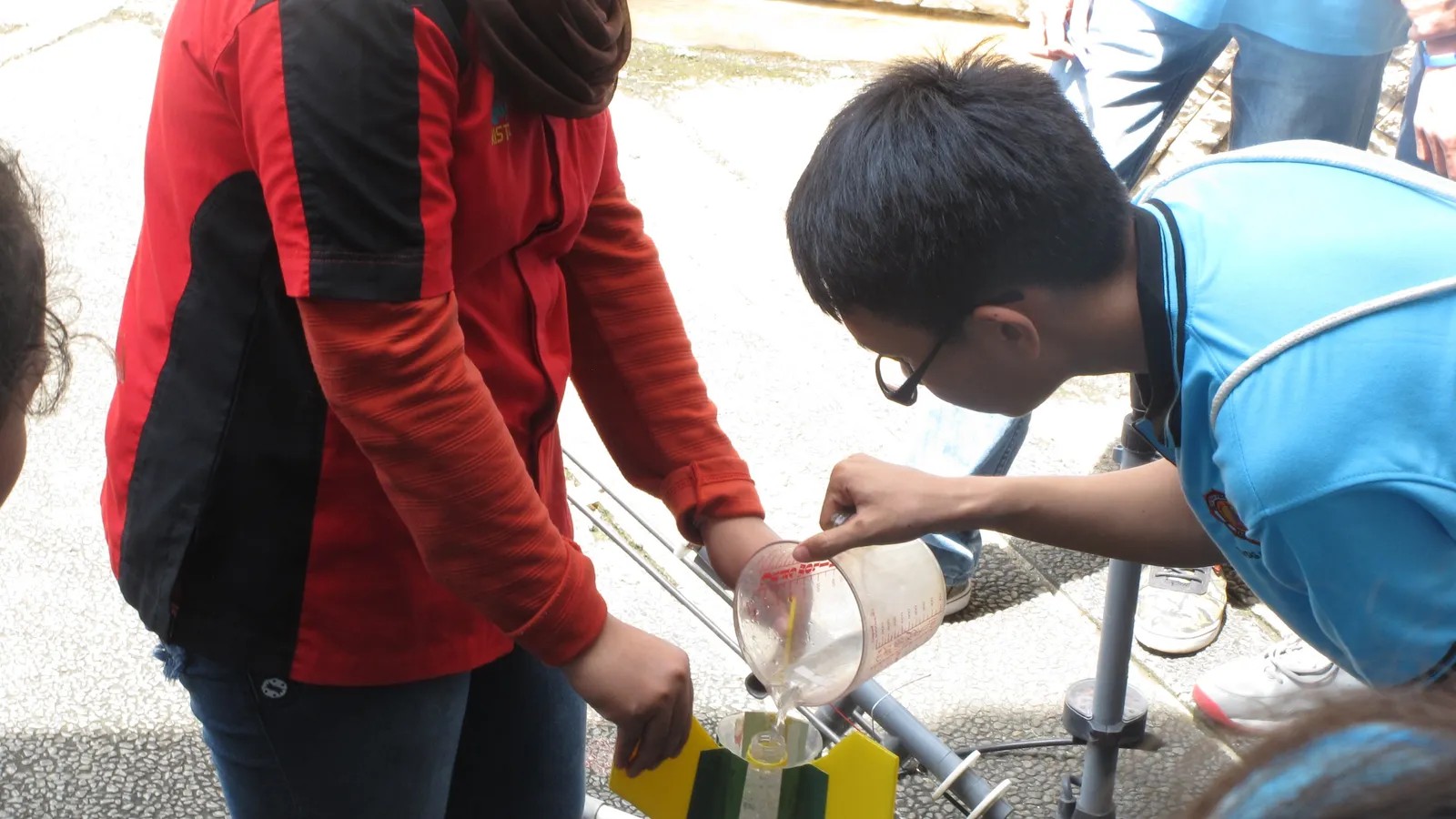
NASA has a classroom activity for grades 5 to 8 built on this exact question: find the ratio of water to compressed air that gives the greatest altitude (NASA STEM activity). Here is a one-afternoon version for a 2-litre bottle.
Pick five fills: 200 mL (10%), 400 mL (20%), 670 mL (one-third), 1,000 mL (50%) and 1,400 mL (70%).
Keep everything else the same: the same rocket, the same nozzle, the same gauge reading on the pump, launched straight up.
Launch each fill three times and keep the middle height of the three.
Plot height against fill and look for the rise, the flat top and the drop.
To measure height, stand a known distance from the launcher, say 20 m, and read the angle to the rocket's highest point with a phone clinometer app or a protractor and weighted string. Height is distance × tan(angle) plus eye height. At 60°, that is 20 × 1.732 = 34.6 m, plus about 1.5 m, so roughly 36 m.
Air Command's simulations suggest a broad plateau between about 20% and 40% (Air Command Water Rockets), with lower flights at the extremes. If launches at the same fill disagree by more than the gap between fills, that is noise; launch more before you decide.
To see a trade-off like this move before you go outside, the Fermi Simulation Lab has interactive simulations for ideas that are easier to see than to read.
Why might your rocket not match the theory?
In the American Journal of Physics, Cedric Gommes noted that careful measurements show water rockets outperforming the usual textbook analysis early in the thrust. Condensing water vapour adds some thrust, but several effects largely cancel, and he concluded that "there remains a difference between theory and experiment" (Gommes, 2010).
A simple model still works well for a class. At the US Air Force Academy, five out of six lab groups predicted their rocket's maximum height within experimental error (Finney, 2000).
If your peak sits elsewhere, check for extra weight, a leaky stopper, crooked fins and wind.
How do you launch a water rocket safely?
Follow NASA Glenn's water rocket safety rules.
Pump no higher than about 50 psi, and never above 90 psi.
The person pumping wears eye protection.
Use plastic drink bottles, new where possible, and retire them after 10 to 15 launches.
Launch on a grassy field at least 30 m wide, never pointed at a person or an animal.
If the rocket fails to launch, never stand over it; the bottle is still under pressure.
Parents: let your child predict, measure and plot; you handle the gauge, the goggles and the clear field.
Next, read why a rocket does not gain speed evenly as fuel burns, what happens to a gas that expands quickly and which hole in a water bottle squirts farthest. To work the rocket numbers on paper, the Fermi Problem Library has worked problems with a step-by-step solver that explains the reasoning rather than printing an answer.


