

On this page
If you punch three holes at different heights in a plastic bottle filled with water, which hole in a water bottle squirts farthest? Textbooks often get this wrong, showing the bottom stream shooting the longest distance. The real answer is a beautiful balancing act between speed and time, and it changes completely if you lift the bottle off the ground.
Which hole in a water bottle squirts farthest?
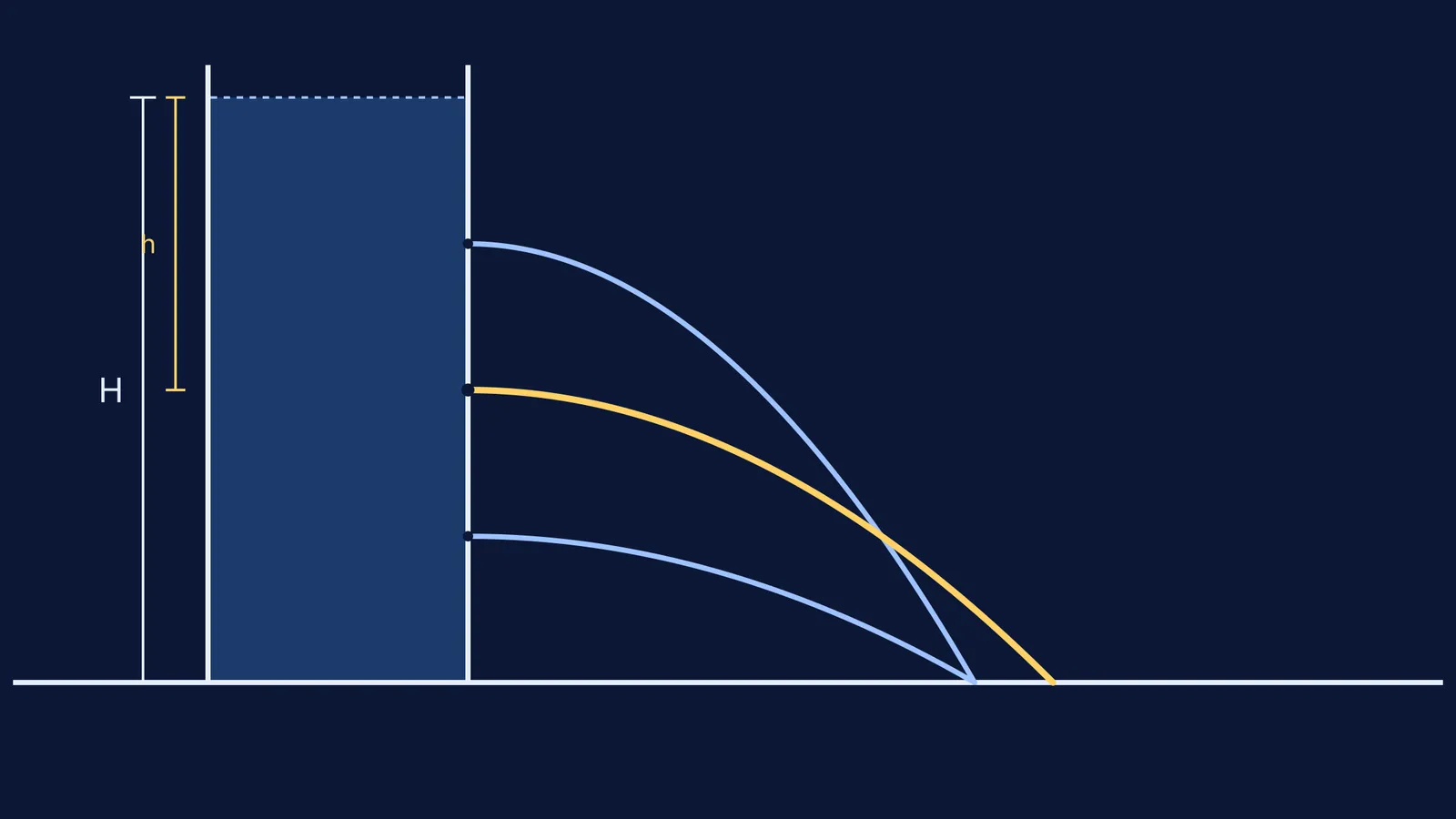
If the bottle is sitting flat on the ground, the water from the middle hole will travel the farthest horizontally.
According to a 2015 theoretical analysis by physicist Vjera Lopac in *The Physics Teacher*, the maximum horizontal range of a jet from a cylindrical bottle equals the total height of the water column, and this maximum always comes from the exact midpoint of the water level.
Even more elegantly, the ranges are mathematically symmetrical. A hole punched 5 centimetres from the top and a hole punched 5 centimetres from the bottom will send their water jets to the exact same landing spot on the floor.
The textbook error that confused generations
For decades, science textbooks used the water bottle experiment to teach students about fluid pressure. Unfortunately, many of them drew the diagram incorrectly. Illustrators frequently drew the water from the lowest hole traveling the farthest distance across the floor, assuming that because the pressure is highest at the bottom, the range must be the greatest.
This error became so widespread that physics teachers began writing journal articles to correct it. The confusion stems from conflating the speed of the water with the horizontal distance it covers. While the pressure and the speed are indeed highest at the bottom of the vessel—a concept related to Pascal's law in hydraulic machines—the water there is so close to the floor that it has almost no time to travel forward before hitting the ground.
How Torricelli's law predicts the jet speed
To understand why the middle hole wins, we have to look at two competing factors: how fast the water exits the bottle, and how much time it has to fall before hitting the ground.
The exit speed is given by Torricelli's law, which states that water leaves a hole at depth h with the same speed it would have if it simply dropped from that height: v = √(2gh). The deeper the hole, the greater the weight of the water pushing down, and the faster the jet emerges.
However, horizontal range depends on both that exit speed and the time of flight. The time a jet takes to fall to the floor depends entirely on its height above the ground, similar to calculating a horizontal projectile from a cliff. The top hole's water has plenty of time in the air, but it barely dribbles out. The bottom hole shoots water out at high speed, but it crashes into the floor almost immediately.
The middle hole strikes the perfect compromise. Its product of exit speed and fall time is mathematically maximised, sending the jet exactly as far horizontally as the total height of the water in the bottle. When equations like this are difficult to picture in your head—much like finding the equation of trajectory of a projectile—tweaking the variables in the Fermi Simulation Lab allows you to drag the hole up and down and watch how the parabolic path responds in real time.
Which hole squirts farthest on a table?
The "bottom hole wins" textbook diagrams are not impossible—they just assume a different physical setup. If you place the bottle on a table or a supporting block rather than directly on the floor, the rules change entirely.
When the bottle is elevated, you give all three water jets extra time to fall through the air. Because the lowest hole already has the highest exit speed thanks to Torricelli's law, giving it a bonus drop distance allows that high speed to dominate the range equation. Lopac's analysis confirmed that with a tall enough support block under the bottle, the lowest hole will easily outdistance the others.
Mastering the equations for exams
For a hole at depth h in a water column of total height H, the height of the hole from the base is (H − h). The horizontal range R on a flat surface is simply the product of the horizontal exit speed (√(2gh)) and the time of flight (√(2(H − h)/g)).
Multiplying these together cancels out gravity entirely: R = 2√(h(H − h))
If you want to prove the symmetry to yourself, try plugging in h = H/4 and h = 3H/4. Both equations will yield a range of 0.866 H.
This is a classic optimisation problem often tested in competitive physics exams. If you are struggling to set up the algebra for kinematics problems like this, Fermi's AI tutor can work out where you are getting stuck and teach you the steps to build the equation yourself.


