On this page
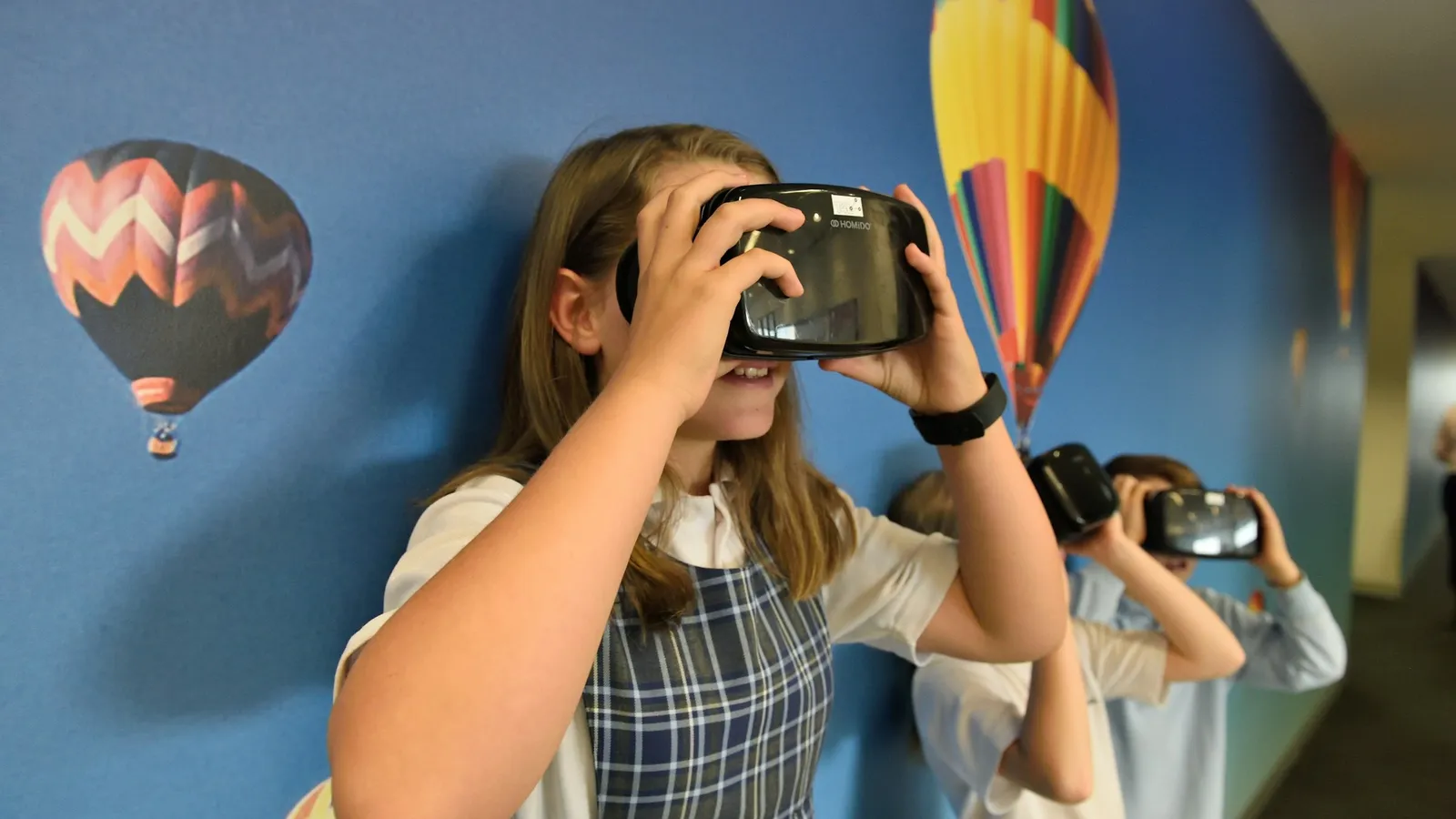
If your school offers VR science lessons, or you are thinking of buying a headset, the demos are impressive: you can stand inside a cell, walk around a molecule or watch blood move through the heart. The question parents and students should ask is simpler. Does it help you understand and remember the science better than a good diagram, video or desktop simulation? This post sums up what controlled studies have found and how to use VR so the experience turns into learning.
Does learning in VR beat learning on a screen?
Not automatically. In a careful experiment, Makransky, Terkildsen and Mayer (2019) had 52 university students learn from the same science lab simulation, either on a desktop screen or through a head-mounted display. Students in VR reported feeling much more present in the lab (an effect size of d = 1.30), but they learned less (d = 0.80). EEG recordings showed higher cognitive load in VR. The authors' reading was that the immersive setting may overload and distract learners.
A second study pointed the same way. Parong and Mayer (2018) taught college students a biology lesson on how the human body works, either in immersive VR or as a self-paced slideshow on a computer. The slideshow group did significantly better on the post-test, even though the VR group reported more motivation, interest and engagement.
So the feeling of "this is amazing" and the amount you learn can move in opposite directions.
Is there any evidence that VR helps?
Yes, with conditions. A meta-analysis by Wu, Yu and Gu (2020) pooled 35 randomised or quasi-experimental studies from 2013 to 2019 that compared immersive VR using headsets with less immersive approaches. Overall, headsets were more effective, but the effect size was small (0.24). The benefit was larger for school students, in science education, when VR offered a simulation or virtual world, and when it was compared with lectures rather than other active methods.
Put the three studies together and a sensible conclusion appears. VR is a medium, not a method. A well-designed VR activity can help, especially for things that are hard to see in a classroom. A VR tour that only shows impressive scenes, with nothing for the learner to do, may load the senses without building understanding.
What makes a VR lesson work?
The same study by Parong and Mayer (2018) had a second experiment. One group watched the VR lesson in one continuous run. Another watched it in segments and wrote a short summary after each one. The segmented group with summaries scored significantly better on the post-test, and they did not report less interest or motivation.
That fits what learning science says about any rich medium. Your working memory can only handle a few new things at once, so breaking a lesson into pieces and asking you to put each piece into your own words helps it stick. Our post on why simulations can beat static diagrams covers the same idea for screen-based simulations.
How should students use VR if their school has it?
Go in with a question. Before you put the headset on, write down one thing you want to find out, such as "Which chamber of the heart pumps blood to the lungs?"
Keep sessions short. Stop after each scene or step rather than watching the whole module at once.
Summarise straight away. Take the headset off and write two or three sentences, or draw a labelled sketch from memory. This is the step that made the difference in the Parong and Mayer study.
Check against your textbook. Compare your sketch with the NCERT diagram and correct what you got wrong.
Test yourself later. A day or two after, try to redraw the process without looking. If you cannot, the VR session felt good but did not teach you much yet.
What should parents and schools ask before paying for VR?
Ask what students will do inside the VR activity, not just what they will see. Ask whether it comes with questions, tasks or a summary step. Ask whether it replaces something that already works, such as a real lab practical, or adds something a textbook cannot show, such as a three-dimensional structure. The meta-analysis found the clearest gains for simulations and virtual worlds, so a module where students manipulate something is a better bet than a guided tour. Our post on virtual chemistry labs compared with hands-on work covers a related decision.
Can you get the benefit without a headset?
Much of what makes VR useful, seeing a process move and changing a variable to watch what happens, is also available on an ordinary screen. The Fermi Simulation Lab has interactive simulations for the ideas that are easier to see than to read, and you can pause after each change to write down what you predicted and what happened.
Next time you use any simulation, VR or not, stop after each step and write one sentence on what you just learned.