

On this page
Put a book on a notebook and pull the notebook. Pull gently and the book comes along. Pull hard and the notebook slides out from underneath it. A two-block simulation lets you find the exact pull where one turns into the other, and predicting it first is the point.
What happens when you pull the bottom block?
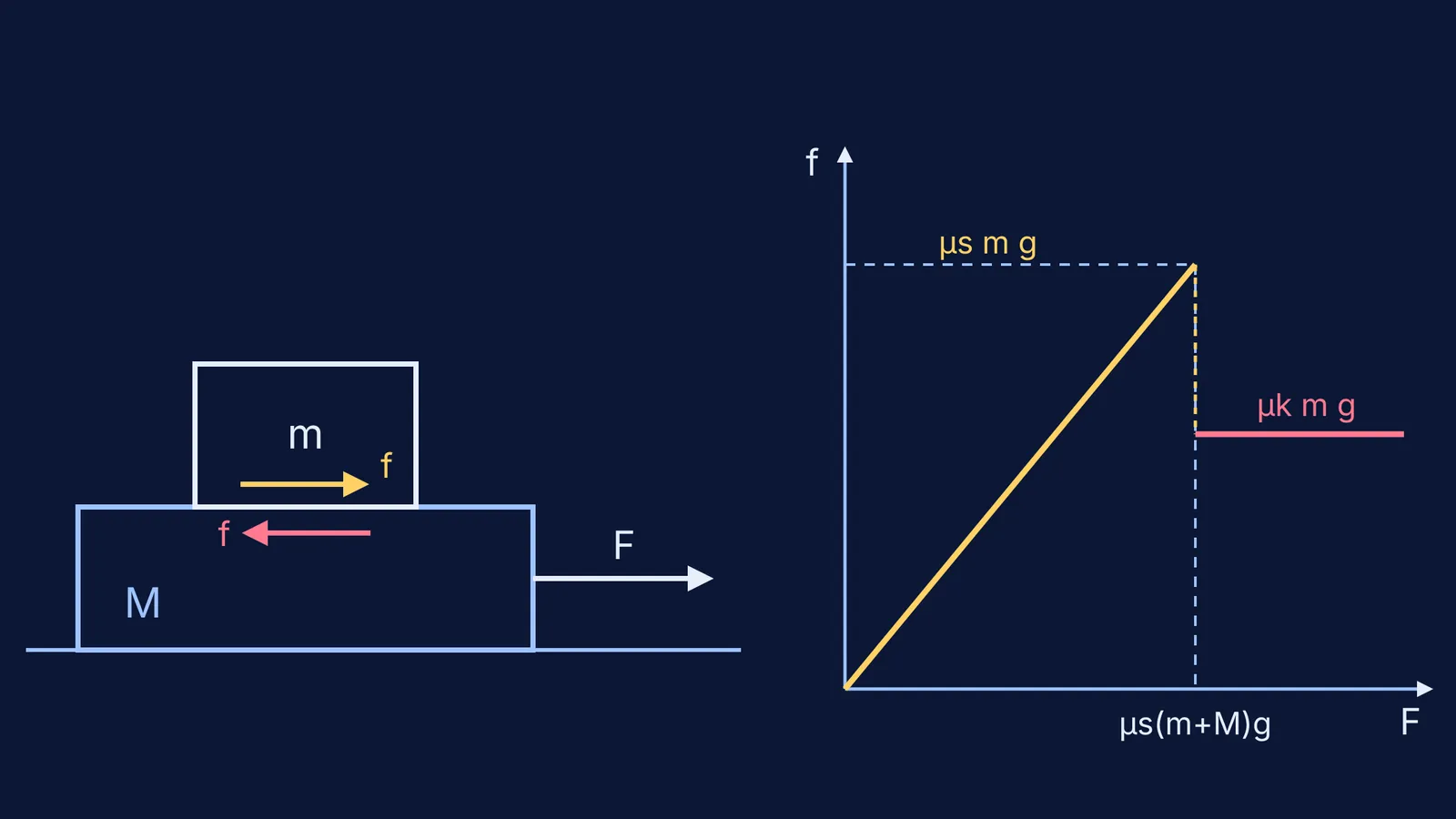
Here is the setup. A top block of mass m sits on a bottom block of mass M, and the floor is frictionless. Between the two blocks the coefficient of static friction is μs and the kinetic one is μk. A horizontal force F pulls only the bottom block.
Static friction adjusts itself: its magnitude obeys fs ≤ μsN, where N is the normal force (OpenStax University Physics, section 6.2). It is only as large as it needs to be, up to a ceiling. If that idea still feels slippery, read why static friction is not always equal to μsN first.
While the blocks move together they share one acceleration, a = F/(m+M). Friction is the only horizontal force on the top block, so it must supply f = ma = mF/(m+M).
Which way does friction act on each block?
On the top block, friction points forward, the same way as the pull. The bottom block is trying to slide out from under the top block. Friction opposes that relative slipping, so it drags the top block along.
On the bottom block, friction points backward with the same magnitude. That is Newton's third law.
The usual mistake is to remember "friction opposes motion" and draw the top block's arrow backward. Friction opposes relative slipping between the surfaces, not motion itself. If you used an AI to draw the diagram, here is how to check an AI free-body diagram arrow by arrow.
When does the top block start slipping?
The friction needed, mF/(m+M), grows as you pull harder. The ceiling, μsmg, stays fixed. Set the two equal and you get the limiting pull: F = μs(m+M)g. Another way to say it: the top block can never accelerate faster than μsg, whatever its mass.
Once the top block slips, kinetic friction μkmg takes over. The top block's acceleration drops to μkg, and the bottom block's becomes (F − μkmg)/M.
For a worked example, take wood on wood, μs = 0.5 and μk = 0.3, the approximate values in Table 6.1 of OpenStax University Physics. Let m = 2 kg, M = 3 kg and g = 9.8 m/s².
At F = 15 N: a = 15/5 = 3 m/s², so friction on the top block is 2 × 3 = 6 N. The ceiling is 0.5 × 2 × 9.8 = 9.8 N, so the blocks move together.
Limiting pull: F = 0.5 × 5 × 9.8 = 24.5 N.
At F = 30 N the top block slips. Its acceleration is 0.3 × 9.8 = 2.94 m/s². The bottom block's is (30 − 5.88)/3 = 8.04 m/s², so the bottom block pulls ahead.
How does the limiting force depend on the masses?
Keep the OpenStax wood-on-wood value μs = 0.5 and change one thing at a time:
Double the top block to 4 kg: F = 0.5 × 7 × 9.8 = 34.3 N. A heavier top block grips harder, but it also needs more force to accelerate, so what counts is the total mass.
Double the bottom block to 6 kg: F = 0.5 × 8 × 9.8 = 39.2 N. The ceiling does not depend on M, but your pull must accelerate M too.
Swap the masses (m = 3 kg, M = 2 kg): the limit stays 24.5 N, because the total is unchanged.
Pull the top block instead and the answer changes completely. The maximum force for two stacked blocks to move together walks through that case.
How do you test this in a simulation?
Predicting first is what makes a demonstration teach. In a classroom study, Crouch, Fagen, Callan and Mazur found that students who only watched demonstrations understood the concepts no better than students who never saw them. Students who predicted the outcome first showed significantly greater understanding (American Journal of Physics, 2004).
The Fermi Simulation Lab has interactive simulations for ideas that are easier to see than to read. Try this plan in any two-block simulation you use:
Write down your predicted limiting pull before you press play.
Set F to about 80% of that value. Check that the friction reading matches mF/(m+M).
Raise F in small steps past your prediction. Note the step at which the blocks separate.
Swap the two masses and predict again before running it.
Challenge: give the floor a friction coefficient μf. Show that the limit becomes F = (μs + μf)(m+M)g, then test it.
If a result surprises you and you can't see why, Fermi's AI tutor notices where you are stuck and decides whether to explain, ask or show.
Write one prediction, run it once, and let the screen tell you whether your friction arrows were right.


